





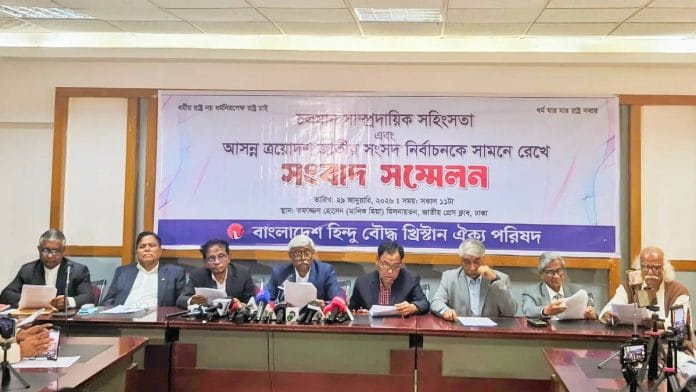



New Delhi: For minorities in Bangladesh, taking part in the upcoming general elections on 12 February remains “an outright challenge”, the country’s top minority council has said.
In a direct attack at the Yunus administration, the Bangladesh Hindu Buddhist Christian Unity Council alleged in a press conference in Dhaka Thursday that the government was downplaying the violence against minorities and was aiming to distort the Constitution, putting minorities at risk.
In a written statement read by acting general secretary Manindra Kumar Nath, the council said that although minority voters remain eager to exercise their democratic rights, persistent concerns over personal safety, livelihoods, property and dignity are yet to be addressed.
“While most members of minority communities have consistently contested elections, participated in election campaigns, and voted in favour of non-communal political forces, at the present time, this has become an outright challenge. Under these circumstances, if minority voters feel discouraged from casting their ballots, the responsibility cannot be placed on them,” the council stated.
It also alleged bias in the constitutional referendum that is set to take place alongside the national election.
“In this national parliamentary election, ‘Yes’ and ‘No’ votes have been introduced in the name of a referendum, through which secularism has been excluded from being declared a fundamental principle of state governance. The government and the Election Commission are directly campaigning in favour of this, which we consider to be sorrowful, unfortunate and clearly biased,” read the statement, put up on the council’s website.
The council accused the government, the administration, the Election Commission and political parties of failing to create a secure and confidence-building environment for minority voters, urging authorities to take immediate and effective measures.
“The Constitution of a non-communal, secular, and discrimination-free Bangladesh, based on the hopes and aspirations of 75 million people at the time and the dreams of 30 million martyrs achieved through the Liberation War is now facing a serious challenge. We believe this will stand as an obstacle to minority communities obtaining equal rights as citizens of Bangladesh. In this situation, ensuring that minority communities can safely go to polling centres and cast their votes freely is a major challenge,” it said.
“No specific initiatives have so far been observed on the part of the government and the Election Commission to create a safe environment and ensure protection, particularly for religious and ethnic minorities and indigenous communities during the pre-election, election period, and post-election phases.”
The council presented seven demands, including ensuring a level playing field for minority candidates and voters, banning the use of religion and communal sentiment in election campaigns, and providing adequate security through law enforcement agencies and, if necessary, the army. It also called for minority-dominated areas to be designated as high-risk zones with enhanced monitoring.
Also Read: Why India works. And why Nepal, Bangladesh, Pakistan keep breaking down
Communal violence numbers
According to the council, incidents of communal violence have continued in Bangladesh in recent months, following a pattern seen last year. Between 1 January and 27 January alone, it recorded at least 42 such incidents nationwide, including 11 killings.
The statement mentioned a total of 2,184 incidents of communal violence across the country during the uprising in 2024.
Since 5 August, 2024, the total number of communal violence incidents stands at 522, it added.
It detailed 61 incidents of murder (with 66 victims killed); 28 incidents of violence against women, including rape and gangrape; 95 incidents involving attacks on places of worship, idol vandalism, looting, and arson; 21 incidents of occupation or attempted occupation of land belonging to places of worship; 102 incidents of attacks, vandalism, looting, and arson targeting homes and business establishments; 38 incidents of abduction, extortion demands, and torture; 47 incidents involving attacks, death threats, and torture; 36 individuals subjected to torture and arrest on allegations of so-called religious blasphemy; 66 incidents of forcible occupation of homes, land, and business establishments; and 29 other incidents.
The council also slammed the interim administration’s report on communal killings on 19 January, which said that a total of 645 incidents were identified in 2025, of which 71 incidents were found to contain communal elements. The remaining 574 incidents were claimed to be criminal or social disputes.
“We wish to state in unequivocal terms: Does Nobel Peace Prize Laureate Professor Dr Muhammad Yunus intend to redefine ‘communalism’ in a new way, suggesting that except for violence occurring solely at temples or within the premises of places of worship, no other incidents taking place in society and the state constitute communal violence?” the council asked.
“Among the 173 deaths mentioned (in government report), only one murder has been identified by the government as a ‘communal killing’. Even 58 Hindu women were victims of rape during this period, and these incidents have also been identified by the government as non-communal. We strongly condemn and protest against such an absurd definition of communalism,” it added.
It further said the current government “consistently denied the ongoing communal violence and, at times, has attempted to divert the issue of ‘communal violence’ through irrational explanations in order to mislead both national and international communities”.
The council said the February election would take place in an atmosphere of fear, intensified by ongoing mob violence.
Minority communities and indigenous peoples, particularly women and young people, are living in constant anxiety, while minority business owners have struggled to operate normally. In some areas, families have been forced to leave their homes because of security concerns, it alleged.
(Edited by Nida Fatima Siddiqui)
Also Read: Bangladesh considers ending duty-free Indian yarn imports, impose tariffs amid textile sector unrest