





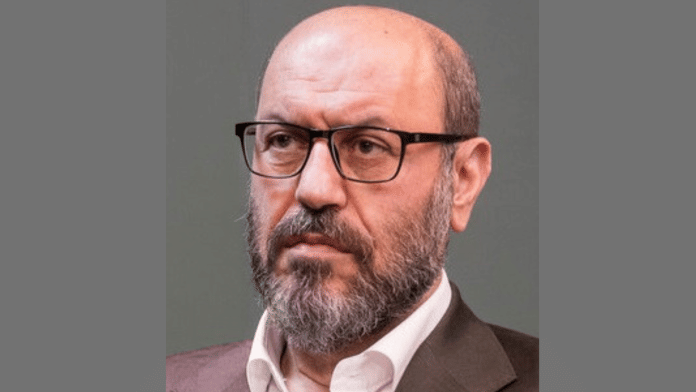



New Delhi: Iran has appointed Brigadier General Hossein Dehghan, a former defence minister and senior commander in the Islamic Revolutionary Guard Corps (IRGC), as secretary of the Supreme National Security Council. He is often considered a key figure who enabled the formation of Lebanese armed group Hezbollah, having modelled it after the IRGC.
Dehghan was also one of the chief decision-makers of the Iran-Iraq War in the 1980s, along with Mohsen Rezaee, Rahim Safavi and Ali Shamkhani. He was considered among the Ayatollah’s 13 generals who helped shape the war.
Dehghan, 68, replaces Ali Larijani, who was killed along with his son in an Israeli airstrike in Tehran Tuesday.
Born in Shahreza in 1957, Dehghan’s career has been closely tied to the transformation of Iran after the Iranian Revolution. He holds a Master’s degree in metallurgy and a PhD in public administration from Tehran University.
In his early 20s, he joined the newly established IRGC and quickly rose through its ranks. He was active during the 1979 takeover of the US embassy in Tehran, an episode that reshaped relations between Iran and America.
By 1980, he had become commander of the IRGC in Tehran, a position he held until 1982. According to local reports, he then oversaw a sweeping crackdown on political opposition, during which many activists, including members of the Mujahedin-e Khalq or the People’s Mojahedin Organization of Iran (PMOI), an Iranian dissident group, were detained and executed.
Dehghan’s career
In 1982, following Israel’s invasion of Lebanon, Dehghan was reassigned to oversee IRGC operations in Syria and Lebanon. There he led a contingent to Lebanon’s Bekaa Valley following Israel’s invasion, which played a key role in laying the groundwork for what would become Hezbollah.
Between 1982 and 1984, he played a central role in organising and training forces that would later form Hezbollah, drawing on the IRGC’s structure and methods.
Western governments have directly linked him, as IRGC commander, to the 1983 bombing of a US Marine barracks in Beirut that killed hundreds of American and French personnel. Iran has denied this allegation, but it led to US sanctions against him.
After returning to Iran, Dehghan continued to advance within the military establishment. From 1986 to 1991, he served as deputy commander of the IRGC Air Force, and from 1992 to 1996 as deputy chief of the joint staff. He later moved into senior defence administration, serving as deputy minister of defence from 1997 to 2003 during the presidency of Mohammad Khatami.
In the early 2000s, he briefly served as acting defence minister before taking on additional roles, including heading the Martyrs and Veterans Affairs Foundation from 2005 to 2009 under President Mahmoud Ahmadinejad and being the Vice President from 2004-2009.
Defence & diplomacy
Dehghan’s prominent role came in 2013, when then president Hassan Rouhani appointed him minister of defence, a post he held until 2017. During that time, he oversaw aspects of Iran’s military development and helped expand strategic cooperation abroad, including a 2016 defence agreement with China that included joint exercises and coordination on counterterrorism.
The same year, Dehghan negotiated an arms agreement with Russia but declined to provide details when questioned by parliament about Tehran’s military cooperation, including the use of Iranian bases by Russian aircraft for operations in Syria.
His response drew sharp criticism from Larijani, then speaker of parliament who accused him of “disrespecting parliament”. Amid mounting pressure, Dehghan later announced that Iran would end the military arrangement with Russia.
In 2017, amid tensions with Saudi Arabia, he warned that Iran would respond broadly to any military action, saying that in such a scenario “no area would remain untouched except Mecca and Medina”. He has also consistently maintained that Iran’s missile programme would not be included in international negotiations.
After Dehghan left the cabinet, then Supreme Leader Ali Khamenei appointed him as a senior military adviser on defence industries and armed forces logistics, further consolidating his role within Iran’s security structure. In 2019, the US imposed sanctions on him, citing his alleged connection to the Beirut bombing and his senior position within the IRGC.
In a 2020 CNN interview, Dehghan said Iran was not seeking war with the US, while warning that any response to military action would be directed at military targets. “The response for sure will be military,” he said, “but we are not looking to open a broad conflict.”
In 2021, he announced his candidacy for Iran’s presidential election, presenting himself as a figure capable of working across political factions. Although he did not ultimately emerge as a leading contender, his candidacy was criticised and debated, as many claimed it would lead to increasing intervention of military figures in Iran’s political system.
Dehghan has been heading the Mostazafan Foundation, one of Iran’s largest economic institutions, since October 2023.
With Dehghan now in one of the key positions in Iran, decision-making is likely to reflect his hardline approach to military strategy and his consistent emphasis on deterrence.
(Edited by Nida Fatima Siddiqui)