





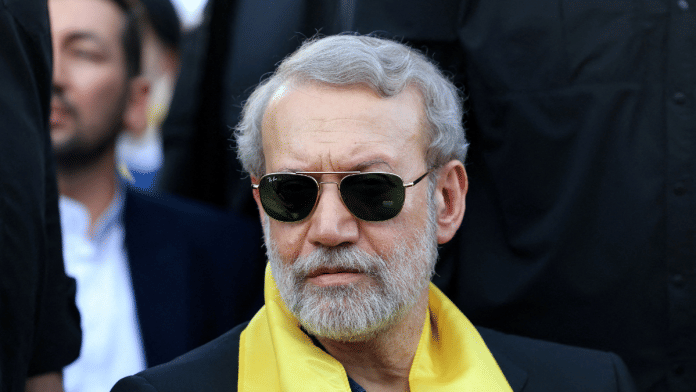



In episode 1811 of Cut The Clutter, ThePrint Editor-in-Chief Shekhar Gupta examines Israeli announcement that Iran’s most powerful political operator, Ali Larijani, has been assassinated, and what his death mean for the structure of power in Tehran. Long seen as a key strategist who operated at the intersection of ideology, statecraft and security, Larijani’s influence extended well beyond formal titles, often placing him at the centre of Iran’s most critical decisions.
Here’s the full transcript:
Has Ali Larijani been assassinated? He was the most significant, powerful and consequential leader in Iran for a long time. In fact, even while Ayatollah Khamenei was alive, most of the serious work was done by Ali Ardashir Larijani.
I was surprised to discover that second name, because it points to the Zoroastrian Persian origins of Iranian society and culture. People talk about that all the time; this is a culture that precedes the arrival of Islam.
The Israelis have claimed this and have now issued a statement. First, the Israeli defence minister, then Prime Minister Netanyahu himself, appeared and said that Larijani has been assassinated. Along with him, the Israelis say that Brigadier General Gholamreza Soleimani of the Islamic Revolutionary Guard Corps (IRGC) has also been killed in an attack on their dwellings in Tehran.
Remember Major General Qasem Soleimani, another Soleimani who headed the IRGC, was assassinated near Baghdad in Donald Trump’s first term. So, Gholamreza Soleimani, an IRGC brigadier, is said to have been killed. The Israelis make the same claim about Ali Ardashir Larijani.
There is not yet independent confirmation. A couple of Iranian websites, not propaganda outlets but reasonably credible sites, have reported that a key government official called them and confirmed Larijani’s death. I should underline that there is still no official confirmation from the Iranian government. At the same time, as I was hesitating about whether to discuss Larijani today, I noticed that the Wikipedia entry on Larijani has been changed from “is” to “was”, which suggests a wider acceptance that he may have been killed.
הבוקר חיסלנו את עלי לאריג'אני. עלי לאריג'אני זה הבוס של משמרות המהפכה, שזה חבורת הגנגסטרים שמנהלת בפועל את איראן. אנחנו חיסלנו לצידו גם את מפקד הבסיג' – זה העוזרים של הגנגסטרים, שהם מפיצים טרור ברחובות טהרן וערים אחרות של איראן נגד האוכלוסייה. גם שם אנחנו פועלים; פועלים מהאוויר… pic.twitter.com/bOwQgRZ6Ti
— Benjamin Netanyahu – בנימין נתניהו (@netanyahu) March 17, 2026
He is a fascinating figure and I wish I had read and listened to him more. He is, or was, a man of letters, a philosopher and a science graduate, in fact a computer science and mathematics graduate, who then did his Master’s and PhD at Tehran University in western philosophy. He was an expert on Immanuel Kant, the 18th century Enlightenment German philosopher, and has written six books on Kant’s philosophy, sometimes arguing with him, often because Larijani was a self-described religious fundamentalist.
For him, Kant was too rational; Kant sought empirical evidence for everything. There are things in spirituality for which you cannot find empirical evidence. That does not mean they are not right; that was Larijani’s view.
Science has its domain, what is empirically proven, and spirituality or traditions have theirs. The two are not in conflict, he argued. That is how he justified both his commitment to science, mathematics and philosophy and his religious fundamentalism.
While fulfilling those responsibilities and while being one of the most closely watched men by Israelis and Americans in Iran, he was also a professor in Tehran University’s literature and humanities faculty, where he gave regular lectures. He published at least six books related to Kant and around 30 to 35 papers in international journals.
Look at his life. After his education, he joined the armed forces, the IRGC, during the Iran–Iraq war from 1980 to 1988, and rose to the rank of brigadier general. Soon afterwards the Ayatollahs recognised his talent and brought him into government. He became culture minister and head of propaganda; he ran Iranian radio and television for 11 years. He served on the Supreme National Security Council, which works directly under the Supreme Leader, between 2005 and 2007.
In 2005, he contested the presidential election and lost, finishing sixth, even though he was the most conservative candidate and had conservative support. After losing, he said the problem in Iran was that 75 percent of people were focused only on economics and only 5 percent cared about spirituality or religion. That was his regret.
He was then talent-hunted by the Ayatollahs and in 2005, he was appointed to the Supreme National Security Council for two years. After that he became speaker of the Iranian parliament in 2008. From 2008 to 2012 he served as speaker.
In 2021 and again in 2024, he sought to contest elections, the latter an early poll triggered by the tragic death of President Ebrahim Raisi in a helicopter crash near the border with Azerbaijan. Both times his candidature was rejected by the Guardian Council, which is essentially a council of the clergy that advises the Supreme Leader and guards the spiritual principles of the Islamic Republic. In Persian, it is called Shura-ye Negahban.
The precise reason for his disqualification is unclear; possibly he was seen as too sharp, too smart or too Westernised, or perhaps his talents were being reserved for negotiations with the West, which has been his central job for many years.
Lately, he had even overshadowed the recently elected president Masoud Pezeshkian. The foreign minister, Abbas Araghchi, was more like a spokesperson for the regime while real power resided with Ali Larijani. From what we read about Iranian politics, it appears the Supreme Leader had said he would take charge in case of any key IRGC leader’s assassination or any key Iranian leader’s death, including his own.
Also Read: Why every war in Gulf triggers oil crisis & role of Saudi, UAE pipelines | Cut The Clutter
‘Why don’t you check Larijani?’
Larijani emerged as the most powerful figure this year after January, when mass protests erupted. On 15 January, those protests were suppressed; estimates of fatalities vary widely, from 7,500 to 35,500, with a commonly cited range between 25,000 and 30,000.
How powerful had he become by then? A New York Times account based on American sources illustrates his authority. It is well-known that Donald Trump warned that if planned executions were carried out in Iran he would strike and that the regime should abandon any plans for mass executions.
It is also recorded that Steve Witkoff, Trump’s special envoy for troubled areas, called seeking to speak with the Iranian foreign minister. Before speaking, Araghchi sought authorisation from President Pezeshkian, who replied, “Why don’t you check Larijani?” That exchange shows Larijani had the authority to allow or block the conversation; I cite it only to indicate the extent of his power.
Larijani also made a high-profile statement on Al-Quds Day, the day many Islamic countries observe in solidarity with Jerusalem. He appeared on the streets, and pictures and videos were posted and tweeted.
He contrasted Iranian leaders being among their people with leaders of other countries who, he said, were “on Epstein Island”, a pointed remark that created a stir among American and Israeli critics on social media. Given Israeli intelligence capabilities, public taunting like that was perhaps not an act of discretion. One image was posted by a former adviser to an Israeli prime minister, who claimed a masked man was a Mossad agent. Larijani’s public appearance and provocation, therefore, bear noting.
Mr. Hegseth! Our leaders have been, and still are, among the people. But your leaders? On Epstein's island! https://t.co/iywavTegyv pic.twitter.com/rxFhzsWoq5
— Ali Larijani | علی لاریجانی (@alilarijani_ir) March 13, 2026
Power in Iran is divided. There is the Majlis, the elected parliament, which has certain powers, and a directly elected president with limited authority. The real power lies with the Supreme Leader, who is selected not by popular vote but by a council of clerics. The Supreme Leader has committees and councils to advise him; one is the Guardian Council, which ensures that legislation from the Majlis or government actions do not contradict the principles of the Islamic Republic.
Remember the 1979 revolution that brought Imam Khomeini to power: it created the first modern state explicitly based on religious doctrine. Khomeini was widely read in Western philosophy—Plato and Aristotle among others—and not a stereotypical cleric. He set up a system that included the Guardian Council to protect the ideology of the state. The clerical authorities also preserved limited democratic rights for the elected president and parliament, but when conflicts arose between the Guardian Council and elected bodies, another committee was established to resolve them: the Expediency Discernment Council.
The Expediency Discernment Council arbitrates differences between the religious body and the elected institutions. In Persian, it is Majma-e Tashkhis-e Maslahat-e Nizam. Since 2020 Ali Larijani was a member of that council. The chairman of the council is Sadeq Larijani, one of Ali Larijani’s brothers. They are, therefore, a powerful family.
I read a long article that described the Larijani family as the Kennedys of Iran, except that this family has members across many scholarly fields: mathematics, computer science, philosophy and medical science. One brother studied at the University of California; a niece studied medicine in Cleveland and was teaching at Emory University until she was doxxed during the January protests and lost her position. The family is spread across the world.
Gid’on Lev notes that reading Larijani’s work is a disorienting experience. On one hand a pragmatic man emerges who does not hesitate to criticise his authorities, who aspires to a modern, developed society and who writes about freedom of expression and democracy. On the other hand, he is a self-defined fundamentalist Muslim who preaches ideological religious leadership. That contradiction followed him through his career. Lev says Larijani believed the real war is not over material assets but over the spirit; he identified the ills of Western society and held up a mirror to them.
Larijani’s father was a senior Shiite cleric, the only cleric in the family, which may explain why the Guardian Council considered him insufficiently trained in religious studies when it disqualified him from presidential runs in 2020 and 2024. His eldest brother, Dr Mohammad Javad Larijani, served as a close adviser to Khamenei on foreign affairs. He studied mathematics at UC Berkeley, founded a centre for theoretical physics in Iran, and was the first to receive permission to introduce the internet in the country.
His second brother, Sadeq, now leads the Expediency Discernment Council and previously headed the judiciary for more than a decade. Another brother, Bagher Larijani, served as deputy health minister and chancellor of Tehran University of Medical Sciences. Larijani himself married the daughter of Ayatollah Ruhollah Motahhari’s closest disciple. Motahhari, who encouraged Larijani to study philosophy rather than go deeper into computer science, was assassinated within weeks of the revolution on 1 May, 1979.
The most powerful positions Larijani held were membership of the Expediency Discernment Council and the post of secretary of the Supreme National Security Council. Together those roles made him, in practical terms, the second most powerful person after the Supreme Leader. If the Supreme Leader is unwell or incapacitated and not trained to succeed, for all practical purposes Ali Larijani functioned as a de facto second-in-command. The Expediency Discernment Council’s role is to “discern the interests of the Islamic Republic” by resolving internal regime conflicts. On that council only two representatives are nominated by the supreme leader; one was Ali Larijani and his brother chaired the body.
Another key institution is the National Defence Council, which controls military affairs. Its commander was Admiral Ali Shamkhani, who was killed on the first day of the killings along with others; his funeral was publicised. That body is now effectively leaderless. If Ali Larijani has been killed, the campaign to decapitate the regime leadership will have progressed a long way.
I regret I did not study Larijani’s work earlier. He visited India several times and Indian leaders met him when he was speaker for 12 years. The more I read, the clearer the picture of a very complex, interesting man becomes. He wrote on mathematical proof versus spiritual belief, arguing that the difference between a philosophical argument and a mathematical proof lies not in the argument but in the assumptions.
He engaged with the demarcation problem in the philosophy of science, the difficulty of distinguishing scientific from non-scientific theories. Scientific theories require empirical evidence; non-scientific theories, such as folklore or scripture, do not. His writings say that science and mathematics have their domains and spiritual belief another, and that the supposed conflict between them is invalid. If such debates cannot resolve to a conclusion, religion will prevail; that is why he called himself a religious fundamentalist while engaging with science, mathematics and modern philosophy.
Larijani’s broader view was that Western civilisation, though admired and studied by him — he sent his daughter to the United States and his brother studied there — had reached a breaking point. Grappling with alienation and loneliness, the West’s only remedy, he argued, was to abandon egoism and humanism, renounce scepticism and return to deep belief, effectively rejecting the rotten tree of modernity.
I became absorbed in his philosophical arguments, many of which lie outside my usual field. I know Kant’s name, but not all the other philosophers Larijani debated, and a deeper dive would have taken too long. In conclusion: with a background in mathematics and computer science and a PhD in philosophy from a reputable Tehran University, Larijani exemplified Iran’s strong higher education system. Iran has high literacy and high female literacy; nearly half of doctors are women and many STEM graduates are women. It is a country that defies many stereotypes.
While living such a complex life, Larijani negotiated repeatedly with Vladimir Putin in Moscow and travelled to China, signing multi-decade strategic deals. As recently as 11 February, he was in Qatar negotiating. He was a substantial political player. For example, he may have been among the first political leaders to use fake news at scale against an ideology he opposed.
When Mohammad Khatami, a reformist, became president, Larijani, then propaganda chief and head of television and radio, approved a film that showed Khatami supporters dancing and singing on the day of the assassination of Imam Hussein, the most sacred figure in Shia Islam. Those images were fake.
On that note, I will conclude this particularly complex, difficult and fascinating episode of Cut The Clutter.
Note: Iran has confirmed that Ali Larijani was killed in an Israeli strike, hours after Israel announced his death.
Also Read: Pakistan SC judges resign over 27th Amendment: How it crushes judicial independence, & controversy