








New Delhi: Artificial intelligence is an “idiot savant” that could wipe out some white-collar jobs and fracture the world into an increasing divide between tech overlords and everyone else, a United Nations official warned Monday.
UN Under-Secretary-General for Digital and Emerging Technologies Amandeep Singh Gill made the remarks at a lecture titled ‘Multilateralism and the Future of AI’ at the India International Centre, moderated by former foreign secretary Shyam Saran, in New Delhi.
Gill spoke as the AI Impact Summit began in the national capital Monday. The summit is the fourth global iteration of the gathering, and the first to be held in South Asia.
Gill opened the talk by explaining AI’s workings. “It uses data and desired results to build models. These models spot patterns in new data to mimic human thinking, reasoning, and actions. But these are just statistical tricks, not real understanding,” he said.
The “idiot” side of the technology, he said, lies in its brittleness: “AI trained on sharp wildlife photos confuses blurred backgrounds for birds or animals.”
The ‘savant’ side
But AI’s “savant” dimension is formidable, Gill said.
Large language models, such as Gemini and ChatGPT—trained for months on vast datasets of text, audio, video, and code—now function as autonomous agents capable of handling niche tasks, solving multi-step problems, and managing full software projects.
“A year ago, AI worked on real tasks for just 10 minutes alone. Now it’s hours, soon, days or weeks… This could replace human experts with virtual workers,” Gill said.
He called AI a general-purpose technology like steam or electricity, “but on steroids”.
Software firms are already gripped by what the industry calls a SaaS-pocalypse– a mash-up of the words SaaS and apocalypse, indicating the decline in market value for Software-as-a-Service (SaaS) companies due to the emergence of AI–he said.
History, Gill argued, will be the arbiter of who gains and who loses. “England turned France’s steam engine invention into mass-produced goods and dominated, while France faltered. Japan trailed the US due to its slow software ecosystem development,” he said.
India’s gaps and strengths
Despite India’s IT expertise, a single Bay Area artificial intelligence startup outperforms the country’s top seven IT companies combined in talent, Gill said, calling this gap real and significant.
Former foreign secretary Saran told ThePrint, “India has lagged because Washington & Beijing have built up manpower, training facilities and knowledge systems starting from their universities to their offices.”
But he cautioned against unfair comparisons. “It is also irrational to compare a $27 trillion economy (US) and a $16 trillion economy (China) with our $4 trillion economy. We should play with our strengths, which is the pool of data we have due to our size,” Saran added.
The AI divide
Gill outlined stark global asymmetry underpinning an “AI divide” layered on top of existing digital and data divides.
Last year, all of Africa had fewer than 1,000 graphics processing units (GPUs). By comparison, a single mid-level Chinese university held 1,200—and Meta alone commanded 600,000, he said, giving an example.
Gill framed the policy challenge as a trilemma of opportunities, risks and readiness.
The opportunities are substantial—faster scientific discovery, gains in health, farming, governance and climate action, he said, adding that the risks are equally serious.
Drawing on the concept of ‘Maya’ or illusion, Gill warned that synthetic data can distort reality, and AI-generated imagery can embed bias.
Labour markets face abrupt transformation without accompanying funds for reskilling or new social contracts to redistribute gains, Gill said.
More insidiously, he warned of fraying social bonds, cognitive decline from AI dependence, inscrutable model behaviour, and unknowns such as superintelligent AGI (Artificial General Intelligence).
Institutions, meanwhile, are caught in what he called the “twin pacing problem”—AI’s rapid expansion outpacing both institutional and personal readiness. At a personal level, AI is a tireless research assistant, Gill said, but, “as a diplomat, I worry about weak or inadequate safeguards amid rival geopolitics”.
The multilateral path
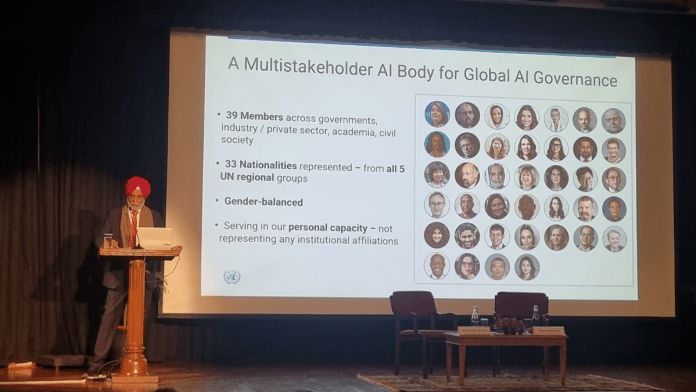
At the United Nations, AI now cuts across three core pillars—peace and security, human rights, and sustainable development, Gil said, tracing the governance momentum to the Bletchley Park (UK) AI summit, the first in the series, which led to creation of a 39-member expert advisory body to map global needs beyond national or corporate efforts.
Last week, the UN approved a 40-expert scientific panel—which included IIT Madras professor Bala Ravindran – to act as an “early warning system” that will counter AI hype and fear.
Gill flagged upcoming governance forums in Geneva in July and New York in 2027, alongside this week’s India summit. “We have a short runway of a few months for the scientific panel to produce its inaugural report, but it will guarantee each country a seat in the discussion,” he said.
He stressed that governance requires capacity, and pointed to a proposal by the UN Secretary-General for a $3 billion global AI fund to support 80–90 under-resourced countries—covering computing, data, talent, and policy.
He put the figure in perspective—it amounts to less than 1 percent of what a single nation spent on AI infrastructure last year, and would enable local, open-source adaptations rather than the development of frontier models.
A network of cooperation centres—backed by Brazil, China, Ethiopia, India, Kenya, and others—is advancing the effort, from Kenya-Saudi meetings to recent workshops in Dakar, Senegal.
Gill concluded the address on a note of cautious optimism, arguing that science, policy, and capacity are the three necessary pillars for “multilateralism at its best, agile, inclusive”—guarding against risks while ensuring AI’s promise is shared fairly and equitably.
Also Read: It’s skill or sink, say panellists at AI Impact Summit. ‘If you don’t do AI, AI will be done to you’