





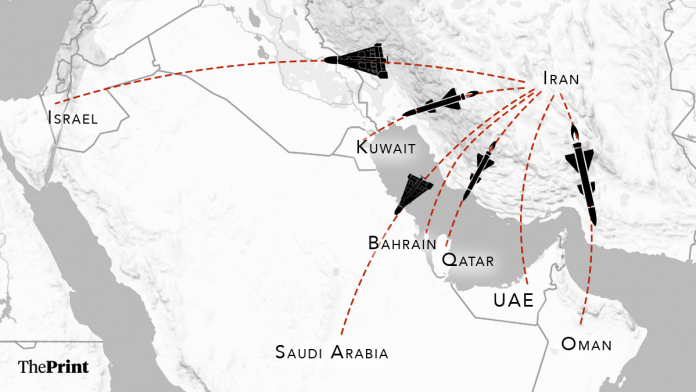



New Delhi: Iran launched more than 4,300 missiles and unmanned aerial vehicles (drones) at the six member-states of the Gulf Cooperation Council (GCC) in retaliation since 28 February. In comparison, it launched around 930 missiles and drones at Israel during the same period.
This means that around 83 percent of the missiles and drones Iran launched were targeted at the GCC member-states—the United Arab Emirates, Qatar, Oman, Saudi Arabia, Bahrain and Kuwait.
Tehran has launched at least 1,815 UAVs and 372 missiles, including 357 ballistic missiles, at the UAE since 28 February, the start of the conflict, according to data published by the Emirati Ministry of Defence.
A look at the data of aggregated foreign aggressive events carried out against the Emiratis in the past month published by the Armed Conflict Location and Event Data (ACLED) indicates that the UAE has faced 112 such events exposing at least 2 million people to potential impact.
ACLED includes both successful and intercepted drone and missile strikes as a part of its strike events. When several projectiles struck the same location on the same day, ACLED records it as a singular event.
ACLED data showcases that the six GCC countries have faced around 416 strike events over the past month. Whereas, Israel has faced roughly 317 strike events.
The data about the number of missiles and drone strikes aimed at Israel was compiled by Arab News.
Tehran’s retaliation has focused on a number of strategic installations across the region, including energy infrastructure, apart from American military installations. Last week, Iran struck Qatar’s Ras Laffan Industrial City on 18 and 19 March. The attack damaged infrastructure producing liquefied natural gas (LNG), wiping out roughly $20 billion worth of annual natural gas exports. The loss of production at Ras Laffan is set to impact roughly 17 percent of Doha’s annual exports of LNG.
Similarly, Iran struck the UAE’s Habshan gas field—the largest oil and gas facility in the West Asian nation. The UAE suspended operations at the field for roughly a week, and reportedly resumed operations earlier this week.
Iran also launched strikes at Ras Tanura and Yanbu—two facilities operated by Saudi Arabian Oil Company (Saudi Aramco) in the last few weeks, leading to temporary suspension of operations at these facilities.
The strikes by Iran come as a part of its publicly stated policy: countries hosting American installations in the region are legitimate targets, given that the US and Israel are the main combatants against Tehran. Further, geography adds to Iran’s capability to strike at the GCC countries. The distance between Iran and Israel is more than 1,300 kilometres, with its missiles required to cross countries such as Iraq, Syria and Jordan.
It should be noted that the data available is till 25 March, and does not show a full picture of the strikes, as the war is still ongoing between all the combatants.
The numbers include both successful and intercepted strikes.
Also Read: How Iran choked Strait of Hormuz & why it’s not easy to break the blockade
Attacks on GCC member-states
After the UAE, the second country that faced the majority of Iranian launches is Saudi Arabia.
Iran has launched at least 733 UAVs and 49 missiles at Saudi Arabia over the past four weeks, according to data released by Riyadh’s Ministry of Defence and collected by Institute for the Study of War (ISW) and the Critical Threats Project (CTP) at the American Enterprise Institute (AEI). The data shows that on 16 and 20 March, Iran launched 75 and 76 drones respectively at targets across Saudi Arabia, which are the two days that witnessed the most intense barrage of strikes emanating from Tehran.
The period of the data that has been collated by the CTP and ISW is between 28 February and 25 March.
On 18 March, Iran launched 12 ballistic missiles at Saudi Arabia, marking the most intense barrage of strikes faced by Riyadh. After Saudi, the country that has faced the most number of strikes from Iran is Kuwait.
At least 365 missiles have been launched at Kuwait over the last four weeks of war, while a further 268 UAVs were launched at the Gulf kingdom by Iran. Kuwait, however, has not shared data for the number of strikes it has faced on 28 February, between 2 and 5 March and on 11 March.
On 1 March, the Kuwaiti Army announced that it had faced 283 missiles and 93 drones. It is not clear how many of the launches were on 28 February and how many were on 1 March. Bahrain, the other GCC member in the region, has faced 331 drones and 153 missiles between 28 February and 25 March, according to Manama’s Ministry of Defence.
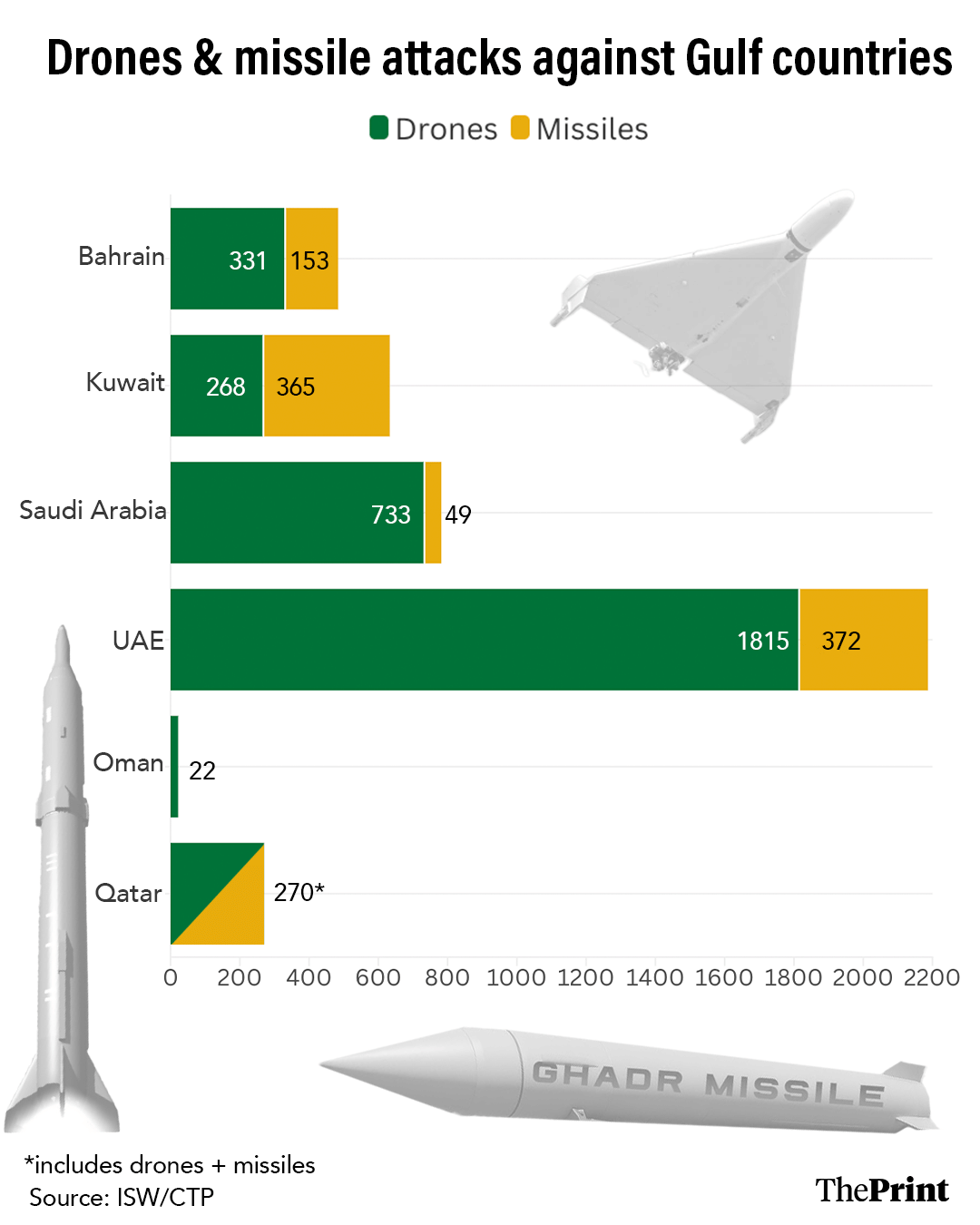
Oman and Qatar in comparison have faced far less intense strikes from Iran. Qatar has seen at least 270 missiles and drones combined launched at the country, while Oman has witnessed at least 22 drone strikes till date.
Qatar, however, saw massive damage to its energy infrastructure in a strike by Iran last week. The strike at LNG facilities at Ras Laffan was retaliation against Israeli strikes on Iran’s South Pars gas field which it shares with Qatar. Tehran has its largest natural gas facility here.
The US was quick to distance itself from the strike. US President Donald J. Trump had issued an ultimatum, calling on Tehran to allow ships to freely transit the Strait of Hormuz. The ultimatum issued last weekend gave Iran 48 hours to comply. However, on Monday Trump extended the deadline to 27 March, while asserting that talks to end the war are currently ongoing between the US and Iran via third parties.
Iran has rejected Trump’s 15-point proposal, while issuing its own five conditions to end the war, which includes complete end to the aggression by the US and Israel, security guarantees to prevent future strikes against the West Asian nation, compensation for losses caused, ending the war on all fronts including in Lebanon and recognising Tehran’s sovereignty over the Strait of Hormuz.
The Strait of Hormuz is a global chokepoint as it accounts for the flow of roughly one-fifth of the world’s energy supplies. The disruption to the transit of ships through this international waterway has caused the price of oil to spike by around 40 percent since the war began, to around $107 a barrel Thursday, according to the Brent crude futures benchmark.
Hezbollah, the armed militia in Lebanon have also joined the conflict in support of Iran, leading to intense fighting between the group and Israel over the last two weeks.
(Edited by Amrtansh Arora)