








A philosopher, politician, former nuclear negotiator, national security advisor and one of Iran’s most influential power centres, Ali Larijani had long been at the heart of the Islamic Republic’s strategic thinking. As Speaker of Parliament and an advisor to the Supreme Leader, he was among his country’s most articulate voices.
On Tuesday, Iran’s supreme national security council confirmed the death of its chief Ali Larijani, after Israel claimed they had fatally hit him, bringing renewed focus to his views and legacy.
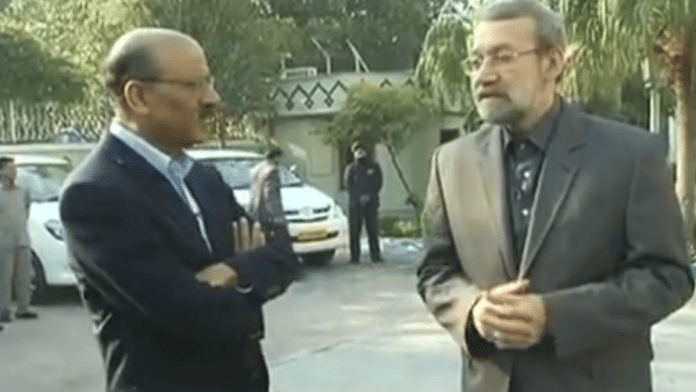
In this 2013 edition of Walk the Talk, recorded in New Delhi, he speaks to ThePrint Editor-in-Chief Shekhar Gupta about India-Iran ties, differences over the IAEA (International Atomic Energy Agency) vote, sectarian tensions in the region, and Tehran’s position on nuclear negotiations, Israel, and global power equations.
Here is a complete transcript of the interview.
SG: Hello and welcome to Walk The Talk. I’m Shekhar Gupta at the Iranian ambassador’s residence in New Delhi, and my guest today is the Speaker of the Iranian Parliament, in many ways an advisor to the Supreme Leader, a former chief negotiator on the nuclear issue, a former national security advisor, a philosopher, a computer scientist, and most importantly a key contender in the coming presidential elections in June. And yet, all of 57 years old. Mr. Ali Ardashir Larijani, welcome to Walk The Talk.
Larijani: Thank you very much.
SG: In fact, in 10 years of Walk The Talk, you are the first guest from your country.
Larijani: You know, we always consider India as our friend and we always try to maintain our contacts with this great country. I remember that when I was the Secretary of the Supreme National Council of Iran, the first visit that I paid to another country was India. Therefore, I can say that our relation with India is very close and tight.
SG: You’ve had some meetings in Bombay and Delhi. How good have they been? And what’s the mood that you pick up?
Larijani: We had very good meetings, both in Bombay and in New Delhi, both with the business people and the high-ranking officials of your country, like His Excellency the Prime Minister, the President and your Foreign Minister. Overall, we had very good meetings.
SG: Because India and Iran have a very nuanced relationship and a very practical one. And both countries give flexibility to each other.
Larijani: Maybe it is better to say that Iran and India play a complementary role to each other. And so they both play the roles, but when they are put together, they can complete each other. And this goes back to the roots that bind the two countries together. It goes to the centuries of the past. There were many Iranian scientists who came to India. I can say that for almost two centuries, Persian was the official court language.
You have some great people who are also considered great people for us, too, like Gandhi, like Jawaharlal Nehru. These are some great people. The people of Iran know about them. Their works are being studied even today in Iran. You have some Indian poets, and they have actually written their poetry in Persian language. They are very famous in Iran, too.
So, I can say that the people of the two countries are very close to each other. And the countries, when they have people, very good people-to-people contacts, then it is very easy for them to have political cooperation.
SG: And, yet we have some arguments also between us.
Larijani: That’s natural. In the world today, there are always small arguments and differences. Sometimes you see that even in a small family, people, members of the family are arguing with each other. We have to see whether they are tactical or strategic. But when it comes to the strategic level, we have no difference of opinion.
SG: So when India votes in IAEA against Iran, is that a tactical move? Is that a strategic move?
Larijani: It is not strategic, but it is a major difference. And I think close countries like us should pay more attention to each other. If we have strategic problems, then it is going to affect all of the relationship in a major way.
SG: So, you think that that act of voting against Iran does not affect the fundamental relationship or the quality of the fundamental relationship?
Larijani: It might have had some effects, yes, but it has not been fundamental. You see that the relationship is going on.
SG: Also because Iranians are consummate diplomats for 2,000 years.
Larijani: Indians have been very good or career diplomats for many years. I mean, differences like this, arguments like this, are not the ones that can separate the two nations from each other. Of course, the leaders of the two countries are wise enough. They are not going to make a big deal out of it.
SG: Because that vote came when you were the chief negotiator.
Larijani: I remember that at that time I was encouraging Iran to adopt a Look East policy, because during the time of the Shah, Iran was looking at the West. And at that time we had talks with Indian leaders. That voting was like a stroke.
SG: Like a blow.
Larijani: Maybe they could have chosen other things. I mean India.
SG: So what did you tell your Indian friends then?
Larijani: Nothing really important. Maybe I said something like, you could have done a better job, because you know us very well. We wanted India to play a more active role. You know, we have the UK and France also involved in this matter. But India cannot be compared to the two. It’s a great country. It is a major economic power. It has a large population. It is very close to us culturally. We wanted India to play its card the right way.
SG: You are very right when you say we have many other points of closeness— culture, religion, spirituality. Because we in India cannot forget, and we will always be grateful, that when we had big Hindu-Muslim tensions after the Babri Masjid incident, Mr. Rafsanjani came to India and he, in a public speech at the Imambara in Lucknow, said that Muslims in India should feel safe under the Indian system of secularism. And that had the effect of cooling down the anger in India. India will remain eternally grateful for that.
Larijani: You know, this has always been the strategy of the Islamic Republic of Iran to foster unity amongst Muslims. We have always been pro-tranquilly and peace. We have always been against terrorist acts.
SG: Or communal differences between different communities in this case.
Larijani: I believe that we have huge mutual interests in the region and we have to try to take advantage of them in peace and harmony. You know, these extremist groups have been creating problems for everyone in the region. You know, what’s going on in Afghanistan, in Syria. We have always been against such moves. We have always invited Muslims to have a peaceful coexistence with each other.
SG: In fact, that’s what impressed people in India, that Iran was speaking in its own voice and not just reflecting at that point even the view of the OIC. Iran is always an original mind and an original power. It can look at things like a big power by itself, like a major power by itself.
Larijani: This is the same role that we have played in other parts of the world. We believe this is our responsibility to do so. You know, in Iraq, there were so many clashes and tensions after it was occupied. Iran had a spiritual presence there and tried to calm things down. And in Afghanistan, we tried to prevent a civil war.
That was the idea that was fostered by Imam Khomeini, the founder of the Islamic system in Iran. He said that Muslims should have a convergence and unity. Let me tell you something. As far as I know, behind these extremist movements, you can find the intelligence services of certain countries and some others.
SG: Do you describe Israel as a Western country or as an Asian country or an Eastern country?
Larijani: You know, Israel is famous for such actions. They have assassinated five Iranian nuclear scientists in the past few years. This regime is founded on terrorist acts. But I think more important intelligence services are behind them.
You know, the more important point to know is that ethnic groups, followers of different faiths and religions have been living with each other for thousands of years. But these are new incidents. It means that they are not natural. There is an outside agent that is interfering.
For example, in Iraq, we have Shias and Sunnis. They were marrying each other. They were having a peaceful coexistence for many years. Now, we see in recent years that there are tensions, there are conflicts there.
SG: In fact, I noticed that your family had relocated to Iraq. You were born in Najaf.
Larijani: Yes, I was born in Najaf. I know Iraq very well. There are many ethnic groups there, followers of different faiths, but they always had very good relations with each other. You had these things here too, Muslims, Hindus, people who were living peacefully.
SG: And Shias and Sunnis live quite peacefully in India.
Larijani: But sometimes there are some elements that provoke them. You know, they say that the British have this policy, divide and conquer. And this is something very deceptive. And there are some plots like this always being hatched.
SG: So how do you look at the targeting of Shias in Pakistan right now?
Larijani: I think there are two reasons behind it. One, there is this extremist or radical thinking that is to blame. Unfortunately, it has been there for many years, this way of thinking. They think that we are the only ones who are Muslims, others are kafir, others are infidels. So this is very reactionary.
And there is also something that is behind the scenes. Both of them are at play. We believe that all the followers of different faiths in Islam, like Hanbalis, Shafi’is, Sunnis, Shias, they are all like brothers to each other. So, we have to focus on unity, not matters of conflict and differences.
SG: So what are you advising your Pakistani counterparts? Because the president of Pakistan is in Iran right now.
Larijani: We have always had close relations with Pakistan as a neighbouring country. We have always wanted peace and tranquility to prevail in both Pakistan and Afghanistan. And they always listen to us.
SG: But are you now impatient or worried about this persistent attack on Shias which are killing large numbers of people, not one or two people, hundreds of people?
Larijani: You know, in Iran we also have Sunnis, other minorities. We have a lot of Zoroastrians and Christians.
SG: Well, Sikhs have been there in Iran forever.
Larijani: We have always had this strategy in Iran so that different ethnic groups and religions would have peaceful coexistence.
SG: So what are you telling the Pakistanis then? Are you advising them?
Larijani: You know, there is a point here. Maybe there are some groups in Pakistan and they are involved in some actions, but the actions, I’m sure, are not approved by the government.
SG: The current negotiator, we are going back to Almaty now. He said that these talks have been like a turning point. Secretary Kerry has said that there might be hope for this is a new beginning. Do you see some hope in the current negotiations on the nuclear issue?
Larijani: I’ve been in India, so I don’t know about the details of the negotiations. Just like you, I have got my information from the media. I have to see the details, then I can pass judgments.
SG: But are you optimistic about negotiations?
Larijani: I can’t jump to any conclusions, but according to what I’ve heard from the media, I have no reason to be pessimistic.
SG: Because the Supreme Leader has said on the one hand that nobody can stop Iran from doing whatever it wants, by way of enrichment, stockpiling of material. At the same time, the official position is that Iran does not want nuclear weapons. So what does Iran want?
Larijani: It wants to have access to nuclear knowledge, fuel for our power plants. You know that in the future, fuel is going to be a crucial matter. How many power plants do you have? More than 20. Don’t you need fuel for them? This is something that has made all countries think. Now, we can have another question.
We are a member of IAEA, and according to the rules and regulations of IAEA, the member countries can have access to this knowledge, and they can have peaceful programmes. Why is it that they say that Iran should not have a peaceful programme? Based on what international convention or law? So, this means that IAEA is not doing a good job. It is ineffective.
It is like this. Countries should either develop a bomb and have nothing to do with IAEA, or they shouldn’t have anything related to nuclear energy. This is a dangerous thing. It is like high tech. It is like high technology. Countries should have access to this technology.
But at the same time, they should have enough understanding not to develop a nuclear bomb. We have proven this. You know, in the Iran-Iraq war, Saddam Hussein made use of chemical weapons against Iran. And you know that chemical weapons are relatively easy to produce. But we never retaliated.
SG: Most of our plants, our power plants, civilian plants, are under IAEA safeguards. How come IAEA has only found problems with Iran’s programme? They keep raising questions. They keep questioning your compliance with NPT and with safeguards. Because IAEA is a UN agency.
Larijani: I think you can take a guess, an educated guess. They have other problems with us. Now they seek pretext. They come up with excuses to put more pressure on us. And sometimes they told me about this in our negotiations. In the media they say something different.
They say we are worried about Iran’s nuclear programme. But in negotiations they say different things. They said that we are doing this to you because you are disturbing the balance of power in the region. But these are not rational things.
SG: But you talked about disturbing…somebody is concerned about Iran disturbing the balance of power in the region. Is that balance of power vis-à-vis Israel or vis-à-vis Saudi Arabia, or both?
Larijani: I think they are doing this, they are classifying countries of the region because they want to dominate the energy resources. Therefore, there are different classifications. They want to have a monopoly. They want to dominate the energy sources of the world. Maybe one of the plots that they will be following in the future will be to prevent the progress of major powers in the east by controlling their energy sources.
SG: So where do you put the two countries in this equation, Saudi Arabia and Israel?
Larijani: I think they are very different from each other.
SG: Saudi Arabia is an Islamic country.
Larijani: We don’t put Saudi Arabia in this equation at all. I said that we have always been pro-unity so that there will be peace in the region. Israel is like a pest. It creates problems for the whole region.
SG: Pest is a strong word. I think it’s even stronger than what your president has used for Israel.
Larijani: No, maybe I made a mistake, you know. Israel is a disturbance.
SG: It’s a nuisance.
Larijani: Nuisance, yes.
SG: Do you agree with your president’s description of Israel?
Larijani: There is no doubt that the Zionist regime in the region makes trouble.
SG: How do you respond to your president’s questioning of the Holocaust, for example, which got many people in the world very disturbed? Do you share that view?
Larijani: There are different views about Holocaust. That is a historical incident. I think the more important thing is that we should see in what ways they are taking advantage of it. I’m not a historian to discuss it. Let’s suppose that Hitler did this.
He made this big mistake. But why should the Palestinians pay the price for it? This is something that is wrong. They want to magnify the Holocaust on one hand and then diminish the occupation of Palestine on the other.
SG: So let’s come back to Delhi. Many in India, including security agencies, feel that there was Iranian involvement in the attack on an Israeli woman diplomat in Delhi. Is Iran helping India? What is the status of our talks on that?
Larijani: Of course, we have been cooperating with India. We have no problem with… these are actually fairy tales. We have no reason to be involved in such things. I told you about Iran’s strategy. This suits the Israelis themselves, you know, because they are used to doing things like this. Maybe they do it themselves, the Israelis do it themselves, so that they can pit friendly countries like us against each other. They have done things like this, mischievous things like this in the past.
SG: So you have no evidence of any Iranian involvement?
Larijani: We have not been told about the existence of any evidence.
SG: But are your agencies helping Indian agencies?
Larijani: Yes, any information, intelligence that our Indian friends want from us, we will put this at their service. But there is no information to give them. I told you, in principle, we have always been against such actions.
SG: So, to that extent you condemn the attack on any diplomat?
Larijani: Yes, definitely. Yes, we do believe in the orders and the norms and the well established ones. These are disorders.
SG: Disorder. These are wrong things.
SG: Now, before I let you go, because you have so much on your CV already, in my introduction I forgot one key factor, which is that you are also an elected member of parliament from the holy city of Qom. You are married into an Ayatollah’s family, you are an Ayatollah’s son-in-law. Just explain to us Indians a little bit, how does this balance of power work within Iran—the clergy and the Supreme Leader on the one hand, elected leadership on the other, and many in the opposition. You have many arguments with your president. Many people in the world don’t realise that under the supreme leadership in Iran there is a very robust, argumentative democracy.
Larijani: You know, arguments and differences of opinion are natural in all countries that have democracy. You have to know that the system of the Islamic Republic of Iran is democratic. If any person is related to an Ayatollah, it doesn’t mean that he is going to be in opposition. The important thing is that whether people elect him or not.
SG: If you were to advise Assad, what would you tell him today?
Larijani: I would have two pieces of advice. My first piece of advice would be to the countries that are sending arms to him.
SG: To stop doing it. And let there be elections. And second advice?
Larijani: Let elections happen in Syria. Three elections.
SG: And if Assad loses, let him go out.
Larijani: Yes, of course. Maybe people vote for him, maybe they don’t.
SG: So, that’s your advice. Thank you very much. And the last question, are you contesting elections this June?
Larijani: I still have time to announce it. Thank you very much.
(Both laugh)