





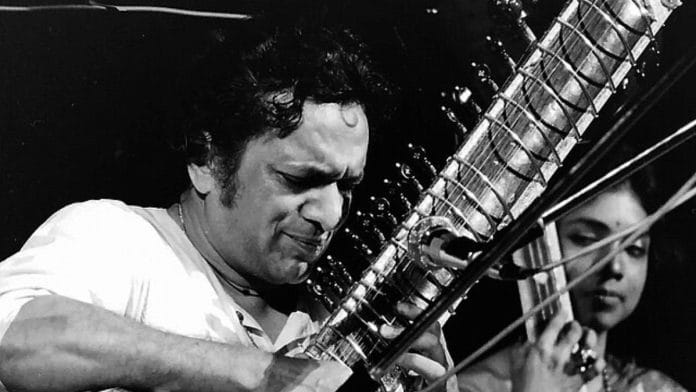



It was Indian sitar maestro Pandit Ravi Shankar who first brought the world’s attention to Bangladesh’s struggle for independence, said M Hamidullah Riaz, the Bangladesh High Commissioner to India. Shankar’s music helped spotlight the humanitarian crisis, he added in his speech during Bangladesh’s National Day celebrations in Delhi last month.
On 1 August 1971, a pair of benefit concerts organised by George Harrison and Ravi Shankar took place at Madison Square Garden. They raised relief funds for refugees in erstwhile East Pakistan, following the Bangladesh Liberation War.
“I knew that if I gave a concert myself, I would not be able to raise a significant amount. [Harrison] was really moved and said, ‘Yes, something should be done.’ That was when he wrote the song ‘Bangla Desh’,” Shankar noted in his book, Raga Mala: The Autobiography of Ravi Shankar.
The concert became the largest benefit of its time, featuring a supergroup of performers including Ringo Starr, Bob Dylan, Eric Clapton, Billy Preston, Leon Russell, and Badfinger.
“The priority was to attract world attention to what was going on,” Harrison later said. “It wasn’t so much the money because you can feed somebody today and tomorrow they will still be hungry, but if they’re getting massacred, you’ve got to try and stop that first of all.”
Shankar the dancer
Shankar was born on 7 April 1920 in a Bengali family and spent his youth touring India and Europe as a dancer in his brother Uday Shankar’s troupe. At 18, he abandoned dance to pursue music, studying the sitar for seven years under the strict tutelage of court musician Allauddin Khan in Maihar, where he lived in the traditional gurukul system. There, he mastered the sitar, surbahar, and several Indian classical forms, often training alongside Khan’s children, Ali Akbar Khan and Annapurna Devi. Shankar made his public debut in 1939 through a duet with Ali Akbar Khan.
After completing his studies in 1944, Shankar moved to Mumbai, composing for ballet performances and films, where he composed evocative scores for Satyajit Ray’s celebrated Apu Trilogy. His work includes the significant film, Dharti Ke Lal (1946), which was based on the Bengal famine of 1943.
In her tribute to Shankar on his birth anniversary Wednesday, West Bengal Chief Minister Mamata Banerjee called him “one of the foremost cultural torchbearers of Bengal’s Renaissance, and a pride of Bengal and Bengalis”.
In 1945, Shankar recomposed Muhammad Iqbal’s immortal poem, ‘Sare Jahan Se Achcha’.
From 1949 to 1956, the sitar maestro served as music director of All India Radio, shaping a generation’s understanding of classical sound. He established the Indian National Orchestra, which blended Western and Indian instruments.
Shankar is credited with the “sitar explosion” of the 1960s. By 1967, his impact on the industry was undeniable: Billboard named him Artist of the Year; he collaborated with Yehudi Menuhin at the United Nations; John Coltrane named his son Ravi; and his music was no longer strange to Western ears.
Shankar died on 11 December 2012. His works still serve as a bridge between cultures.
Also read: Amitav Ghosh wants to fight climate change with faith, not reason
Global ambassador of Indian music
Shankar was awarded the Bharat Ratna in 1999. Yet it was his role as a global ambassador that set him apart. Touring Europe and the Americas, he introduced audiences to the depth and complexity of Indian classical music.
Shankar had once compared Indian music to the parable of the blind men trying to feel an elephant. In his biography of the maestro, Indian Sun: The Life and Music of Ravi Shankar, author Oliver Craske wrote about the composer relating the story in a London press conference. In whichever country Indian classical music was played, Craske writes, the locals saw resemblances to their own music. Americans said it was like jazz; Japanese compared it to their folk music.
“But the similarities are very superficial. Beyond that, there is something very deep that is yet to be appreciated by Westerners,” Shankar said in London.
His performances at the Monterey Pop Festival in 1967 and at Woodstock in 1969 brought Indian ragas to the counterculture. However, Shankar famously insisted that audiences shouldn’t arrive intoxicated to the events so they could truly appreciate the discipline of the music.
In Indian Sun, Craske writes beautifully about the force that compelled Shankar to compose.
“Once, when asked why he made music, he joked, ‘There’s an insect gnawing in my head.’ There was some truth hidden in his jest. He had no choice; it was as if there was always something else impelling him on his unlikely and often lonely mission.”
(Edited by Prasanna Bachchhav)