








New Delhi: From its orbit in the infinite darkness of outer space, more than 100,000 km above the Earth, spy satellite Vela 6911 recorded two tiny bursts of light on the Prince Edwards Islands, in the remote southern Indian Ocean, half way between Africa and Antarctica.
Logged as Event 747, the flashes of light was soon confirmed to have been released in low-yield nuclear test, by the sensitive Hydroacoustic Data Acquisition System at Ascension Island. Later, more evidence emerged from the thyroid glands of Australian sheep, which grazed along the path of the radioactive plume that had drifted east across the Indian Ocean. A new nuclear power was born on 22 September, 1979.
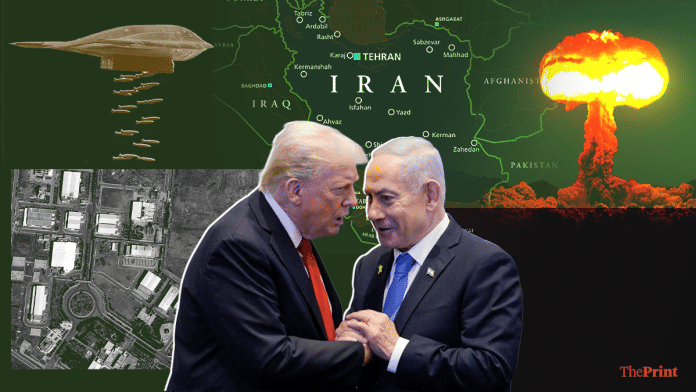
Hi, and welcome to ThePrint Explorer. I’ve been away for the last few weeks, taking some time to work on a research project. And as I was doing that, the world lurched into a war that can potentially reshape the Middle East. Israeli and American combat jets and missiles have been hitting sites across Iran, seeking to obliterate both its nuclear programme and the regime itself. Today, I’ll be looking at how the world got here—and the story of that Israeli nuclear test is key to the story.
The world had become a very dangerous place in 1979: the Iranian revolution took place in February, costing Israel one of its most trusted partners, the Shah of Iran. Tensions between the Cold War adversaries were starting to spike. Fearing disclosure of the Israeli nuclear test could jeopardise the peace process he had carefully crafted in the Middle East, US President Jimmy Carter asked a panel of experts to provide him with a list of other reasons that might, conceivably, explain Event 747.
Even though he was soon equipped with excellent excuses, the US President did not hide the truth from himself. “We have a growing belief among our scientists that the Israelis did indeed conduct a nuclear test explosion in the ocean near the southern end of Africa,” Carter recorded in his private diary.
And that was that. Except, of course, it wasn’t.
Iran’s nuclear baby-steps
Let’s start, as it were, with the prequel: Following the end of the Second World War, the major powers all scrambled to acquire the nuclear weapons the US had unleashed to terrifying effect in 1945. The Soviet Union, helped by its extensive nuclear espionage network, succeeded in testing its first nuclear bomb in September, 1949, years ahead of what experts had predicted.
The UK followed in 1952, France in 1960, and China in 1964. Technically, the UK, France and China all had the protection of a superpower—but their leaders could not be sure that the US or the Soviet Union would protect them at the cost of their own survival.
The nuclear bomb was, everyone understood, quite different to all other kinds of weapons: Their destructive power quite literally rendered the concept of victory in war irrelevant. Yes, the Soviets or the Americans could crush all powers in a war—but only at the cost of their own complete and assured annihilation. And who would risk that?
And exactly because of this, a second wave of nation-states began seeking the nuclear bomb, too: Israel, of course, but India, too, and Pakistan, and Apartheid South Africa, which produced six weapons by the early 1980s. There were others, like South Korea and Brazil, which mastered many of the technologies needed to produce a nuclear weapon, though they never made one.
Like Israel, Iran was one of these “second-generation” nuclear powers. The emperor of Iran, Muhammad Reza Pahlavi, had acquired a small research reactor from the US in 1967, capable of producing 5MW of electricity. Later, in the early 1970s, the Shah announced an ambitious plan to construct 23 nuclear reactors, as part of his country’s search for a post-petroleum future.
The American-supplied nuclear research reactor laid the foundations for Iran’s nuclear programme. The Tehran Research Reactor (TRR) was a light water reactor supplied in 1967, together with hot cells for the production of medical isotopes and 5.58 kg of highly enriched uranium (HEU) fuel. The reactor housed at the Tehran Nuclear Research Center, was capable of producing up to 600 grams of plutonium annually.
In 1987—long after the revolution—Argentina’s Applied Research Institute converted the reactor to run on low enriched uranium (LEU) instead of high-enriched uranium. Argentina subsequently supplied Iran with 115.8 kg of safeguarded LEU. Between 1988 and 1992, Iran conducted undeclared reprocessing experiments with fuel pellets irradiated in the TRR.
From the outset, it was clear that the prospect of acquiring nuclear-weapons technology was at least part of the reason for Iran’s interest in reactors. In 1974, just after India’s first nuclear test—supposedly conducted for peaceful purposes, like building dams and reservoirs—the Shah was reported to have made his desire for a bomb public. Later, the Shah denied having said anything of the kind, but American diplomats believed he was signalling that Iran “could not stand idly by if other nations like Israel or Egypt should go nuclear.”
The US had worries of its own, though, to do with the prospect of nuclear proliferation. From the beginning, America had worried that Iran might enrich uranium to weapons-grade levels. To prevent this, it floated various suggestions, including the purchase of enriched uranium from a reactor it had invested in, or setting up an offshore facility in Pakistan, together with that country.
In 2009, the TRR was expected to run out of fuel within the following few years. After the failure of the proposed LEU-fuel exchange deal between Iran on the one hand, and Russia and France on the other, Iran declared it had started enriching uranium to up to 20 percent in order to manufacture fuel pellets for the TRR. In February 2012, Iran loaded the first batch of indigenously-produced fuel rods into the Tehran Research Reactor.
The French guarantee
Ever since the release of a three-part Israeli television documentary in 2024, the country’s notoriously secretive nuclear programme has had a public airing. The documentary, ‘The Atom and Me’, centres around interviews with Benjamin Blumberg, the head of the Israeli scientific intelligence agency responsible for the nuclear mission. Lakam, Blumberg’s agency, was so secretive that its work was often withheld from Israel’s external intelligence service, Mossad. The interviews were recorded in 2018, with a promise not to air them until Blumberg’s death.
Large parts of the story, though, have long been well-known outside Israel, ever since the publication of historian Avner Cohen’s superb book on the country’s nuclear programme.
Even though Israel joined the US’ Atoms for Peace civilian-nuclear technology initiative in 1955, leading to a reactor being established at Nahal Soreq in 1960, its leaders soon realised that the framework was of no help in developing a nuclear weapon.
Israel’s leaders turned, instead, to France. Like Israel, France believed that it needed its own nuclear weapons to ensure survival in a dangerous world. French assistance, including access for Israeli scientists to nuclear research facilities, laid the foundations for the atomic weapons programme in the mid-1950s.
French Prime Minister Guy Mollet, guilty of having drawn Israel into the Suez crisis in 1956, which undermined the fledgling state’s relationship with both the US and the Soviet Union, emotionally declared: “I owe them the bomb, I owe it to them.”
The French commitment to Israel’s nuclear weapons programme became explicit from the outset of work on the Dimona nuclear reactor in 1958. The plans included all the technological components required for a plutonium-based nuclear weapon, including underground facilities to extract plutonium from spent uranium. From at least 1960, declassified documents reveal the US was aware the Dimona reactor was designed not for the production of energy but for weapons-grade plutonium.
Large amounts of equipment Israel could not legitimately acquire it simply stole, Victor Gilinsky and Leonard Weiss have recorded—just like other states in a similar situation, like Pakistan and North Korea.
In 1968, weapons-production quantities of Uranium-235 were stolen from a facility in Pennsylvania. This operation appears to have involved some of the same Mossad operatives to kidnap Nazi leader Adolf Eichmann from Argentina. The spy, arms dealer and film producer Arnon Milchan, similarly, was involved in the theft of high-speed switches needed to trigger a nuclear explosion.
The story soon expanded to include a profoundly disturbing relationship with Apartheid-era South Africa, with Israel using the services of the former Brigadier and mercenary Jonathan Blaauw to acquire uranium. In return, Israel helped South Africa with conventional military know-how, as well as assistance in its own nuclear weapons programme.
From declassified documents revealed in 2010, it is clear Israel was willing to sell technology that South Africa used to intimidate its Black African neighbours. In a letter dated 11 November 1974, then-Israeli foreign minister Shimon Peres said Israel and the South African apartheid government share a “common hatred of injustice.”
Also Read: British, Soviets & Americans returned from Afghanistan. Pakistan, Munir need to learn from past
The art of the deal
From at least 1969, America knew that Israel was a nuclear power if an undisclosed one: In one memo, then-National Security Adviser Henry Kissinger made clear that Tel Aviv had at least a dozen surface-to-surface French-made missiles capable of delivering nuclear weapons, and an arsenal of 30-40 warheads. This clearly flew in the face of past Israeli assurances. The previous year, Kissinger noted, then-Ambassador and later Prime Minister Yitzhak Rabin had promised Israel would not be “the first to introduce nuclear weapons into the Middle East.”
Following protracted discussions at the White House on 26 September, 1969, President Richard Nixon and Prime Minister Golda Meir arrived at a landmark secret deal: The US would act as if Israel had no nuclear bombs, thus allowing it to continue military assistance, as long as Israel kept them secret.
Israeli leaders, however, knew that actual deterrence could only be established when their adversaries were certain their nuclear bombs actually worked—hence the tests on Prince Edward Island and the wilful cover-up that followed in the West.
The nuclear programme in Iran, meanwhile, kept ticking forwards, even after the Shah was dethroned. The new regime in Tehran was soon being subjected to missile and chemical-weapons strikes by Iraqi dictator Saddam Hussein’s government. The US, enraged by its embassy personnel having been taken hostage by Iranian students, encouraged Iraq. As the world stood by, Iran concluded that it needed to develop the tools to make a nuclear weapon—but refrain from actually assembling a device if sanctions were lifted.
Last year’s attack on Iran made clear that the country’s nuclear programme could rapidly recover from annihilation. Iran now has substantial nuclear infrastructure: the Fuel Enrichment Plant and Pilot Fuel Enrichment Plant in Natanz; the Fordow Fuel Enrichment Plant near the city of Qom. There are centrifuge R&D facilities in Tehran and in Esfahan. Iran also grown a large industrial base to support these activities.
Even if the regime is dethroned, its successor will enjoy the same resources—and, likely, face the same strategic compulsions which make the pursuit of nuclear weapons attractive to Tehran.
To move forward in the talks in Muscat, it is necessary to understand the existential anxieties that drove Israel are identical to those which underpin the behaviour of Iran and other states with nuclear weapons programmes. Iran fears that shorn of its missiles and nuclear capabilities, it could be dismantled by its richer Arab neighbours or the US. Trump and Iranian negotiators will have to find guarantees that address the concerns of Tehran.
Last year, US Special Envoy to the Middle East Steve Witkoff revealed that Trump had also written to Iran, saying: “We should talk. We should clear up the misconceptions. We should create a verification programme so that nobody worries about weaponisation of your nuclear material.”
That’s precisely what US President Barack Obama had sought to do in 2015 through a long dialogue process involving Iran, Germany, and the five permanent members of the United Nations Security Council (UNSC)—the US, Russia, China, the UK, and France.
That time, Trump resiled from the agreement, citing Iranian work on ballistic missiles as a continuing threat to Israel. This time, he began strikes even as Iran and America were negotiating in Oman. By the account of Oman’s foreign minister, the mediator of the talks, an agreement was in sight when Trump decided to authorise the attacks.
Is there such a middle ground? The nuclear theorist Kenneth Waltz, writing in 1981, suggested that when it came to nuclear weapons, “more may be better”. Their very nature, he argued, meant “the measured spread of nuclear weapons is more to be welcomed than feared”. This, he went on, was because in “a conventional world, deterrent threats are ineffective because the damage threatened is distant, limited, and problematic. Nuclear weapons make military miscalculations difficult and politically pertinent prediction easy.”
Put simply: “In a conventional world, one is uncertain about winning or losing. In a nuclear world, one is uncertain [only] about surviving or being annihilated”. Iran’s regime, the argument goes, no more seeks annihilation than does Israel, or North Korea, or Pakistan, or India.
The final answer might lie in Iran acquiring nuclear weapons, whether through design or the failure of negotiations. Even US attacks on Iran, most experts concur, will at most delay Tehran’s acquisition of nuclear weapons by some time. The consequences for the Middle East might seem terrifying—but it might just prove the least destabilising of many terrible choices.
(Edited by Tony Rai)
Also Read: Pakistan vs TTP: Asim Munir’s been riding the jihadi tiger; he’s now realising he’s the nearest meal