





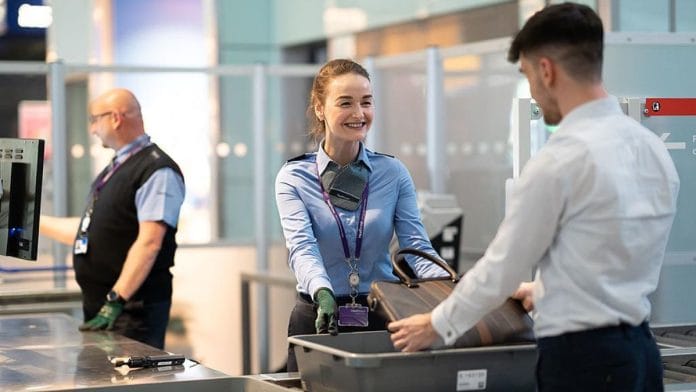



New Delhi: When a passenger has a flight to board, the drill to stuff tiny bottles into flimsy plastic bags, while hoping nobody pulls them up at the security check, becomes a part of that journey. But, as of January 2026, you don’t have to do that at the United Kingdom’s Heathrow Airport. Thanks to a massive £1 billion upgrade.
Now, passengers can carry individual containers of up to 2 litres each in their hand luggage, as opposed to the earlier 100ml limit. Passengers also don’t need to take out the liquids or large electronic items such as laptops and tablets when they go through the security check.
With this technological push, Heathrow Airport becomes the busiest airport in the world to implement this technology at all terminals and lanes. More than 84 million passengers use the London Airport every year, making it the busiest hub in Europe, a report in Mirror said.
The goal is to make queues move up to faster. It also stops the waste of single-use plastic bags. A press release from the airport estimates that almost 16 million plastic bags will be saved per year.
A Computed Tomography scanner allows passengers to now carry full sized bottles to the airport, without the hassle of security checkpoints. It works similarly to a medical scanner, but for suitcases.
However, the airport has issued a note of caution—security equipment at all airports is not the same. “If you’re flying from another UK or international airport, check the security rules before you travel, as liquid limits and screening requirements may be different,” Heathrow’s website reads.
Why did the rule start?
Passengers have not always had to bring ‘travel-sized’ liquid goods through airport security. The rule began in August 2006, after a terrorist plot to use liquid explosives disguised as soft drinks to blow up US and Canada-bound planes was thwarted by the British Metropolitan police.
In the immediate aftermath, no liquids were allowed at all. But, a few weeks later, the 100ml rule kicked in. It was adopted around the world.
Heathrow Airport is part of a growing club that has scrapped the 2006 rule. In the UK itself, Gatwick, Birmingham, Bristol and Belfast Airports have moved to the 2 litre rule.
Ireland’s Shannon and Donegal airports were actually some of the first in the world to switch to the new rule. Italy’s Rome Fiumicino, Milan Linate and Milan Malpensa Terminal 1, Bergamo Orio al Serio, Bologna and Turin Caselle airports are also part of the new system.
According to a Gulf News report, Dubai Airports chief executive Paul Griffiths confirmed that trials were underway for advanced security scanners supplied by Smiths Detection. It allows passengers to leave liquids over 100ml and laptops inside their hand luggage. But the official website for the Dubai International Airport has not updated their rules regarding the same.
Melbourne airport’s Terminal 1 has introduced “state-of-the-art body scanners and CT x-ray technology lanes”, which allow passengers to keep their electronic devices and liquids in their carry-on bags while going through security, but the liquid limit remains unchanged.
In the US, there are select Computed Tomography lanes at JFK Airport, Los Angeles Airport, Chicago Airport and Atlanta Airport.
Most airports in Canada, New Zealand, India, Australia, France, Spain, Greece, and Amsterdam have continued to enforce the limits.
Also read: Darbhanga to Deoghar, small towns are dreaming big with UDAN airports. With some turbulence
What is allowed with the new rules?
When travelling through any Heathrow terminal, passengers can keep liquids in their cabin bags, they can carry liquids in individual containers of up to two litres each, and they can leave large electrical items, such as laptops and tablets, inside their bag.
It allows passengers to carry baby food or milk, and liquid medicines.
The banned items list includes flammables, bleach, toxic, oxidisers, corrosives, explosives, fireworks, incapacitating sprays, ignitable gas devices and compressed gas.
(Edited by Theres Sudeep)