





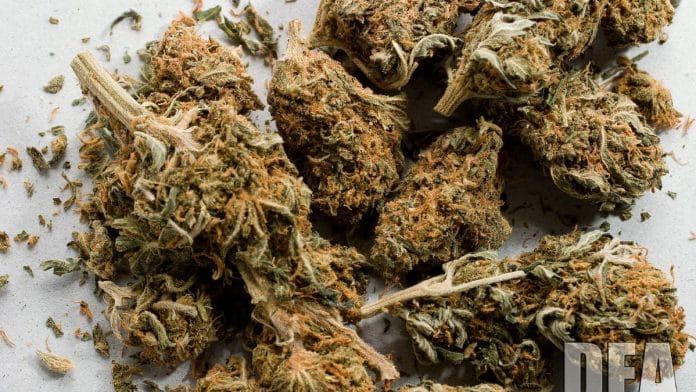



New Delhi: US President Donald Trump is expected to ask agencies to look into reclassifying marijuana under the Controlled Substances Act. It’s part of a broad plan to loosen the country’s long-standing federal restrictions on the drug. The Washington Post was the first to report on the plan, which would move cannabis from Schedule I, the category for addictive substances with “no accepted medical use,” to Schedule III, meant for medicinal drugs with addiction potential. This would be the biggest federal change on cannabis in fifty years, even though it doesn’t legalise the drug nationwide.
There is no coincidence in the timing. Politically, things have drastically changed: Most Americans now reside in places where cannabis is legal for either medical or recreational purposes, and the business has grown into a multibillion-dollar industry that demands regulatory certainty.
The Department of Health and Human Services (HHS) and the Drug Enforcement Administration (DEA), in particular, have been conducting official reviews since Joe Biden’s term regarding rescheduling. The Department of Justice officially proposed the reclassification in 2024. The Republican-led House Appropriations Committee attempted to block the DOJ. Hearings for the same have been delayed since then.
Trump first indicated an inclination for reclassification in August this year.
The administrative backing for reclassification would be strengthened by Trump’s order. It would expedite a decision that has taken years to make.
Another element is pressure from the industry. Federal prohibition, according to cannabis firms, has hindered research, prevented access to finance, and deterred investment. As financing and consolidation depend more and more on regulatory stability, executives and trade associations have reportedly been speaking with Trump’s team.
Reformers are also aware of the political optics: A government action on cannabis offers a rare bipartisan victory, appealing to criminal justice reformers, libertarian conservatives, and a business community that wants certainty all at once.
Also read: The long list of harmful effects of cannabis criminalisation no one talks about
What does US law say?
The Controlled Substances Act (CSA) was passed in 1970. It created four schedules of drugs. Schedule I drugs are highly addictive and have no medicinal value, Schedule II drugs have high abuse potential and have accepted medical use with severe restrictions, Schedule III drugs have potential for abuse and an accepted medical use, and Schedule IV drugs have a low potential for abuse relative to the other schedules and have medicinal value.
Schedule I status, which marijuana currently holds, imposes strict restrictions on growing and sale, makes it difficult to fund research, and prohibits physicians from recommending cannabis.
Federal prohibition of marijuana remains in place despite dozens of states liberalising their laws, leaving Americans to traverse an uncomfortable patchwork: Legal under state laws, prohibited under federal ones.
Although a presidential order cannot change the law, it would at the very least change the federal government’s perspective on cannabis.
Also read: Scientists find cannabis won’t make you ‘lazy & unmotivated’, but it can make you less reliable
What are the implications?
There will be significant implications if marijuana is added to Schedule III. It would change the federal government’s approach from punitive to regulatory, paving the way for more extensive changes down the road.
It would publicly recognise acceptable medicinal use, making it easier for researchers to qualify for government grants without having to go through legal red tape.
Approval would still be necessary for pharmaceutical-style cannabis products, but the process would be more transparent.
Rescheduling could alleviate banking restrictions, reduce compliance costs, and draw in institutional investors for the legal cannabis industry, which has expanded despite the weight of federal tax fines and restricted access to financing. Though some fear that a partial reform would solidify corporate power before small businesses have an equal opportunity.
The bigger ramifications will probably take years to materialise.
Social justice advocacy groups, such as Marijuana Justice, contend that because communities of colour are disproportionately affected by enforcement, rescheduling must be combined with record expungement and broader decriminalisation.
Also read: India’s cannabis law is nonsensical, it’s time for ‘Big Bhang’ reform
How have previous US presidents dealt with marijuana?
This period is part of a lengthy arc of changing federal opinions.
During the “war on drugs,” the Ronald Reagan and Bill Clinton administrations tightened penalties; the Richard Nixon-era CSA established today’s strict scheduling structure; and Barack Obama’s Justice Department signalled tolerance for states legalising cannabis through the 2013 Cole Memo, which Donald Trump’s first attorney general later revoked.
Joe Biden started the scientific evaluation, which is currently coming to an end, and authorised pardons for simple possession.
Trump’s most recent action is an acceleration rather than a policy revolution.
Rescheduling will change how the government handles the drug, how researchers study it, and how markets value it, but it won’t make cannabis legal overnight. In a country where cannabis laws have long moved from the bottom up, state by state, Washington may finally be catching up.
(Edited by Theres Sudeep)