





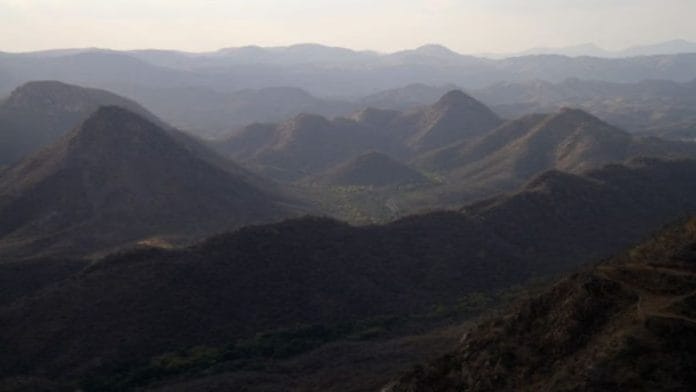



New Delhi: Ten out of the 15 major mineral licenses granted in Rajasthan in 2025 were located in the Aravallis, covering limestone, iron, zinc, copper and even emerald. Four out of 10 new mining blocks put up for auction on 28 November, a week after the Supreme Court accepted the new definition of Aravallis, also fell within the Aravalli districts certified by the Rajasthan government.
The two-billion-year-old mountain ranges are a haven for mining companies and have a history of being mined as far back as 4000 BCE, during the later Harappan civilisation. As fold mountains that have had millennia to develop and concentrate metals, the Aravallis are rich in base metal deposits like lead, zinc and copper. They are also rich in sedimentary rocks, including sandstone, limestone and marble, which continue to be mined.
“It is the foothills that have the best minerals—be it quartz or lead or marble, geologically, the base of the hills is targeted,” said MD Sinha, a former IFS officer who was posted in Haryana. “Different kinds of mining have different impacts on the environment. Quartz mining, for example, completely destroys the water table of a region,” he added.
The Rajasthan, Delhi and Haryana governments, as well as the Supreme Court of India and the National Green Tribunal, have all banned mining in different sections of the Aravallis at different points. Delhi-NCR, Faridabad, Gurugram and other protected areas in the Aravallis are off-limits for mining, and in Rajasthan—where mining is allowed—it requires environmental clearances from the state.
However, illegal mining continues rampantly across the entire mountain ranges, especially in Rajasthan. Over 27,000 cases of illegal mining, transporting, and stocking of minerals were recorded from 2020 to 2025 in the 20 Aravalli districts of the state.
What exactly is being mined—both legally and illegally—in the Aravallis?
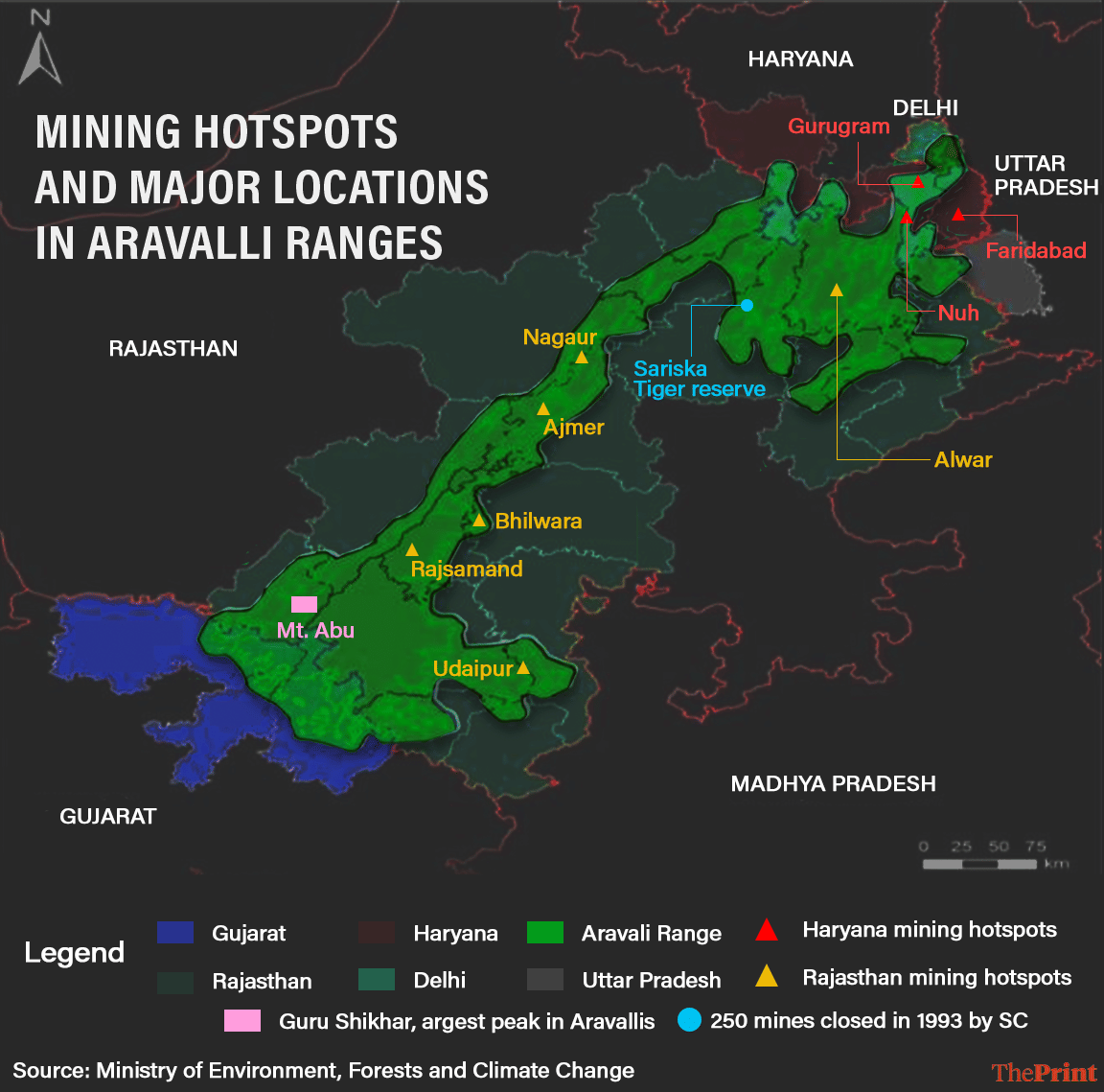
Major mining in Rajasthan
Rajasthan—home to nearly 90 per cent of the Aravallis—is India’s sole producer of lead and zinc, as well as a major producer of calcite and silver. It contains 89 per cent of India’s total lead and zinc resources, primarily due to the Aravallis. It also contains almost 50 per cent of the country’s copper reserves, 66 per cent of feldspar, 88 per cent of India’s silver ore and 63 per cent of marble.
In terms of pure resources, Rajasthan has 31 million tonnes of zinc, 11 million tonnes of lead, 868 million tonnes of copper, and 29 billion tonnes of limestone.
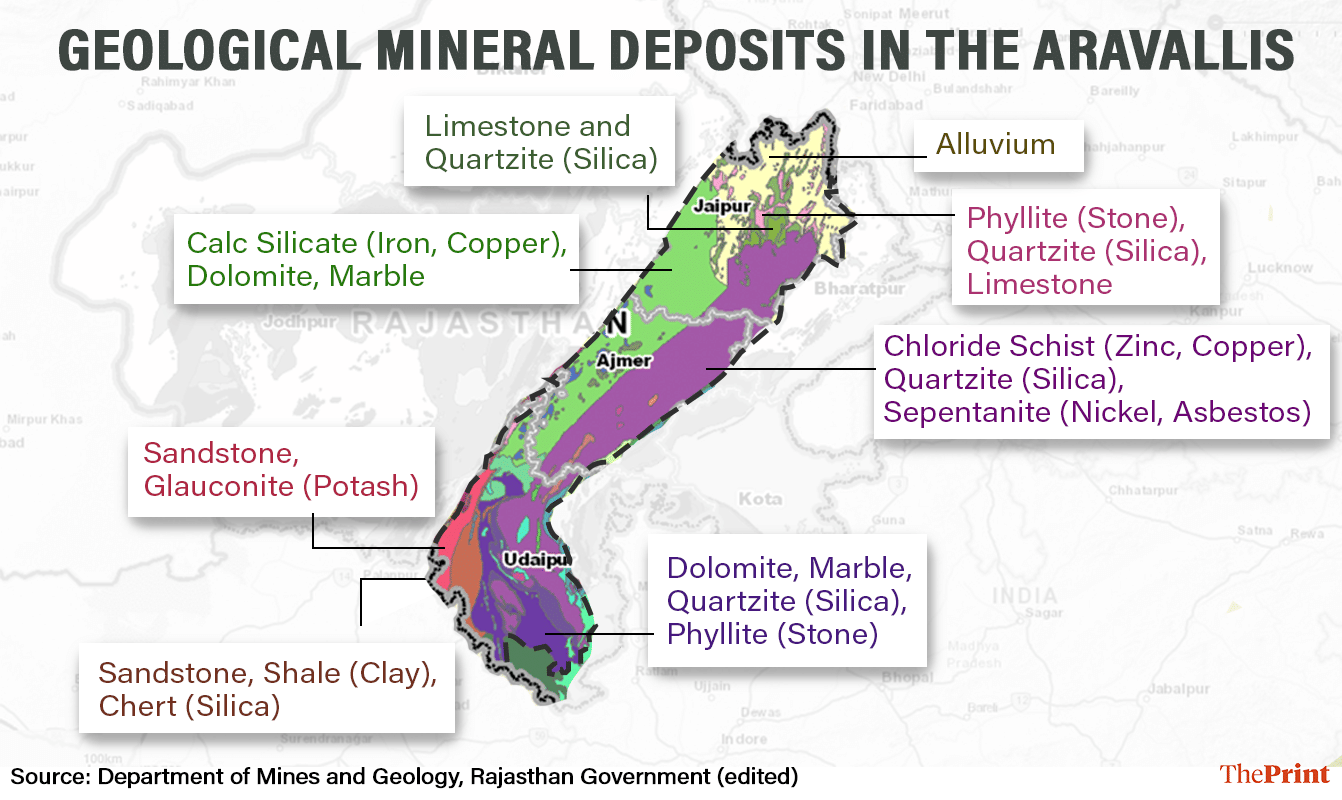
These are major sedimentary and volcanic deposits found in large concentrations in the Aravallis because of the range’s great age. The Aravallis are made up of high-grade metamorphic rocks, formed under intense pressure and high temperatures. These geological processes are ideal for the concentration of metals, and since the Aravalli minerals had billions of years to form, they are found in multiple layers under the surface.
Lead and zinc are base metals often found together, and in Rajasthan, they are concentrated in Ajmer, Udaipur, Chittorgarh, Bhilwara, Pali, Rajasamand, and Sirohi districts – all within the Aravalli range. Most of the mining for major minerals is done legally and requires multiple permissions as well as environmental clearances. Even so, violations and overstays of mining leases have been flagged over the years.
“If you have been given the government license to mine for three years, but you continue for four or five years without permission, that is still illegal mining, right?” said Kailash Meena, an activist who has worked in the Aravallis for over three decades.
For example, in 2018-2019, the Indian Bureau of Mines (IBM) inspected 83 mines in Rajasthan and found mining violations in 71 of them. From 2018 to 2025, IBM inspected around 707 mines in Rajasthan, and found 474 violations, meaning roughly 67 per cent of the mines were not following rules and guidelines.
The top six minerals in Rajasthan, in terms of revenue, are lead-zinc, silver, copper, limestone, lignite and iron ore. Out of the total Rs 3,945 crore revenue from major minerals in 2023-24, Rs 2,419 crore came just from lead and zinc.
From batteries to ornaments to pipes, sheets and alloys, lead is a versatile metal that is used for a variety of applications in different industries. Zinc, too, has an excellent non-corrosive property, and it is used widely in construction for galvanising pipes and other metal items.
Minor minerals – sand, marble
Aside from base minerals, the Aravallis are also rich in minor minerals such as marble, quartz, limestone and granite. There are more than 24,000 million tonnes of granite, 35,000 sq kms of sandstone, and 12,000 million tonnes of marble present in Rajasthan.
These are used mainly for residential construction, flooring, tiles, and urban infrastructure. This is also the mainstay of illegal mining activities in the mountains, around Rajasthan and Haryana, using heavy stone crushers and dynamite blasting.
Classified as minor minerals by India’s Ministry of Mines, these deposits have formed because of sedimentary processes in the Aravallis. Over millions of years, layers of limestone, sandstone, granite and marble accumulated in the mountains, interrupted by long periods of erosion. This long geological history makes the Aravallis richer than other, younger deposits of similar minerals, with each layer varying in rock type, quality and chemical composition.
Unlike major minerals, mining marble, masonry stone and granite is a fundamentally different process. Lead, zinc and copper are found in ores and require underground extraction and extensive processing before use. Legally, these minerals are regulated by the Rajasthan Department of Mines and Geology and require permission first for exploring and then for extraction.
But minor minerals like marble and granite are the rock itself. There is no processing required, and the mining or quarrying needs a lot more brute force. This is the type of mining that can erase entire hill ranges, and it’s exactly what has been slowly eating into the Aravallis, as noted by the Supreme Court.
“They bring huge stone crushers, carry out dynamite blasting right inside the eco-sensitive mountains,” said Meena. “It is terrible not just for the mountain but for everyone living around it. The noise, the dust, the impact on water and soil is unimaginable.”
In 2018, the Supreme Court’s Central Empowered Committee observed that 25 per cent of Rajasthan’s Aravallis had been lost to illegal mining and stone crushing.
Also read: Aravalli zoning plan can easily be bent for the powerful. Govt must make all data public
Laws against illegal mining
In the Aravallis, there have been many attempts by state governments to control illegal mining. According to a Lok Sabha answer in 2025, the Rajasthan state government has deployed Border Home Guards in mining offices, mandated GPS and Radio Frequency Identification (RFID) for mineral transport vehicles, and set up district-level monitoring committees to keep a check on illegal mining.
There are also measures like making entry into mining sites entirely digital, so the government is aware of when a vehicle enters and leaves a zone. In a Lok Sabha response, the Centre said it has vigilance teams to investigate illegal mining complaints. Penalties for illegal mining currently include fines up to Rs 5 lakh per hectare, and up to five years of imprisonment.
However, these measures don’t always tend to pay off. According to government data presented in Parliament in July 2025, despite there being 27,693 reported cases related to illegal mining in the Aravallis, there are only 3,199 FIRS lodged. This means only 11 per cent of cases have seen FIRs being lodged.
In some districts like Sirohi, Salumber, Pratapgarh, and Sikar, no FIRs have been lodged in some years, even though there were more than 200 reported cases.
“So many cases go unreported, and even when they are reported, the police do not lodge an FIR. Unless you go on the ground, you cannot see the extent of illegal mining going on in the Aravallis,” said Meena.
(Edited by Ratan Priya)