





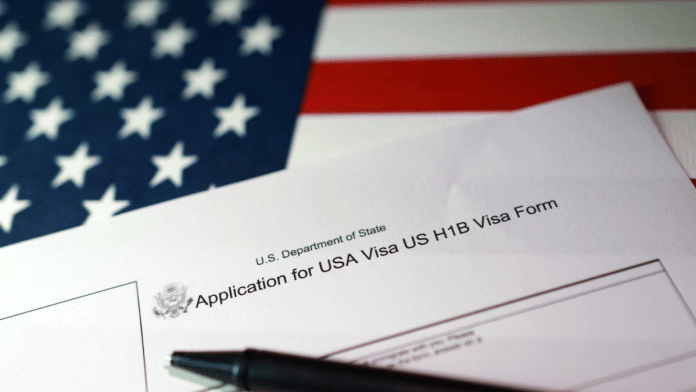



New Delhi: Every year, lakhs of global professionals compete for just 85,000 H-1B visas through a digital lottery. For years, America’s main pathway for high-skilled foreign workers has relied on chance to decide who enters.
Now, the Trump administration wants to change that, by prioritising higher-skilled workers with higher wages, and in the process redefining what the US means by talent.
The move aims to “better protect the wages, working conditions, and job opportunities for American workers”, the Department of Homeland Security said in a press release.
“The existing random selection process of H-1B registrations was exploited and abused by US employers who were primarily seeking to import foreign workers at lower wages than they would pay American workers,” said US Citizenship and Immigration Services spokesperson Matthew Tragesser.
During a White House briefing on Tuesday, US President Donald Trump outlined his view on the H-1B visa programme, saying he supports bringing skilled professionals into the US while recognising critics’ concerns about its impact on American jobs.
“I like both sides of the argument,” Trump said. “But I also want highly competent people coming into our country, even if they train or assist others who lack their qualifications. I don’t want to stop that — and I mean not just engineers, but people at all levels.”
High-skilled, high salary
The Trump administration wants to tilt the scales decisively. A White House-cleared rule would replace the digital lottery with a wage-weighted system tied to Department of Labour’s prevailing wage levels.
Under the proposal, applications would receive multiple chances based on the offered wages. Level I pay would get one entry, Level II two, Level III three and Level IV four.
A senior engineer who is offered a high salary could be up to four times more likely to get an H-1B visa than a recent graduate. Officials say this favours the most skilled workers and stops companies from hiring cheaper foreign labour.
Announced in 2025 and planned for FY2027, the proposal revives a 2020 idea under the “Buy America, Hire American” plan. It comes with other changes, including a $100,000 fee for new H-1B applications starting September 2025 and stricter rules on wages.
Supporters say that the reform finally aligns the H-1B programme with market value, protecting US workers. Critics worry it could hurt startups, universities, non-profits, and early-career workers. Indian professionals, who get nearly 70 per cent of H-1B visas, could be hit hardest.
Indian professionals dominate H-1B approvals, accounting for 71 per cent of FY2024 recipients (283,397 out of 399,395 total petitions), significantly ahead of China at 11.7 per cent. This makes them especially vulnerable to wage-based reforms, which hit entry-level roles common among recent Indian graduates.
Changes introduced during the Trump era have led to widespread visa appointment cancellations in India, particularly at consulates in Chennai and Hyderabad, since early December. Officials cite “operational constraints” from new social media checks for all H-1B/H-4 applicants, pushing interviews to March 2026 or later and leaving thousands stranded.
Legal challenges are expected as previous attempts to change the lottery were blocked in court. Critics have said that the American law doesn’t allow selection based on wages.
How the lottery works today
Every March, employers electronically register prospective H-1B workers for jobs starting on 1 October. Each registration costs $10. If applications exceed the annual cap, US Citizenship and Immigration Services (USCIS) conducts a lottery.
First, it selects 20,000 winners from applicants with US master’s degrees or higher educational qualifications. The remaining entries roll into a second drawing for the general 65,000 cap. Employers with selected candidates then file full petitions by June. If enough petitions are rejected or withdrawn, USCIS may conduct additional rounds.
The odds are grim. For FY2024, USCIS received more than 780,000 registrations, pushing selection chances down to roughly 25-30 per cent. The beneficiary-centric system reduced manipulation, but it did nothing to ease demand or distinguish exceptional candidates from average ones.
Also read: Why US consulates cancelled H-1B appointments for Indians
Origin and evolution
The H-1B visa began in 1952 under the American Immigration and Nationality Act as a pathway for professionals with specialised skills. There was no numerical cap, and the programme attracted little controversy.
But that changed in 1990, when Congress imposed a 65,000-visa annual limit amid anxieties about job competition and wage pressure on US workers.
During the tech boom of the late 1990s, demand exploded. Congress temporarily expanded the cap, then added 20,000 additional visas in 2004 for applicants holding US master’s degrees or higher.
But even that failed to keep pace.
By the mid-2000s, applications flooded USCIS offices. A first-come, first-served system collapsed into chaos, with employers racing overnight couriers to filing centres. In 2008, the government turned to a random lottery as the only administratively workable solution.
Over time, the system has gone through some changes. In 2019, USCIS reversed the selection order to give advanced-degree holders better odds. In FY2025, it introduced a beneficiary-centric registration process, allowing only one entry per unique passport to curb fraud from multiple employers’ filings.
These changes made the system fair, but the main problem remained: randomness still ruled.
(Edited by Ratan Priya)