





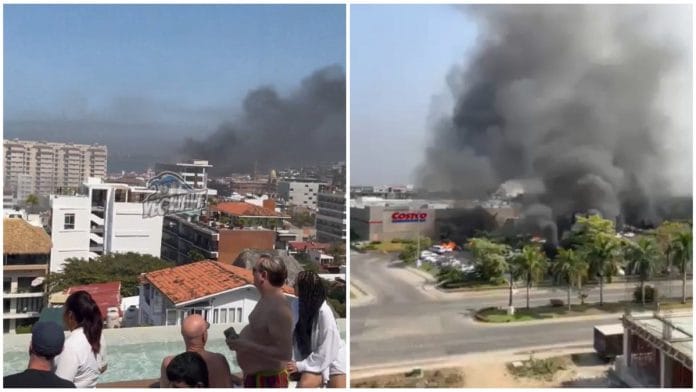



New Delhi: Tourists gather near a rooftop pool, looking out at the azure ocean. Except there is also billowing black smoke and shelter-in-place orders amid violence on the streets. It is among the latest images to emerge from the Mexican resort town of Puerto Vallarta in Jalisco state, which was thrust into chaos after security forces killed most-wanted cartel boss Nemesio Oseguera Cervantes, or ‘El Mencho’, on Sunday.
Reports described Black Hawk helicopters circling as Mexican forces clashed with gunmen of the Jalisco New Generation Cartel, or CJNG, after the operation against El Mencho. Buses and businesses were torched, and more than 250 blockades were reported across 20 states, according to Mexico’s Security Cabinet.
The US State Department has urged Americans to “seek shelter and remain in residences or hotels” and flights have been cancelled.
“Locals and tourists on the ground are calling it ‘under siege’ and ‘the city on fire’,” tweeted journalist Walter Curt on 23 February, sharing videos of smoke rising over the skyline.
🚨UPDATE: Puerto Vallarta is now a WAR-ZONE
Mexican military forces are now in direct, heavy clashes with raging CJNG cartel gunmen across Jalisco following today’s confirmed killing of kingpin El Mencho.
Reports of Blackhawk Helicopters engaging with the cartel, thick black… pic.twitter.com/7J0r07sywV
— Walter Curt (@wcdispatch) February 22, 2026
Mexico’s Defense Ministry confirmed that Oseguera, 59, died from severe injuries sustained during clashes between soldiers and cartel fighters. He was being transported by air to Mexico City after the operation when he succumbed to his wounds.
A $15 million reward had been placed on Oseguera. His cartel was one of the largest and most violent drug trafficking organisations in Mexico, primarily supplying narcotics to the United States. A splinter group and bitter enemy of the Sinaloa Cartel — which featured in the hit OTT series such as El Chapo and Narcos Mexico— CJNG rose to prominence around 2010 under the leadership of El Mencho.
In retaliation for the attack on their leader, cartel members blocked roads and set cars and trucks on fire. They also reportedly firebombed several convenience stores across Mexico following El Mencho’s death. Several videos recorded by residents have been circulating on social media, showing scenes of violence, fires, people running in panic.
🚨NOW IN PUERTO VALLARTA.
Tourist from hotel rooftops watching cartel take the city hostage. Flights have been cancelled. pic.twitter.com/m5OiPdMjso
— Juanita Broaddrick (@atensnut) February 22, 2026
The death of the powerful kingpin is being called the biggest hit to organised crime since the 2016 re-capture of Sinaloa cartel boss Joaquín ‘El Chapo’ Guzmán. However, it seems to have started a brutal vengeance drama in Mexico’s tortuous history with cartels.
“Even as he’s gone, the power vacuum has unleashed renewed waves of violence across Mexico,” said one post on X, which included several photos and videos of the chaos.
Then came Feb. 22, 2026. Mexican security forces killed El Mencho during a military operation in Jalisco.
But far from ending the violence, his death has sparked widespread revenge attacks and chaos in cities like Puerto Vallarta and Guadalajara.
Even as he’s gone, the power… pic.twitter.com/KdeO3MW7QK
— Allen Hampton (@Hamp_Allen) February 23, 2026
Meanwhile, Mexico’s President Claudia Sheinbaum Pardo urged citizens to remain “informed and calm”, writing on X that there was “absolute normality” in most parts of Mexico. Many responded with images of burning buses and buildings.
“How do you stay calm when this is the reality you see?” said one comment.
Also Read: Punjab is caught in a ‘vicious circle’—guns, gangs, lack of jobs & a strained police force
Who was El Mencho?
Born in rural Michoacán, a poppy hub, Oseguera’s path to cartel leadership reflected the cross-border dynamics of modern organised crime. As a teenager, he worked in the fields before crossing the border and going to California, where he got involved in the heroin trade. He was arrested in the 1980s and deported to Mexico.
Once back, he briefly became a policeman before embarking on a ‘career’ as an assassin for the Milenio Cartel, an affiliate of the Sinaloa Cartel. He broke ranks and started CJNG around 15 years ago.
Unlike the flamboyant El Chapo, El Mencho was a shadowy figure, known mostly by leaks of his threat calls and reputation for ordering torture and beheadings of enemies. Both had spectacular escapes in common. If El Chapo tunnelled out of a maximum security prison, El Mencho’s men shot down a military helicopter with a rocket-propelled grenade to help him evade arrest in 2015.
Under his leadership, the organisation became one of the most powerful criminal groups in Mexico and expanded far beyond simple drug trafficking. It was involved in the distribution of fentanyl, methamphetamine, cocaine, and heroin, as well as extortion, human smuggling, and other criminal enterprises.
Due to its location, Mexico has long served as a staging and transshipment point for narcotics moving between Latin America and the United States.
The history of modern drug cartels in Mexico accelerated in the 1980s, when traffickers began moving large quantities of marijuana and cocaine north. One of the first major groups was the Guadalajara Cartel, led by Miguel Ángel Félix Gallardo.
After his arrest in 1989, the cartel fractured into smaller groups, intensifying competition and violence. In the 1990s and early 2000s, rival groups such as the Sinaloa Cartel and the Gulf Cartel expanded and fought bloody battles to control drug routes and shipments.
While the Mexican government launched repeated military campaigns against the cartels, the violence kept resurfacing and the cartels mutating into new groups.
Kingpins such as El Mencho were also often seen as Robinhood-style heroes, according to organised crime expert Edgardo Buscaglia, speaking to Reuters. He said CJNG gunmen even handed out relief packages during Covid and that the group enjoyed political patronage.
“El Mencho’s Jalisco New Generation Cartel was one of the biggest buyers of politicians and political campaigns, which has given it an enormous social base,” he told Reuters.
Also Read: The story of Bihar’s two mafias—sand and booze
What next?
The US State Department issued a shelter-in-place advisory for citizens in Jalisco, Tamaulipas, Michoacán, Guerrero, and Nuevo León. The Embassy of India in Mexico advised Indian nationals in affected regions, including Puerto Vallarta, Chapala, and Guadalajara, to remain indoors, avoid crowds, and monitor official updates.
Security analysts have long pointed out that removing a cartel boss does not end the organisation. Past experience shows that power vacuums can trigger internal battles or splinter factions, potentially intensifying violence.
Under Sheinbaum, Mexico has launched its most aggressive crackdown on cartels in more than a decade. Oseguera’s death, reported the New York Times, could ease pressure from US President Donald Trump, who has threatened strikes inside Mexico on account of its drug cartels. The violence that followed, however, raises questions about what comes next and whether CJNG has a clear successor. If not, his death could trigger fragmentation and fresh bloodshed, NYT added, citing Vanda Felbab-Brown, an expert on non-state armed groups at the Brookings Institution.
People living in cartel-controlled areas are often subjected to murder, extortion, and forced payments demanded from local businesses and residents. At the same time, in poorer or isolated regions, some communities tolerate or rely on cartels for jobs or financial support.
Schools and banks remain closed in parts of Jalisco, including Guadalajara, and concerns are mounting over whether Mexico will still host its scheduled FIFA World Cup matches in June.
Residents are still asking for more details about the operation and its aftermath, with some criticising the lack of specifics in Sheinbaum’s post.
“It downplays what is happening with the retaliatory attacks in response to the operation in different states of the country,” said a post on X.
(Edited by Asavari Singh)