





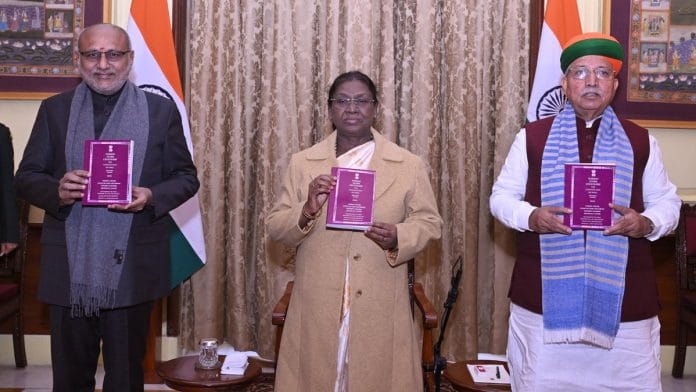



New Delhi: When President Droupadi Murmu released the Constitution of India in the Santali language at Rashtrapati Bhavan on Thursday, she called it a moment of “pride and joy” for the Santal community. It was the first time that the country’s founding document was formally made available in the language using the Ol Chiki script.
In her speech, Murmu spoke about the importance of Santali and said the publication would help the Santal community read and understand the Constitution. The tribal language—spoken primarily in Jharkhand, Odisha, West Bengal, and Bihar—was included in the Eighth Schedule of the Constitution through the 92nd Amendment Act in 2003.
However, the publication, prepared by the Central Institute of Indian Languages, came years after Sripati Tudu, a Santali academic, had already translated the Constitution on his own in Ol Chiki.
“This was my individual work, there was no government involved,” he said.
Also Read: This Pakistani professor is reviving Sanskrit in a Lahore university. ‘This is shared heritage’
Old language, young script
Spoken by more than six million people across South Asia, Santali belongs to the Munda branch of the Austroasiatic language family, one of the oldest in the world.
For a long time, Santali did not have a script of its own. Its literature and folklore were all written in Bengali, Devanagari, or Roman scripts. Among Santali scholars, this dependence was widely seen as a barrier to the development and utilisation of the language.
A turning point came in 1925 when Pandit Raghunath Murmu, a schoolteacher from Mayurbhanj in present-day Odisha, created the Ol Chiki script. Murmu argued that the rich cultural heritage and tradition of Santals could only be preserved if the language had its own writing system. He wrote more than 150 works, including grammar books, plays, poetry, and novels. In his play Bidu Chandan, he gave Ol Chiki a divine origin story, writing that the god Chandan came to Earth in human form and bestowed the script on people.
The Ol Chiki script is written from left to right, with letters kept separate rather than joined. Each letter has been designed to match the natural sounds of the Santali language. The script has 30 basic letters, divided into six vowels and 24 consonants. Unlike Devanagari, vowels are written independently and not as diacritical marks such as the ‘chandrabindu’.
Also Read: Half of urban Indian mothers love being ‘supermom’, says study
The fight for an official Ol Chiki translation
Years before the Central Institute of Indian Languages (CIIL) began translating the Constitution into Ol Chiki, a Santali scholar had already completed the work in 2021.
Sripati Tudu, an assistant professor of Santali language in Bengal’s Purulia, had long dreamed of translating the Constitution into Ol Chiki. Like many others in the community, he spoke Santali at home but was educated largely in Bangla. It was only in Class 10 that he started studying the language and went on to get a master’s and PhD in it.
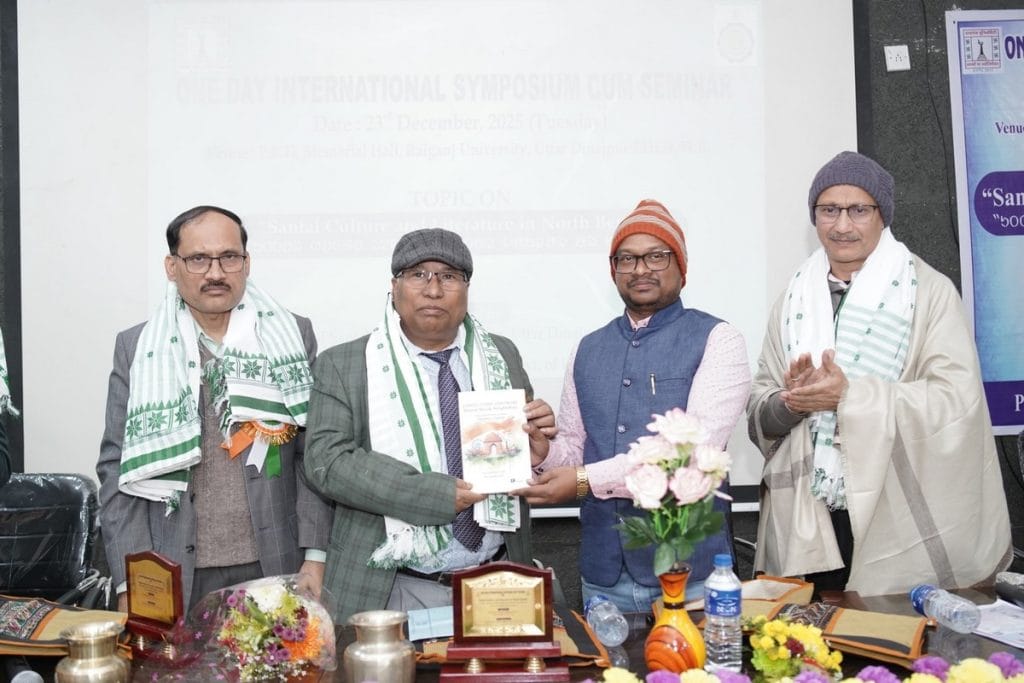
“Until 2000, I noticed the Constitution of India was not available in the Santali language. I wanted to make it accessible to the Santals,” Tudu told ThePrint over the phone.
Before beginning the translation, Tudu read the Constitution in Bengali, Devanagari, and English to understand it fully. He worked on the Santali version during the Covid-19 lockdown and published it in 2021.
Tudu sent copies of his translation to several government offices, and in 2022 his work was mentioned in the 89th episode of Mann ki Baat by Prime Minister Narendra Modi.
But when the CIIL took up the official translation the following year, Tudu was not included in the team. What’s more, the translation was in Devanagari rather than Ol Chiki.
“It made professors and academicians, who have been working on the Santali language, angry,” Tudu said.
Letters of protest were written, after which CIIL said the Constitution would be published in both scripts.
“For us Santals, when we go out we have to use another language. When kids go to school, they face problems. I faced a lot of problems as a child,” Tudu said. “Our culture is associated with our language. That is our identity, and it needs to be developed.”
(Edited by Asavari Singh)