





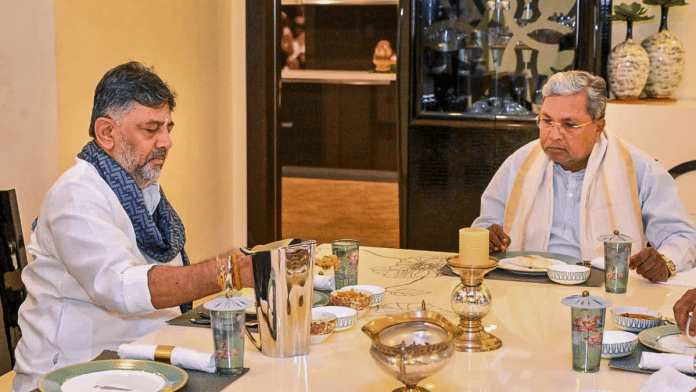



New Delhi: Nati Koli Saaru — the traditional country chicken curry from Karnataka — is suddenly in the spotlight after it was served at Karnataka’s Deputy Chief Minister DK Shivakumar’s residence during a breakfast meeting with Chief Minister Siddaramaiah.
After friction within the Congress party in Karnataka, senior leadership encouraged the two leaders to step into the public eye together in a show of solidarity. Initially, Shivakumar had visited Siddaramaiah’s residence Saturday for the first round of discussions over breakfast. On Tuesday, it was Shivakumar’s turn to host the chief minister.
The centrepiece of the breakfast spread — Idlis, Vada and Pongal — was Nati Koli Saaru, which has its roots in old Mysuru. Country chicken was commonly reared in rural households of Karnataka, where it was cooked on special occasions like harvests and festivals.
After the meeting, Siddaramaiah told journalists that the deputy CM had extended the invitation when he dropped by the chief minister’s residence on Saturday. When asked how the two meals differed, he said, “His house was non-veg, while at my house it was veg.”
Also read: Who is Major Mohit Sharma? Dhurandhar director clarifies film is not based on him
Gained popularity in Bengaluru
The chicken meat in Nati Koli Saaru differs from the commonly used broiler chicken (raised specifically for meat production), mostly found in other meat dishes. Rural families developed their own methods, which included slow-cooking the meat with roasted spices and coconut-based masalas to tenderise and flavour it.
And unlike North Indian chicken cuisines that have thick curries, the saaru resembles more of a thin broth, which is meant to be eaten with rice or ragi mudde—lumps of finger millet.
In the early 1900s, the dish gained popularity at the military hotels of Bengaluru and Mysuru. The hotels had come up to serve non-vegetarian dishes to soldiers, police, labourers and traders.
The dish was relatively inexpensive and packed a high-value serving of protein and spicy flavours.
The military hotels helped popularise the dish in urban areas. And over time, as the dish evolved, different regions of Karnataka came up with their own variations.
In Ramanagara, the dish took on a spicier flavour with thinner broth, while in Chikkamagaluru, the dish was being served with more coconut and roasted masala. The military hotels served theirs with biryani.
Hybrid versions are also found in parts of the Andhra Pradesh-Karnataka border, where less coconut and more chilli are used. But the use of country chicken is common across all variants of the dish.
But the very fact that the breakfast menu made it into news reports shows how the dish has become a symbol of both cultural identity and rural rootedness — a reminder that political differences can soften over a meal that carries shared nostalgia.
(Edited by Saptak Datta)