





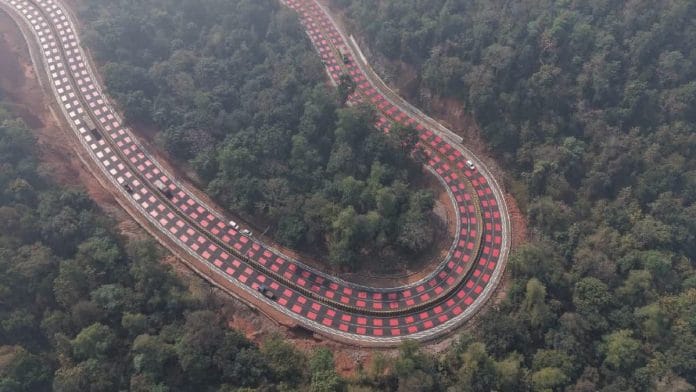



New Delhi: A chequered highway has come up in Madhya Pradesh, designed to improve connectivity and protect wildlife in the surrounding forests. The 11.96-km Hiran-Sindoor section of National Highway 45 between Bhopal and Jabalpur passes through the Nauradehi Wildlife Sanctuary and the Veerangana Durgavati Tiger Reserve.
According to reports, the National Highways Authority of India has constructed 25 underpasses along this stretch to help animals move safely under the road with minimal disturbance to their habitat. However, despite an eight-foot-high iron fence on both sides, some spots on the highway reportedly remain accident-prone.
The red table-top markings on the road are meant to warn drivers that they are entering a wildlife-heavy zone, encouraging them to slow down. These markings are raised slightly, giving the road an uneven texture that forces vehicles to reduce speed. Red was chosen over yellow or white because it attracts more attention due to its longer wavelength. Almost the entire 12-km stretch is covered with these red chequered patterns.
Collision-related deaths
Animals such as deer, jackals, sambar and tigers frequent the roads in the area. The table-top markings and underpasses are part of NHAI’s Green Highways initiative under the 2015 Green Highways Policy of the Ministry of Road Transport and Highways.
Even though comprehensive data on animal-vehicle collisions is limited, available numbers point to the need for such measures. In Punjab, direct collisions with animals account for 53 per cent of all fatalities linked to animal-vehicle collisions. In Madhya Pradesh, there have been 237 such collisions and 94 deaths over the past two years.
The official project report also notes that the upgraded highway is expected to boost tourism and revenue after reclassifying the surrounding wildlife zones.
Also read: Why Trump is going after Indian rice and what the fallout could be
Page out of global playbook
While new in India, this approach follows global examples of wildlife-friendly road design. In Canada’s Banff National Park, the four-laning of the Trans-Canada Highway included fencing on both sides and dedicated wildlife underpasses and overpasses to reduce collisions and maintain habitat connectivity.
The Netherlands has taken a similar approach and now has more than 600 wildlife crossings, known as “ecoducts,” including the Natuurbrug Zanderij Crailoo, which is 800 metres long and 50 metres wide.
(Edited by Ratan Priya)