





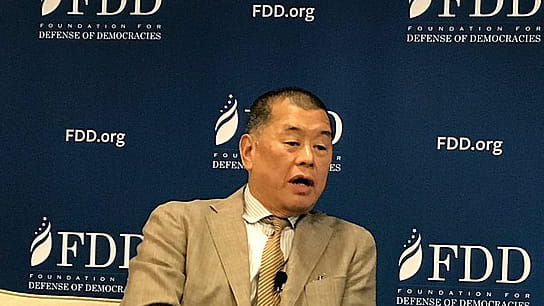



New Delhi: Jimmy Lai, the media tycoon and pro-democracy campaigner from Hong Kong, faces the possibility of spending the rest of his life in prison. On Monday morning, Hong Kong’s High Court found Lai guilty on two national security charges and a lesser sedition charge in a landmark trial that lasted 156 days.
The court ruled that he conspired to publish seditious materials and colluded with foreign forces. Under Hong Kong’s National Security Law (NSL) and the newer Safeguarding National Security Ordinance (SNSO), serious offences like treason, insurrection, and serious acts of sabotage or terrorism can carry penalties of life imprisonment.
Lai, 78, is an open critic of the Chinese Communist Party and was first arrested on 10 August 2020. In May 2021, he was convicted of unlawful assembly over the protests in 2019 and was sentenced to 20 months in prison. A few months later, in December 2021, he was sentenced to 13 months over the banned Tiananmen Vigil. Then in December 2022, he was sentenced to five years and nine months in the Next Media fraud case, and also fined US $257,000. His supporters say the fraud allegations were trumped up.
During his trial, prosecutors said Lai used his media empire to run a long-term campaign against China and undermine national sovereignty. They cited 161 publications, including articles, opinion columns, interviews, and also text messages and livestreams. Lai admitted he once supported foreign sanctions against China but argued he stopped after the law came into effect and denied any seditious intent.
Rise and fall
It won’t be wrong to call Lai one of the most polarising figures in modern Hong Kong. To his supporters, he is a symbol of resistance and press freedom. His story of ‘rags to riches’ is inspiring to a lot.
Born in mainland China, he fled to Hong Kong, then a British colony, at the age of 12, arriving as a stowaway on a fishing boat. He worked as a child labourer in a glove factory. Over time, he climbed the ranks of the garment industry and went on to found the popular clothing brand Giordano in 1981.
A turning point came in 1989, after China’s violent crackdown on pro-democracy protests at Tiananmen Square where Chinese troops massacred student protesters. Lai, who was affected by this deeply, openly supported the student movement and began to see the media as a tool to challenge authoritarian power.
In March 1990, he launched Next Magazine, and then in June 1995, Apple Daily, a tabloid-style newspaper that mixed sensational reporting with hard-hitting investigations and strong pro-democracy views.
Apple Daily grew to be one of Hong Kong’s most widely read papers. It was openly critical of both the Hong Kong government and the Chinese Communist Party. That made Lai a hero among democracy supporters and, as one would expect, a target for Beijing.
In 1994, Lai publicly insulted then-Chinese Premier Li Peng, famously calling him “a bastard with zero IQ”, drawing political and financial retribution from the Chinese state, which forced him to sell his stake in Giordano.
Over the years, Lai moved beyond publishing. He donated to pro-democracy parties, organised private meetings for lawmakers and activists, and joined mass protests, including the 2014 Umbrella Movement.
Also read: What will change if Trump allows reclassification of marijuana? It still won’t be legal
‘Sham conviction’
In 2019, during widespread anti-government protests, Lai was again on the streets. He also met senior US officials, including then-Vice President Mike Pence and Secretary of State Mike Pompeo.
China responded with a sweeping national security law imposed on Hong Kong in 2020. As the law loomed, Apple Daily urged readers to petition US President Donald Trump, during his first term, to “save Hong Kong”. Prosecutors later argued this was evidence of foreign collusion.
Lai’s arrest in August 2020 was followed by hundreds of police personnel raiding Apple Daily’s newsroom. The arrests of senior editors and the freezing of the company’s assets forced the newspaper to shut down in 2021. Its closure sent shockwaves through Hong Kong and was widely seen as a major blow to press freedom in the city.
Lai has pleaded not guilty to the charges, telling the court he never tried to influence foreign policy or ask foreign officials to take concrete action on Hong Kong and that Apple Daily represented Hongkongers’ core values such as “freedom, pursuit of democracy, freedom of speech”.
The court rejected his defence. In an 855-page judgment, judges said Lai’s hostility toward the Chinese state spanned decades and continued even after the national security law was enacted. The verdict described his actions as “deliberate and persistent”.
Judge Esther Toh, reading from the verdict, said, “There is no doubt that (Lai) had harbored his resentment and hatred of the PRC for many of his adult years,”
Lai, who suffers from health issues, including diabetes, high blood pressure, and heart palpitations, has served 1,800 days in solitary confinement. Following Monday’s verdict, the possibility of a life sentence looms heavy, disheartening his supporters.
The Committee to Protect Journalists called it a “sham conviction” and Amnesty International said the verdicts’ predictability didn’t make it “any less dismaying”. Human Rights Watch termed the conviction cruel and a travesty of justice.
Jimmy Lai’s case has become a symbol of Hong Kong’s transformation. Once a global hub of free speech and independent media, the city now operates under strict political control. For his supporters, Lai is paying the price for standing up to power. For Beijing, his conviction is proof that no one is above the law.
As the court prepares to decide his final sentence, the world is watching. Because it is no longer just about one man. It is about the future of dissent, journalism, and freedom in Hong Kong.
(Edited by Aamaan Alam Khan)