








New Delhi: Nearly four decades after the ‘tanker war’ pitted Iraq, the US and its allies against Tehran, Iran’s blockade of the Strait of Hormuz has once again reiterated the strategic significance of this critical passageway that opens up the oil-rich Persian Gulf to the rest of the world. Tehran, which sees all within 12 nautical miles of its shoreline as Iranian waters, has threatened to sink ‘enemy-linked’ vessels transiting the strait.
With talks of a ceasefire having come to naught, and hundreds of vessels stranded on both sides of the Strait of Hormuz, ThePrint explains how Iran weaponised the strait and why the US and NATO allies are reluctant to send in naval escorts to the region.
The importance of the Strait of Hormuz is rooted, above all, in geography.
Over one-fifth of global oil and LNG exports transit the strait, enabling Saudi Arabia, the UAE, Qatar, Kuwait, Iraq, Bahrain and Iran to export crude and natural gas.
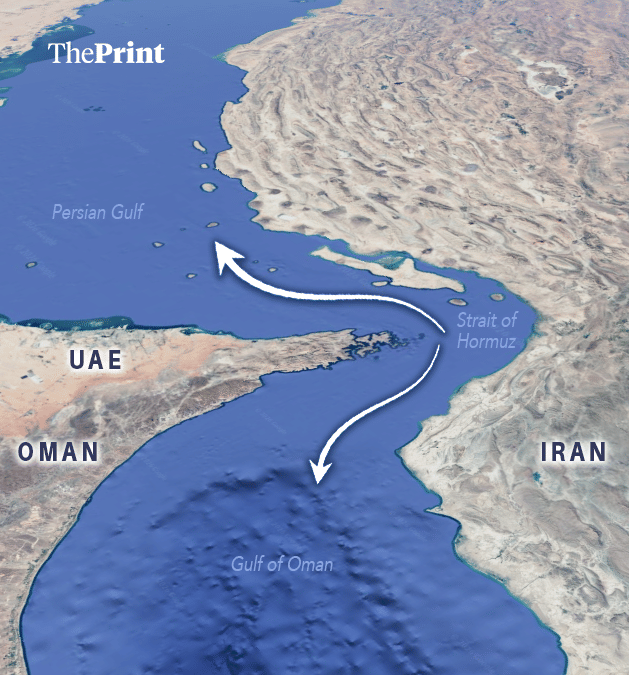
In 2024, oil flow through the strait averaged 20 million barrels per day. China, India, Japan and South Korea together accounted for 69 percent of the crude and condensate flows.
Also Read: Trump dials Modi amid talks with Iran. Importance of keeping Hormuz open discussed
Defender’s advantage to Iran
The choke point has been weaponised for over 500 years now, starting with the Portuguese capture of the island of Hormuz in 1507. There was also the British blockade in 1951 and of course the 1980s ‘tanker war’. Though only 33 km wide and 200 feet deep at its narrowest point, the Strait of Hormuz can accommodate even the world’s largest crude oil tankers.
Here’s where it gets tricky.
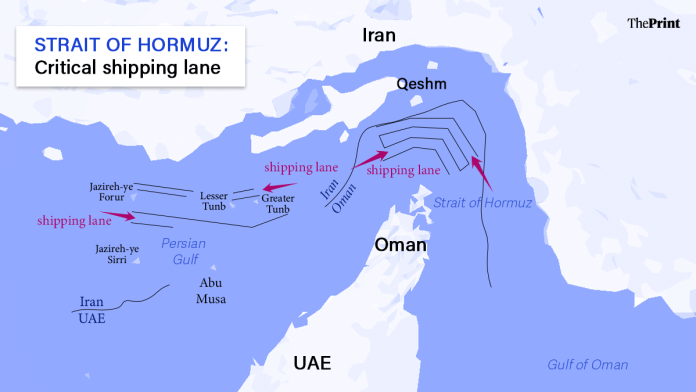
Shipping traffic goes through much narrower inbound and outbound channels, each 3 km wide, with a lane separator between them. Still, any transiting vessel cannot pass through the Strait of Hormuz without coming within miles of Iranian waters.
A critical Iranian bulwark standing in the way of any vessel transiting the Strait of Hormuz is Qeshm island. A popular tourist destination owing to its salt caves and mangrove forests, decades of tensions in the region have earned it the reputation of being an ‘unsinkable aircraft carrier’. The island, spanning 1,445 sq km, anchors Iran’s asymmetric naval power.
Besides Qeshm, Iran has also established significant military presence and infrastructure on three smaller islands: Abu Musa, Greater Tumb and Lesser Tumb.
US and Israeli strikes against the first two, which also host airfields, were confirmed by the Institute for the Study of War (ISW).
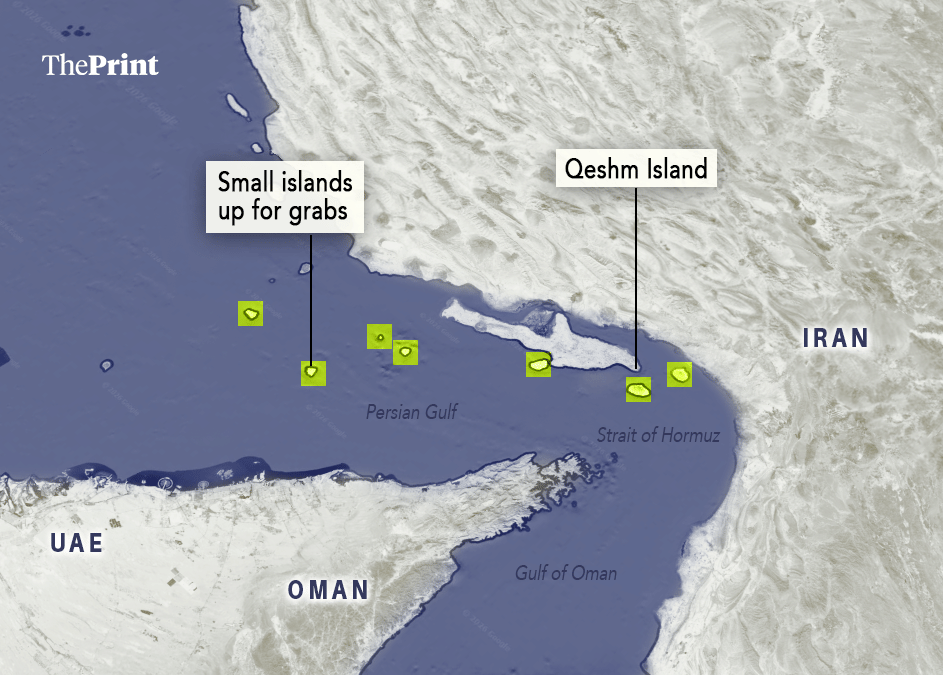
Behind the coastline, as one heads towards the Iranian mainland, stand the Zagros mountains, which provide natural cover for Iran’s anti-ship cruise missile batteries, drone launching sites and underground arsenals.
The possibility of drifting and moored contact mines, coupled with smaller Iranian vessels that can be used to sow mines or attack larger vessels, makes the Strait of Hormuz a perfect staging ground for guerilla tactics—providing Iran with the defender’s advantage.
On the other side of the passageway is Musandam Peninsula, a rocky extension of the Arabian Peninsula controlled by Oman. Its deeply cut coastline, which makes it home to the world’s only desert fjords, is a sight that encounters every sailor passing through the strait. But its strategic importance is undermined by Iranian build-up on the other side.
The chokehold
According to an estimate by BBC Verify, fewer than 100 ships have been able to transit the strait since the beginning of March when the US and Israel launched the first wave of strikes inside Iran, killing the Supreme Leader Ayatollah Ali Khamenei.
Last week, US President Donald Trump called on NATO allies to commit to naval escorts for ships transiting the Strait of Hormuz, even referring to them as “cowards” on account of initial reluctance. On Sunday, NATO Secretary-General Mark Rutte said NATO countries are “coming together” to secure the strait with the UK leading a multinational effort.
But loosening Iran’s chokehold on the strait is easier said than done for two reasons.
One, even the remotest possibility of Iranian sea mines in the Strait of Hormuz will deter private insurers from securing vessels headed to the region. This was evident even during the ‘tanker war’ of the 1980s when the US had to launch Operation ‘Earnest Will’ to escort Kuwaiti ships passing through the strait.
One notable incident from this time involved a crude oil tanker.
Bridgeton, the crude oil tanker, entered the Gulf of Oman and set course for Kuwait. It wasn’t a routine transit. Flanking the vessel were two American destroyers, two frigates and two Coast Guard cutters. Their job was to ensure Bridgeton and LPG tanker Gas Prince transit the Strait of Hormuz. The route was riddled with at least 60 sea mines sown by Iran. By this time, five other tankers had already been struck by mines off the coast of Kuwait.
On 24 July 1987, two days after it commenced its journey through the Persian Gulf, Bridgeton struck a moored mine. It suffered damage to its two forward cargo tanks but continued along its course, acting as a ‘minesweeper’ for the American ships escorting it to its destination.
The second reason is that the geographical advantage on the side of Iran allows it to conceal its missile batteries and drone-launching sites from air power that has given the US, Israel and their allies an edge in conflicts over the years. With Zagros mountains as cover, Iran can target or at the very least threaten all commercial shipping transiting the Strait of Hormuz.
The solution, in theory, is to deploy mine-detection vessels to clear a path.
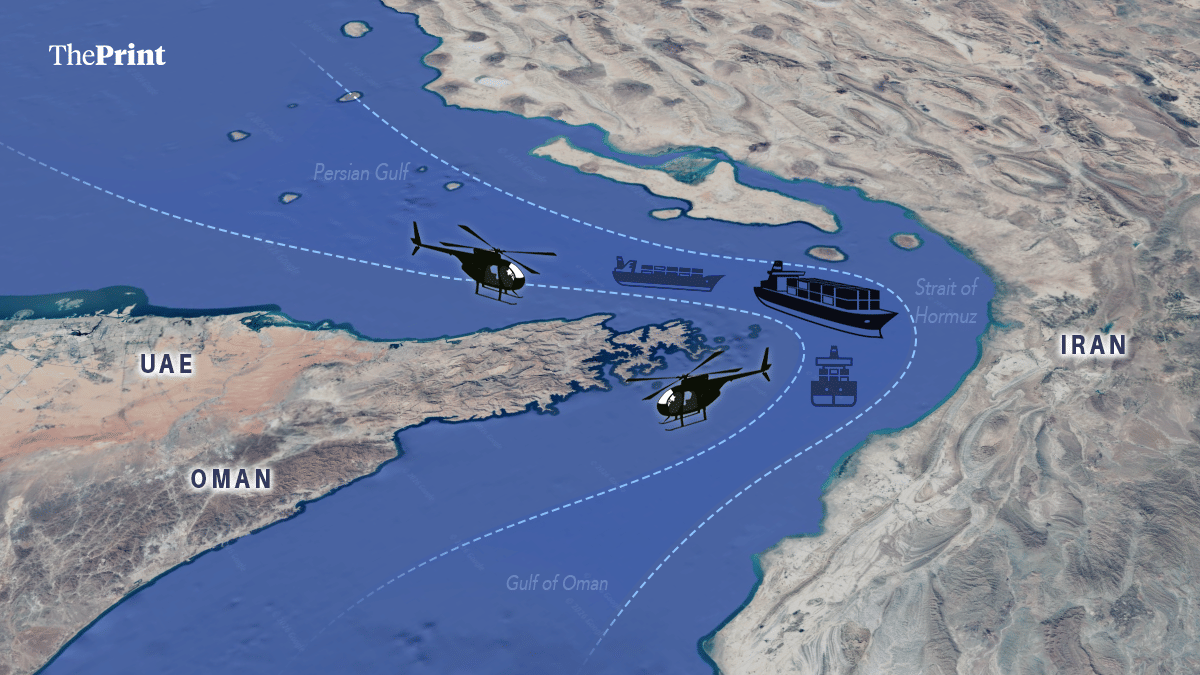
This sea route can then be used for transit, though not without warships to flank tankers and aerial support to counter drones and ballistic missiles.
Also Read: Two Indian LPG tankers exit Hormuz choke point, 20 vessels remain stuck