





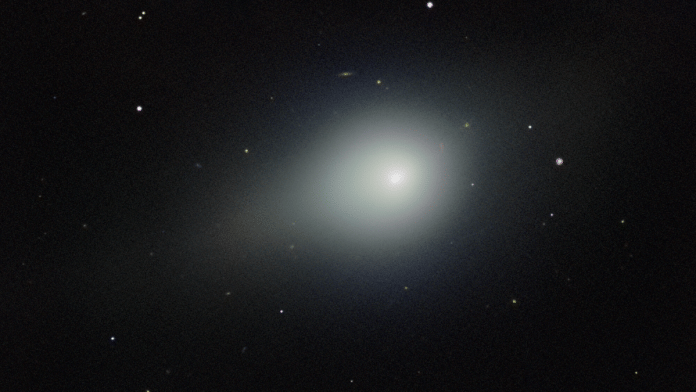



New Delhi: The comet 3I/ATLAS, first discovered in 2025 by the Asteroid Terrestrial-impact Last Alert System telescope in Chile, which sparked multiple conspiracies and curiosities, may be older than the solar system.
3I/ATLAS quickly garnered the attention of astronomers because of its unusual characteristics. It exhibited a non-gravitational acceleration, a strong anti-tail (a visual spike extending towards the Sun, appearing opposite the main dust and gas tails), unique chemical composition, and an unexpected size and brightness on an odd hyperbolic trajectory. The initial observations immediately pointed towards its origins being in another star system. An interstellar object is a celestial body that is from outside our solar system and travels through space.
Unlike the celestial bodies of our own solar system, which have a common origin and similar components, interstellar objects have a distinct chemistry and carry clues about the building blocks of the universe from far beyond the reach of direct observance and aid in the understanding of the home environment of these comets and the origins of the universe in general.
Latest findings, however, suggest that the comet is not just older than the Sun but is also possibly the oldest interstellar object observed so far.
A research team led by Michele Bannister, associate professor at the University of Canterbury, studying the observational characteristics and theoretical aspects of 3I/ATLAS in partnership with the University of Oxford, had estimated the age of the comet as being anywhere between 8 and 14 billion years. Our solar system, however, has existed for some 4.6 billion years, making 3I/ATLAS not only older than our solar system but possibly the oldest of the three interstellar objects discovered.
The findings published in Monthly Notices of the Royal Astronomical Society: Letters and The Astrophysical Journal Letters, and in Astronomy and Astrophysics, regarding the age of the comet challenge previous ideas about interstellar objects, and offer a rare glimpse of primordial matter. Each new measurement may give new information about the conditions of the universe before our solar system existed.
What makes 31/ATLAS so unique?
When the comet was first discovered in July 2025, it was described as having a “teardrop-shaped cocoon of dust coming off its solid, icy nucleus.” It was formerly known as C/2025 N1 (ATLAS).
The comet is named 3I as it is the third interstellar object to be discovered so far, the first two being Oumuamua (2017) and 2I/Borisov (2019), and the NASA-funded ATLAS telescope in Rio Hurtado, which first reported the observation.
On 19 December, it was 270 million km from Earth, the closest it will get to the planet in its voyage through the solar system. Scientists took the rare opportunity to observe the comet closely. A research team affiliated with Breakthrough Listen, an extraterrestrial signal hunting project at Oxford University, used the 100 m Robert C. Byrd Green Bank Telescope (GBT) to look for ‘technosignatures’ sent via narrowband radio signals towards the comet and with four radio receivers of the GBT tuned between 1-12 gigahertz. The team studied the radio waves that bounced back and found no evidence of extraterrestrial technology, c
Speaking to space.com, lead researcher studying the comet at the University of California, Berkeley, Benjamin Jacobson-Bell said, “Past work has shown that 3I/ATLAS looks like a comet and behaves like a comet, and our observations show that, like a comet, 3I/ATLAS is not a source of technological signals. In the end, there were no surprises.”
While the scientific community has always maintained that is simply an interstellar comet, 3I/ATLAS continues to fascinate both the scientists and ‘ET’ theorists alike, recently the US’s Central Intelligence Agency (CIA) in response to a Freedom of Information Act request for reports and assessments of the comet said they can “neither deny nor confirm the existence or nonexistence of such records”.
Responding to the CIA allegedly classifying information about the comet, Frank B Baird Jr Professor of Science at Harvard University, Avi Loeb in his blog on 3I/ATLAS said, “That this information is treated as sensitive enough to be classified by the CIA is surprising, given that NASA officials stated decisively at a press conference on November 19, 2025, that 3I/ATLAS is definitely a comet of natural origin.”
With the comet on a hyperbolic trajectory, according to astronomers, it is now on its way out of our solar system. Its next celestial encounter will be in March 2026, when it will fly by Jupiter at a distance of about 53.6 billion km, giving scientists limited time to study and observe the interstellar object.
(Edited by Insha Jalil Waziri)