





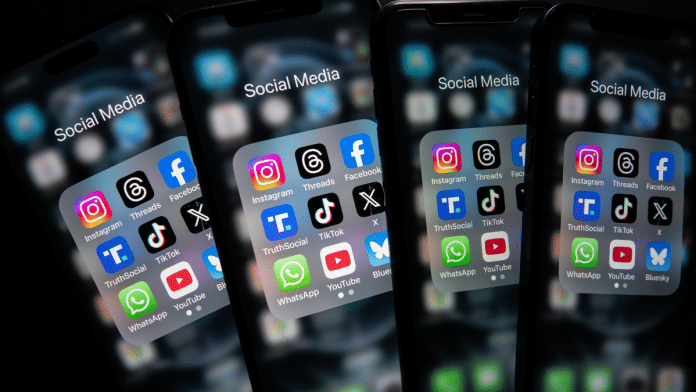



New Delhi: Australia has banned social media for children under 16 years old starting today. They won’t be able to freely access apps such as TikTok, YouTube, Instagram and Facebook. Children between 14 and 16 will be allowed access only with the verified parental consent. The controversial Online Safety Amendment (Social Media Minimum Age) Act was passed following months of debate and a government-commissioned inquiry that warned of the growing mental health risks children face online.
The ten biggest platforms were ordered to block children from midnight of Tuesday or face a fine up to AUD 49.5 million ($33 million) under the new law.
This law was welcomed by parents and lawyers.
It began after the Anthony Albanese government appointed former High Court judge Victoria Laing to examine the effects of social media on children and young people. She submitted the reports earlier this year that said that platforms expose children to violent, sexual and highly manipulative content that they are “not developmentally equipped to process”.
She argued that social media platforms can’t be trusted to regulate themselves. She recommended that the Australian government adopt a legally enforced age threshold, backed by mandatory verification technology.
The government agreed, saying that the current ecosystem is too dangerous for children to navigate alone.
Also read: Perfect reels, real problems: Teens, online mirage & ‘learning to play the game’ at Jindal Lit Fest
New setup
Under the new framework, social media platforms will have to verify the user’s age through a government approved process before they create their accounts. Children who are under 14 would be entirely blocked and those above 14, will need parental consent documentation.
The Australian government is testing many tools for the same such as AI-based age estimation systems and third party verification services. They will check identification documents without storing them permanently. Although, experts say any mass verification mechanism carries risks of data breaches, misuse and mission creep.
Terry Flew, co-director of the Sydney Centre for Algorithmic Transparency, Governance and Society, told The Guardian that “the era of viewing social media as a space for unrestricted self-expression is likely concluding”.
He argued that if platforms had enforced safety measures such as age 13 limits from the beginning, they would not have been able to grow as rapidly or as unchecked as they did.
Those who support the ban say that the harm that comes for social media has become too severe to ignore.
Australia has been witnessing a rise in the cases of anxiety. depression and self harm among adolescents. Parents and mental health advocates are blaming algorithm-driven feeds for exposing children to harmful trends and unrealistic comparisons.
There have been cases of cyberbullying, grooming and the circulation of explicit material involving minors. Pro-ban campaigners say these problems are escalating faster than regulators can respond, making age gating an urgent necessity. Such cases were flagged by the eSafety Commissioner—an independent agency of the Australian government responsible for the regulation of online safety— which already has the power to fine tech companies for failing to remove violent or abusive content.
But even those who are pro-ban are not convinced of the government’s ability to enforce it.
“The government’s social media ban for children under 16 is defensible… [but] there are certainly going to be problems with implementing the ban effectively, and it is concerning that the government seems to be ramming the legislation through without proper community feedback; as a result there are real concerns about the effectiveness of this move,” said Tauel Harper, Associate Professor of Communication, Murdoch University.
Australia’s plan is being closely watched because it could set a global template. Many other countries—the United States, the United Kingdom, France, Spain, South Korea and New Zealand—have been mulling over similar ideas. If Australia succeeds in implementing this system, it will trigger a wave of legislation elsewhere that will reshape how teenagers interact with digital platforms.
(Edited by Theres Sudeep)