





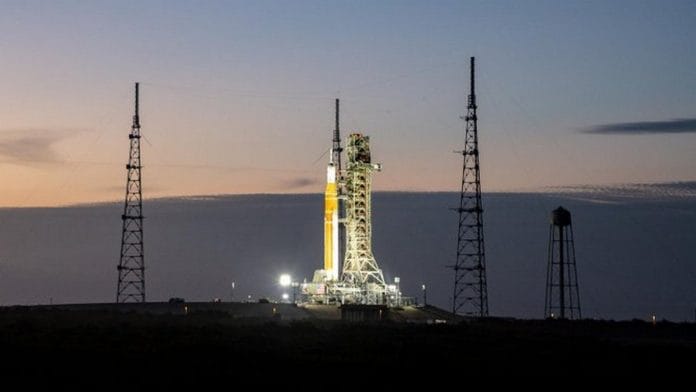



Hyderabad: The launch of NASA’s Artemis II crewed Moon mission has been pushed to next month after engineers flagged a liquid hydrogen leak during the ‘wet dress rehearsal’—the prelaunch fuel test—conducted Tuesday. The US space agency also found that a valve associated with the Orion crew module hatch pressurisation required retorquing.
Artemis II will send astronauts roughly 40,000 miles past the moon aboard the Orion spacecraft. This would be farther than any humans have travelled in space before returning to Earth. Initially scheduled for an early February launch, NASA is now considering an early March window for the 10-day round trip.
NASA astronauts Reid Wiseman, Victor Glover, and Christina Koch, along with Canadian Space Agency astronaut Jeremy Hansen, had entered quarantine in Houston on 21 January to prepare for the mission. The crew is set to re-enter quarantine roughly two weeks before the next planned launch window.
“The launch control team is working to ensure the SLS rocket is in a safe configuration and begin draining its tanks,” NASA said in a press release.
Artemis II Wet Dress Rehearsal: Test terminated at T-5:15.
The launch control team is working to ensure the SLS rocket is in a safe configuration and begin draining its tanks.
Learn more: https://t.co/50EqqAAklA
— NASA's Kennedy Space Center (@NASAKennedy) February 3, 2026
Artemis II follows NASA’s uncrewed Artemis I flight in 2022 and will test important systems needed for future deep-space missions. It will also be the first time astronauts fly on both the heavy-lift Space Launch System (SLS) rocket and the Orion spacecraft. Orion will serve as the crew vehicle, carrying astronauts on a flyby of the Moon—it will not land—and back to Earth.
Tuesday morning’s rehearsal acted as a full-scale simulation of launch day operations. It gave mission managers a chance to evaluate overall readiness. Engineers at Kennedy Space Center in Florida have also been troubleshooting dropouts in audio communication channels and camera equipment across ground teams in recent weeks.
“With March as the potential launch window, teams will fully review data from the test, mitigate each issue, and return to testing ahead of setting an official target launch date” said a press release from NASA.
Also Read: What medieval Marathi poetry reveals about India’s vulnerable grasslands
Moon to Mars
Artemis is designed to use experience from working on the Moon to hone technologies, streamline operations, and inform the policies needed for Mars exploration by 2030.
The mission is meant to provide hands-on experience in space that Earth-based simulations and test setups cannot fully replicate.
Key technologies and systems around Mars human travel are being tested out through the Artemis mission.
To further human space travel, NASA’s Human Research Program (HRP) is prioritising research on hazards to crews during spaceflight. It is targeting five main concerns: radiation, psychological and physical strain from isolation, operating far from Earth without quick help, the effects of low gravity, and the challenges of living in tightly sealed spacecraft and habitats.
Also Read: India launched 393 foreign satellites, earned $143 million in 10 years, says Economic Survey
What are the challenges?
NASA has encountered cost and technical hurdles in advancing the Artemis programme for years.
“Development of the systems required to transport humans to the Moon and Mars safely has proven to be especially challenging due to increased costs stemming from significant technical issues, changing requirements, and overly optimistic schedules,” stated a January 2024 report from NASA’s Inspector General’s office titled ‘Key Challenges Facing NASA’s Artemis Campaign’.
The Orion spacecraft has cost about $9.3 billion so far, from 2012 through 2025. The SLS and Orion operations are expensive to fly, with early Artemis missions costing at least $4.2 billion per launch, not counting roughly $42 billion already spent on bringing the system to the launch pad.
For Artemis III, which will be the first Moon landing since 1972, NASA’s partner SpaceX must complete multiple tests and launches of its lunar lander (HLS Starship), including building a fuel depot in orbit and flying an uncrewed landing and return before astronauts can use it. NASA also needs to finish next-generation spacesuits. These development hurdles have contributed to delaying Artemis III to September 2026.
“Going forward, NASA is planning for at least 10 Moon landings in the future, and the agency needs significant increases in funding for future lander competition,” said NASA Administrator Bill Nelson.
To control costs and improve efficiency, the agency is seeking industry input to streamline the SLS enterprise and asking partners to help build spacesuits and spacewalk services for the Artemis programme and the International Space Station.
(Edited by Asavari Singh)