





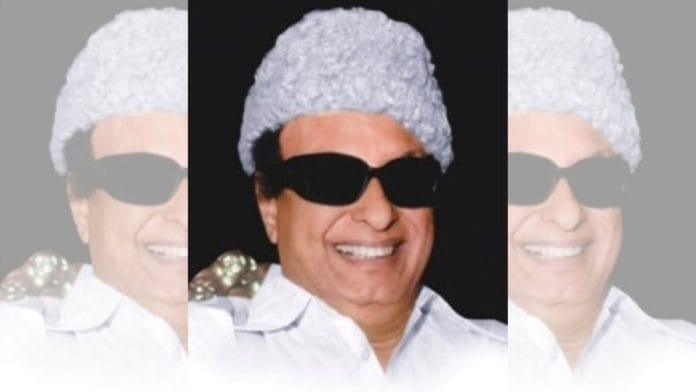



Maruthur Gopalan Ramachandran’s legacy is still being invoked today — nearly 40 years after he died — in campaign speeches and rallies by Tamil Nadu’s regional parties. Popularly known as MGR, the former actor, chief minister, and founder of the All India Anna Dravida Munnetra Kazhagam, or AIADMK, redefined the relationship between cinema, people, and politics.
“As long as he [MGR] was alive, no one could even think about the chief minister’s seat, they couldn’t even dream of it,” said actor Joseph Vijay Chandrasekhar (known as Vijay) in August 2025, at the second state-level conference of Tamilaga Vettri Kazhagam (TVK), the political party he founded in 2024. “He made his political opponents beg before the people for his seat.”
The crowd’s roar rose sharply as soon as Vijay mentioned MGR. Thousands waved red and yellow TVK flags furiously, as if the name itself demanded an acknowledgement. Across the political spectrum — DMK, AIADMK and the newly formed TVK — MGR’s political legacy is untouchable.
According to R Kannan’s book MGR: A Life, offerings to temples went up by 40 per cent when the leader fell ill in June 1985. Two years later, when MGR died, chants of ‘MGR vazhga (long live MGR)’ filled the air as crowds formed a seven-kilometre-long cortège.
“No actor or individual had ever possessed such a sway over Tamils in recent memory. In October 1984, as MGR, by then chief minister for a second time, fought for his life, 22 of his fans immolated themselves, unable to bear their hero’s suffering,” wrote Kannan. “Twenty more had unsuccessfully attempted suicide, only to escape with burn injuries.”
An on- and off-screen hero
In his signature fluffy white fur cap and dark glasses, MGR was seen as a Robin Hood — a champion for the poor and oppressed. This was reflected in both his choice of roles on screen and his charitable donations and populist welfare schemes.
“He chose his films, titles, theme, songs, script most carefully. He assiduously built a do-gooder image both in and outside films,” Kannan told ThePrint, adding that this influenced future leaders like Vijayakanth, who idolised MGR and chose similar hero roles in films.
In Padagotti (1964), MGR plays a fisherman fighting the village’s zamindar (landlord). In 1971’s Rickshawkaran, he is a rickshaw puller who fights against social injustice. His directorial debut, Nadodi Mannan (1958), is about a rebel king implementing welfare policies and economic reform. These roles fed into his political persona.
“People in Tamil Nadu, and even Andhra Pradesh, are very fond of movies. And when they see MGR on screen, they think of themselves as him,” said Kalyani Shankar, a political columnist and author of Gods of Power: Personality Cults & Indian Democracy.
Such was his pull on the audience that after MGR left the DMK to form his own party, “MGR manrams (fan clubs) were turned into AIADMK branches and within two months it recruited two million members and won every by-election from 1972 to 1977,” wrote Shankar in her book.
Also read: Munawwar Rana stripped Urdu poetry of elitism, brought it closer to everyday speech
Unmatched stature
Biographies of MGR such as Naan Yen Pirandhen (Why was I born?) — copies of which were distributed among the poor — projected him as a ‘renouncer of wealth’. His charitable donations and generosity percolated through generations, with many remembering even his decision to become the chief minister as an act of ‘large-heartedness’.
“In 1962, MGR made history when, following Prime Minister Jawaharlal Nehru’s radio appeal in the wake of the Chinese incursion, he announced a contribution of Rs 75,000, the single largest to the war fund,” wrote Kannan in MGR: A Life.
Kannan went on to describe how MGR rushed to then– Tamil Nadu Chief Minister Kumaraswami Kamaraj’s house with a cheque for Rs 25,000 as the first tranche. Upon finding that Kamaraj had left to catch a train, MGR arrived at Egmore railway station to hand over the cheque. According to Shankar, MGR even auctioned a sword to raise funds for the war.
“He had been very magnanimous in giving money. Every cyclone he would donate, and would also buy cycle rickshaws for the rickshawalas,” said Shankar, adding that women “adored” MGR for his women-centric schemes.
Programmes such as the expansion of the mid-day meal scheme eased the daily burden on mothers, while free sarees, marriage assistance, and expanded pensions for widows directly addressed the economic vulnerability of women.
MGR had complete control over his party, similar to how his protégé — Jayaram Jayalalithaa — ran it after him. But despite her stature and 14-year tenure as chief minister, even Jayalalithaa could not eclipse MGR’s stature.
“His popularity cannot be taken over by any other party or any other leader today,” said Shankar, recalling the crowds that would form around his house when she was a child. “Jayalalitha could not become him — even she had to go and place garlands on his statue.”
(Edited by Aamaan Alam Khan)