








Balotra/New Delhi: In September 1992, a handful of lawyers gathered together in New Delhi. It wasn’t a routine meeting about legal strategies or case briefs. They were there to hear Rashtriya Swayamsevak Sangh (RSS) ideologue Dattopant Thengadi, who shared his vision of a resurgent India, which included drafting a new Constitution.
Thengadi, the architect of several Sangh-affiliated organisations such as the Bharatiya Mazdoor Sangh and the Bharatiya Kisan Sangh, had now set his eyes firmly on the legal fraternity.
And from that meeting was born the Akhil Bharatiya Adhivakta Parishad (ABAP), an organisation that today claims to be the country’s largest—and possibly the most influential—legal network.
In his inaugural speech, Thengadi spoke about what he described as the “cancer of minorityism”, questioned the absence of a uniform civil code, and asked why Article 370 was being recognised as a permanent feature of the Constitution.
Thengadi’s vision wasn’t about simple reforms but a complete overhaul—of the law, the legal system, the Constitution, as well as the psychology of those involved in the process. And he saw the Adhivakta Parishad at the centre of this change.
“The Akhil Bharatiya Adhivakta Parishad…is competent and determined to become the nucleus of the Constituent Assembly of the resurgent Bharat,” Thengadi said.
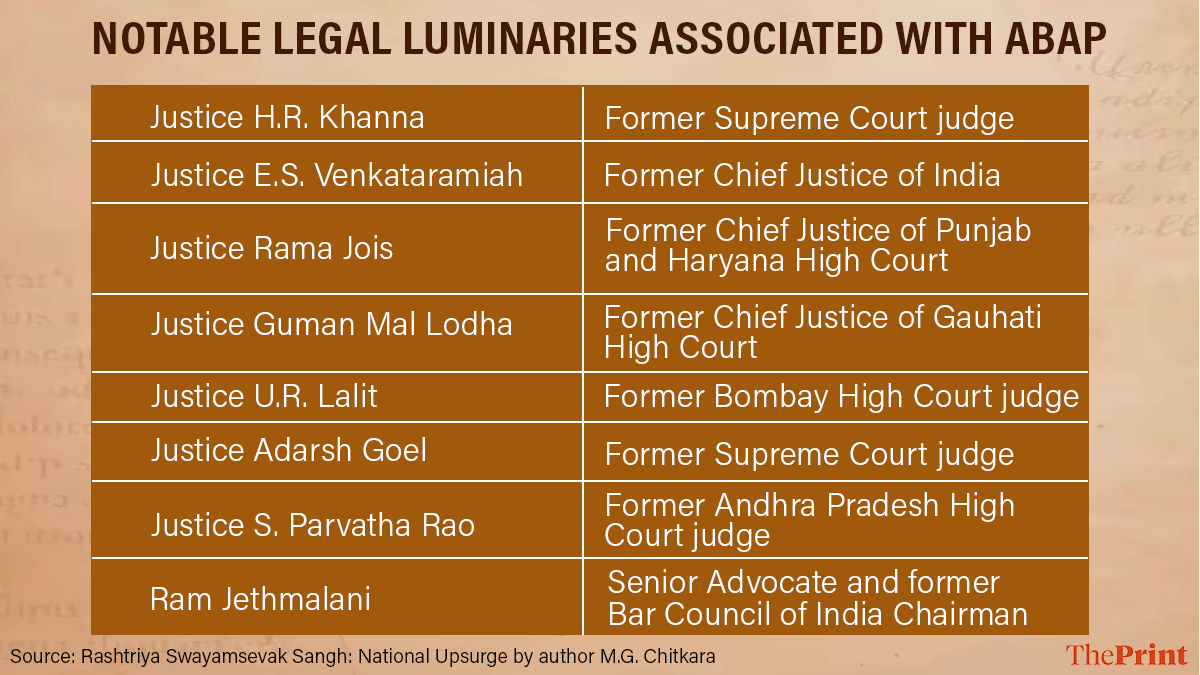
Its initial patrons included legal luminaries such as former Supreme Court judges justices H.R. Khanna and E.S. Venkataramiah, as well as senior advocate Ram Jethmalani.
Over the past three decades, the organisation has grown extensively and claims an average of 200 lawyers in every district court, putting its total membership in lakhs.
Lawyers associated with the Parishad claim credit for shaping several landmark judgments — from the Ram Janmabhoomi dispute and Ram Setu case to litigation related to Muslim reservations in states.
‘The Akhil Bharatiya Adhivakta Parishad…is competent & determined to become nucleus of the Constituent Assembly of the resurgent Bharat,’ RSS ideologue Dattopant Thengadi told lawyers in his 1992 speech.
They also speak of their involvement in a wide spectrum of cases on issues ranging from women’s rights and digital literacy to preserving the country’s history and culture, love jihad, and religious conversion.
However, none of the cases is filed in the Parishad’s name. In that sense, the organisation is everywhere, but nowhere. It doesn’t have formal registrations or a register of its members.
Its office-bearers say the lawyers’ association is not affiliated with any political party, and call it an “apolitical organisation”.
At the same time, they also describe the Adhivakta Parishad as being a part of a “larger ideological community”, with the RSS as the mentor of that ideology, and say it shares a “family” relationship with the ruling Bharatiya Janata Party (BJP).
Some of its members, such as Justice Adarsh Goel, have also made it to the bench, while others, like Bhupender Yadav, have made a name for themselves in politics.
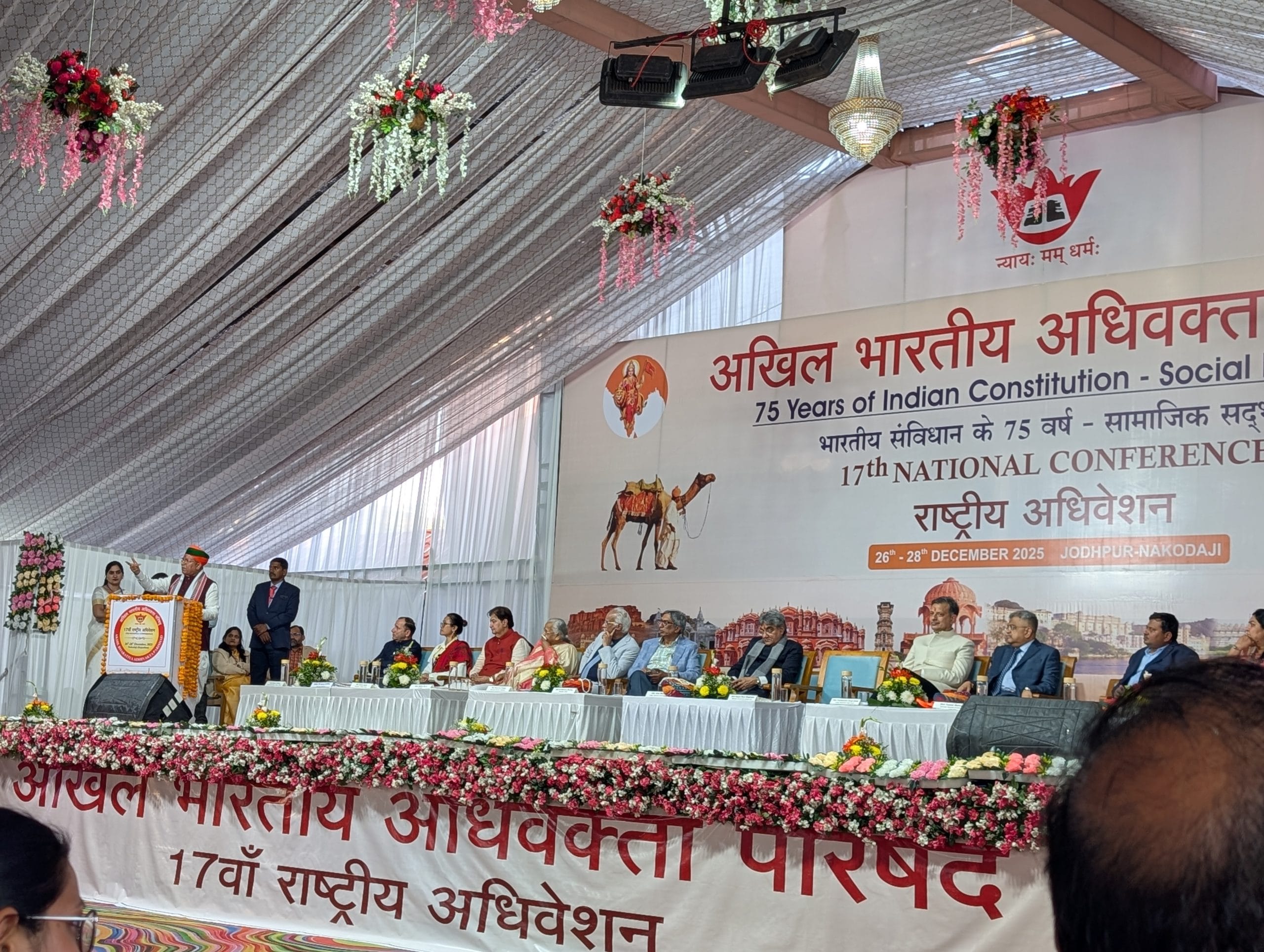
The Parishad’s power was on full display late December 2025, at its 17th National Conference in Balotra in Rajasthan.
Over 2,000 lawyers, a majority of them government advocates, attended the conference. Over two days, they heard sitting Supreme Court and high court judges, senior advocates, and even Law Minister Arjun Ram Meghwal, and discussed what they called forces working to weaken the objective of “social harmony” in the country, and strategised about ways to preserve the cultural fabric of India.
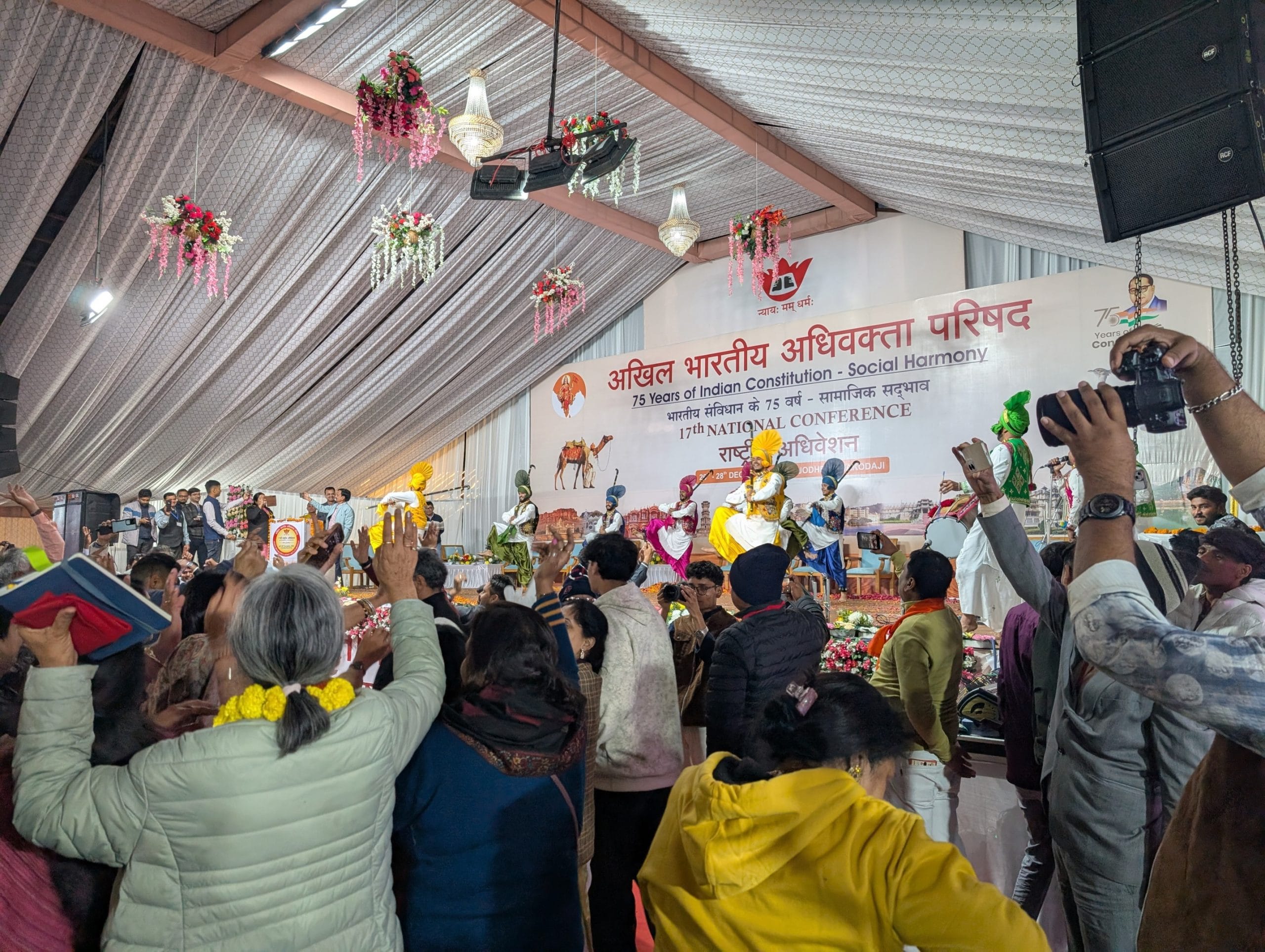
They were gearing up for courtroom battles during the day, and dancing with professional Bhangra performers in the evenings.
At the conference, North Zone Organisation Secretary of the Akhil Bharatiya Adhivakta Parishad, Shreehari Borikar, reminded the lawyers of the challenges ahead. “We will win on the basis of intelligence.”
The battle before them, he said, was a “battle of narratives”, and they were ready to take their intellectual battles to the courts.
Also Read: Terror trials stuck in time: German bakery to Mumbai train blasts, an endless crawl through courts
The modest beginning
At the inaugural address of the Parishad in September 1992, Thengadi wasn’t just bringing like-minded lawyers together. He was also setting up a long-term roadmap for them. The Adhivakta Parishad was established as an umbrella body, subsuming several state-level nationalist forums, many of which were formed in the aftermath of the Emergency.
They included the National Lawyers Forum, formed in Kolkata in 1977, and the Bharatheeya Abhibhashaka Parishad, which came up in Kerala in 1987, years before Thengadi established the Parishad.
Since then, the Adhivakta Parishad has established itself as a nationalist movement aimed at Indianising and decolonising India’s legal jurisprudence.
Lawyers associated with the Parishad call it a “movement”. And it functions like one — a loosely-knit organisation, a nudge for free-thinking lawyers to take up a cause, and the promise of a “national reconstruction” that Thengadi called for.
Additional Solicitor General of India Vikramjit Banerjee credits the Parishad’s growth to its open discussion on nationalism.
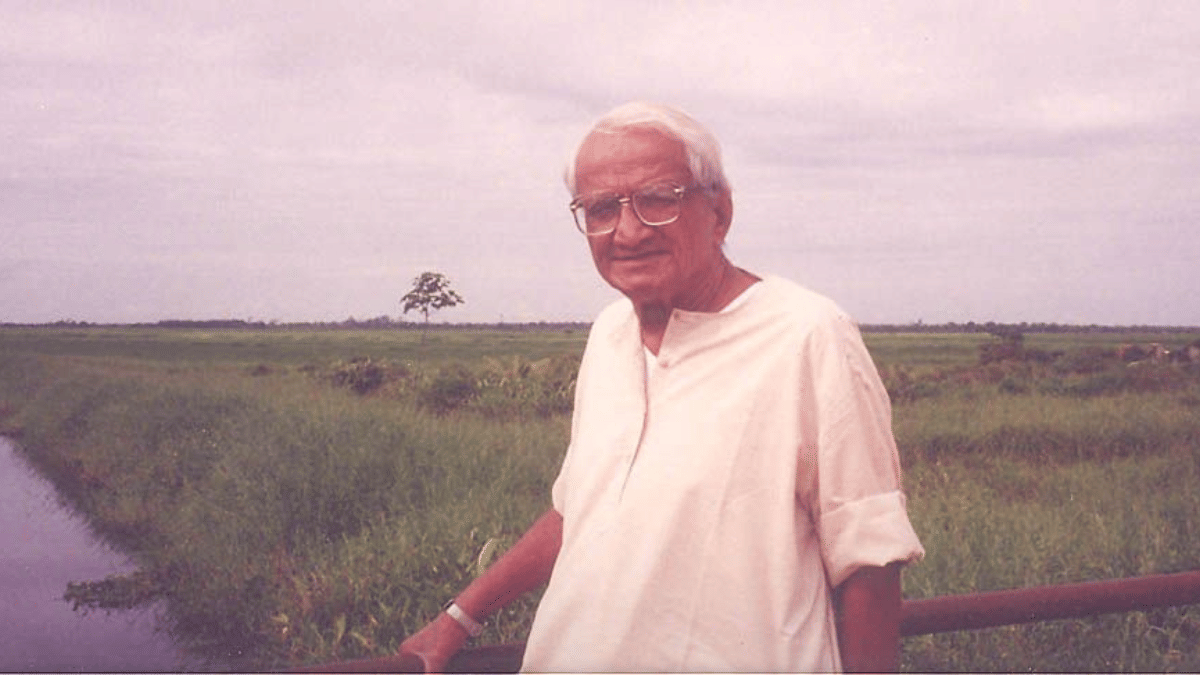
“People in the generation who followed are deeply inspired by their own cultural values and nationalism. When I grew up in Kolkata, you couldn’t talk about it. You would be persona non grata among your friends if you spoke about it,” said Banerjee, who has been associated with the Adhivakta Parishad since 2003, when he moved to Delhi.
He has also been associated with the Nationalist Lawyers Forum in Kolkata.
“It was very difficult for the Parishad to function (at that time)… I have seen the Parishad or the Nationalist Lawyers Forum in the days when it operated out of a room which had been given by someone, meetings held over cups of tea and samosas. Even then, the vision never wavered. It was inspirational,” says Banerjee.
Much like the Parishad itself, the current national vice president of the Adhivakta Parishad, Advocate R. Rajendran’s story also begins with the RSS. He told ThePrint that he joined the Sangh when he was in school.
“Later, when I joined college, I started my work with the Akhil Bharatiya Vidyarthi Parishad. I firmly believe that any qualities in me are through the Vidyarthi Parishad,” he says. Once he became a lawyer, he joined the Adhivakta Parishad and rose through the ranks — from district secretary to elected state secretary and then state general secretary.
Rajendran says the Adhivakta Parishad is a part of a “larger ideological community”, and the RSS is the mentor of that ideology.
“That ideology is simple: nationality (nationalism). The RSS has not given any new ideology to the nation; it was always there. And now the Sangh has been trying to strengthen that ideology for the last 100 years. The Adhivakta Parishad is a part of that larger ideological family,” he told ThePrint.
The Parishad’s closeness with the BJP is often questioned, more so since the Parishad’s general secretary in the 2000s, Bhupender Yadav, became the Minister of Environment, Forest and Climate Change in 2021.
Rajendran says the Parishad and the BJP are all members of a family. “A family member relationship is there. But that doesn’t mean that responsibility in the Adhivakta Parishad is a stepping stone for any kind of power or responsibility in the BJP… But being a member of that larger family, a cordial relationship is there (with the BJP),” Rajendran says.
“The BJP is also an organisation that is working in the field of politics and trying to develop that narrative through political power. We are trying to develop that narrative through a change in the mindset of lawyers,” he adds.
‘When I grew up in Kolkata, you couldn’t talk about it (ABAP). You would be persona non grata among your friends if you spoke about it,’ says Additional Solicitor General of India Vikramjit Banerjee.
The bricklayers
While Thengadi is credited as the founder of the Parishad, its early supporters included a distinct group of judges and senior advocates.
A book by M.G. Chitkara, Rashtriya Swayamsevak Sangh: National Upsurge, lists many legal luminaries of the institution. They include Justices H.R. Khanna, E.S. Venkataramiah, Rama Jois, Jitender Veer Gupta, Guman Mal Lodha, U.R. Lalit, and senior Advocate Ram Jethmalani.
Many of them had, by then, had their own run-ins with the Congress government.
Considered a champion of liberal values, Justice H.R. Khanna was the sole dissenting voice in the infamous 1976 ADM Jabalpur judgment, upholding the suspension of fundamental rights during the Emergency, an opinion that cost him his elevation to chief justiceship.
Despite being the seniormost Supreme Court judge, he was superseded by Justice M.H. Beg as the chief justice in 1977. Justice Khanna resigned the same day.
‘That ideology is simple: nationality (nationalism). RSS has not given any new ideology to nation; it was always there. And now the Sangh has been trying to strengthen that ideology for last 100 years. The Adhivakta Parishad is a part of that larger ideological family,’ ABAP vice president R. Rajendran.
Justice Rama Jois resigned as the chief justice of the Punjab and Haryana High Court days before Thengadi’s speech in August 1992. According to news reports from the time, he “felt constrained to resign following the elevation of two relatively junior high court judges to the Supreme Court”.
An editorial in The Indian Express, titled ‘Blow to Judiciary’, blamed former prime minister Indira Gandhi for having tampered with the judge selection norms, and alleged that after that PM Narasimha Rao “failed to reverse this downward trend”.
Before he was a judge, Justice Jois was also one of the lawyers who was arrested and put into prison.
During the Emergency, an arrest warrant under the Maintenance of Internal Security Act (MISA) 1971 was also issued against advocate Ram Jethmalani, then the chairman of the Bar Council of India. This followed his speech at the Palghat Lawyers Conference in Kerala in January 1976, when he had famously launched a tirade against Indira Gandhi and Sanjay Gandhi.
Jethmalani left India a day after the ADM Jabalpur judgment. He caught a flight to Canada and managed to get political asylum in the United States, becoming the first person to be granted asylum due to the Emergency.
On the other hand, Justice Guman Mal Lodha was a dedicated RSS worker. He worked as the state chief of the Jana Sangh between 1969 and 1971, and as an MLA between 1972 and 1977.
During the Janata Party government, which also had the Jana Sangha as part of the coalition, Lodha was elevated as a judge of the Rajasthan High Court in 1978.
Ram Janmabhoomi to Ram Setu
Over the years, the Parishad appears to have exerted considerable influence on the justice delivery system. While its name rarely figures in case files, its imprint is evident across a range of cases nationwide, from the Ram Janmabhoomi and Ram Setu matters to those involving Muslim reservations and cow smuggling.
While the Parishad itself is usually never the face of these litigations, it often is the soul of it. For instance, in 2016, former national organising secretary of the Parishad, senior advocate Joydip Roy claimed that Parishad lawyers were “still fighting the Sri Ram Janmabhoomi case”.
A member of the Parishad’s Delhi unit told ThePrint that it played a pivotal role in the litigation over the Sethusamudram Shipping Canal, which proposed to create a shipping route between India and Sri Lanka.
However, the project involved dredging through the Ram Setu, the bridge believed to have been built by Lord Ram to cross over to Sri Lanka with his Vanara Sena to bring Sita back from Ravana.
Given the cultural significance of the bridge, petitions were filed in the Madras High Court and later transferred to the Supreme Court. The pleas sought a restraint on the destruction of the Ram Setu.
In 2007, the court passed interim orders that no damage be caused to Rem Setu during dredging operations.
The same year, two affidavits filed by the then Manmohan Singh government, questioning the existence of Lord Ram and Ram Setu, created a furore, leading the Centre to withdraw the affidavits.
In March 2018, after the change of government at the Centre, the government filed a fresh affidavit saying that it intended to explore an alternative to the earlier alignment to the Sethusamudram Ship Channel Project without affecting or damaging the Ram Setu, or Adam’s bridge, “in the interest of the nation”.
Another member of the Parishad’s Delhi pointed to litigation around the conduct of the Common Law Entrance Test (CLAT) in regional languages, and pleas involving the admissions process and minority status of St Stephen’s College despite receiving substantial government funding.
On the ground, lawyers associated with the Parishad spoke with pride about the cases and the causes that they had taken up in their courts.
For instance, Advocate Prem of Ferozabad spoke about how he fights several cases pro bono. “We’ve seen many times, Muslim boys lure Hindu girls. If we ever get a case like this, we fight that case free of cost so that any of our daughters in the Hindu community gets justice. We also fight cases of cow smuggling free of cost.”
The West Bengal unit of the Parishad has also pursued several pleas, from minority reservations in the state and anti-cow slaughter cases, to countering Christian missionaries allegedly aiming at mass religious conversions in the state.
The Parishad functions through four ‘ayaams’ or dimensions— knowledge collective, litigation, organisation and outreach. Any new joinee is inducted into one of these four ayaams.
It also has ‘nyaya kendras’ across the country, aimed at taking up legal aid work. In that sense, the Adhivakta Parishad borrows from the Sangh’s ideology of ‘antyodaya’ — that justice must reach the last person in the queue.
The litigation ayaam is the one that spearheads causes in the country’s courts.
“The Parishad does a lot of crucial litigation. I have appeared for extensive litigation for tribal students and their matters in court about the condition of tribal hostels in court…In many courts, the Parishad has done yeoman’s work for the deprived,” says Banerjee.
At the National Conference, the Parishad’s national president, K. Srinivas Murthy, spoke about how the organisation can help with a range of cases from cow smuggling to the acquisition of forest land.
While speaking on its litigation wing, Murthy said that the organisation should have a team of karyakartas to deal with cases at every district court and the high courts. “They don’t argue the cases,” he said.
He cited the example of Andhra Pradesh, where he said religion-based Muslim reservations were challenged three times, and the Parishad fought.
“First (the case was before) a bench, (we were) successful; the second time, five-judge bench (we were) successful, the third time a seven-judge bench (we were) successful, but I didn’t argue,” he told the gathering.
“The litigation ayaam pramukh should see that those who argue the best cases have to represent our cases. That must be our motto,” he added.
Murthy also spoke about cow smuggling cases.
“If a gauraksha pramukh comes (to you), saying, ‘Sir, there are so many (lorries carrying cows) crossing the highway, we must do something.’ What will they do? Stop the lorry and throw stones,” he said.
“That’s not what should be done. After the lorry is stopped, how should the litigation be started? Give them representation, give a police report, take the cows to the animal husbandry and get them tagged, then the cows should be given to the animal welfare-recognised gaushala, then the gaushala must be given money to run it,” he added. “They are emotional beings, so we have to help them.”
Additionally, Murthy also spoke about cases where a forest dweller’s land is taken away without due process.
“Collectors give a notice that they want the entire tribal area land. But they cannot. Under the new Land Acquisition Act 2013, you have to take the permission of the gram sabha. They don’t know; you have to help them,” he said.
He encouraged people to work as a team and liaise with lawyers in high courts and the Supreme Court to create a strong foundation for cases in lower courts.
“You are aware that the Ram Janmabhoomi case was finalised in the court, but the foundation was effectively laid at the trial court level,” he asserted.
The bar and the bench
The steady growth and popularity of the Parishad among lawyers has meant that lawyers affiliated with it also make it to the bench.
One of the earliest legal luminaries associated with the Parishad was Justice Umesh Ranganath Lalit, who was appointed an additional judge of the Bombay High Court in 1974.
He was due for confirmation as a permanent judge of the High Court in 1976. However, during the Emergency, then Prime Minister Indira Gandhi refused to extend his term, despite approvals by the chief justice of the high court, the Maharashtra government, as well as the then minister of law, justice, and company affairs of the Government of India.
Reports speculated the extension was denied due to bail orders passed by him during the Emergency and his links with the RSS and the Adhivakta Parishad.
While the Shah Commission of Inquiry report did not cite these reasons, it called the refusal to extend his term an “abuse of authority and misuse of power” by Gandhi.
Justice U.R. Lalit’s son, Justice U.U. Lalit also served as a Supreme Court judge, after being elevated from the Bar, and went on to serve as the chief justice of India.
Another senior figure associated with the Parishad was former Supreme Court judge Justice Adarsh Goel, who also served as the organisation’s general secretary.
Justice Goel’s appointment as a judge was mired in controversy after news reports said that an Intelligence Bureau (IB) report had described him as a “corrupt person”, and had noted in the political affiliation column that he had been the general secretary of the Adhivakta Parishad.
At the time in 2001, the NDA government was in power. While then President K.R. Narayanan returned Justice Goel’s recommendation to the government, Law Minister Arun Jaitley rejected the IB’s comments as a “slur”, saying that the collegium had found Goel to have an “impeccable reputation of being an upright and honest advocate”.
Similarly, Justice S. Parvatha Rao served as a judge of the undivided Andhra Pradesh High Court from 1990 to 1997. According to the RSS mouthpiece Organiser, when Justice Rao was first shortlisted for judgeship, then Union Law Minister P. Shiv Shankar asked him to dissociate himself from the RSS.
However, the judge refused, saying the RSS was not a banned organisation. He was then appointed as a judge during the Vajpayee-led NDA government. After retirement, he served as an RSS Kshetra Sanghchalak and later as the president of the Adhivakta Parishad.
Outside court
The Parishad also brings out a quarterly legal magazine, Nyayapravah, with articles ranging from complex legal issues to commentaries on the resurgence of Sanatana Dharma for a strong Bharat.
The magazine provides publication opportunities to lawyers and law students. The Nyayapravah issue from the first quarter of 2025 also had an article by Justice L.C. Victoria Gowri, whose 2023 appointment as a Madras High Court judge was mired in controversy, with a petition in the Supreme Court against her appointment.
Critics said Justice Gowri was a former BJP Mahila Morcha national secretary who had made remarks against minorities.
Past videos surfaced, in which she allegedly called Christians “white terrorists”, and in an opinion piece for RSS’s Organiser, she said that her hometown Kanyakumari was becoming a “Hindu-minority city with rampant conversions”.
Rajendran says that the Adhivakta Parishad has been carrying out various activities “in creating a national feeling among the lawyers, working for national integrity, working for the expansion of lawyers’ professional skills, and for creating a better atmosphere in the judiciary for better justice dispensation”.
Who can join the organisation?
Rajendran says that any lawyer who believes in the “ideology” of the Adhivakta Parishad is welcome to join the organisation, irrespective of caste, creed, or political ideology. He says the Parishad is not affiliated with any political party and calls it an “apolitical organisation”.
Advocate Tabassum Rahim Sibgat, a Kashmiri Muslim who became a part of the Parishad in 2024, dismisses the perception that the Parishad promotes an RSS-aligned agenda inside courtrooms.
“If the Parishad was spreading propaganda, why would I, as a Muslim, be a part of it? The Adhivakta Parishad welcomes everyone with open arms. If there was an issue of caste or creed there, I could never have been a part of that platform,” Sibgat told ThePrint.
The lawyer, who is also a national-level arm wrestler, told ThePrint she has been “inspired” by the Parishad and has been working on women’s empowerment and conducting awareness campaigns on the rights of individuals and the cyber crime.
Sibgat attended her first Parishad conference last year. “Being on the platform made me feel like I was seeing the entire Bharat on one stage,” she told ThePrint.
‘Enemy forces, group sex marriages’
At the conference, the Parishad warned of “enemy forces” disturbing the country’s peace. Murthy insisted that four major international forces were “attacking this nation in the core values”.
“These four international forces have got the backing of international mafias, well-connected political and financial support. These people, with the help of some of our friends here, are creating social disharmony. They create non-existing binaries,” he said, without elaborating.
He called this a “slow poison” that was gradually “seeping into our social system”.
Borikar also encouraged the lawyers to research and look into not just current issues, but also subjects that may become relevant in the future. He gave the example of “group sex marriages”.
“Could we have ever imagined this happening in India, that five people would come together and marry. But this is coming into our imagination now, and people are trying to make it a reality. You see it in advertisements today, too. So would we have to challenge such advertisements?” he asked.
At the Parishad, it is usually just such a nudge to karyakartas that pushes them to take up cudgels for nationally aligned social causes.
‘If we want to protect the culture, the history, the future of the country, and if the court is used to harm it, then we would need people to keep the country’s perspective forward,’ Shreehari Borikar, Organisation Secretary (North Zone), ABAP.
Borikar may be the only non-lawyer at the Adhivakta Parishad. He was the National General Secretary of the Akhil Bharatiya Vidyarthi Parishad before becoming the ABAP’s organising secretary for north India. Having studied in Nagpur, he has been associated with the ABVP since 1990.
An early start
On a sunny Thursday afternoon in early January, Delhi University’s Shankarlal Hall was packed with over 400 law students, their eyes gleaming with hope.
They were the chosen ones, selected under the the Dr B.R. Ambedkar Law Internship programme run jointly by the Akhil Bharatiya Vidyarthi Parishad and the Adhivakta Parishad.
Over 1,000 students had applied, but fewer than half were selected through an interview process. They were now assigned internships under various lawyers at courts and tribunals across Delhi.
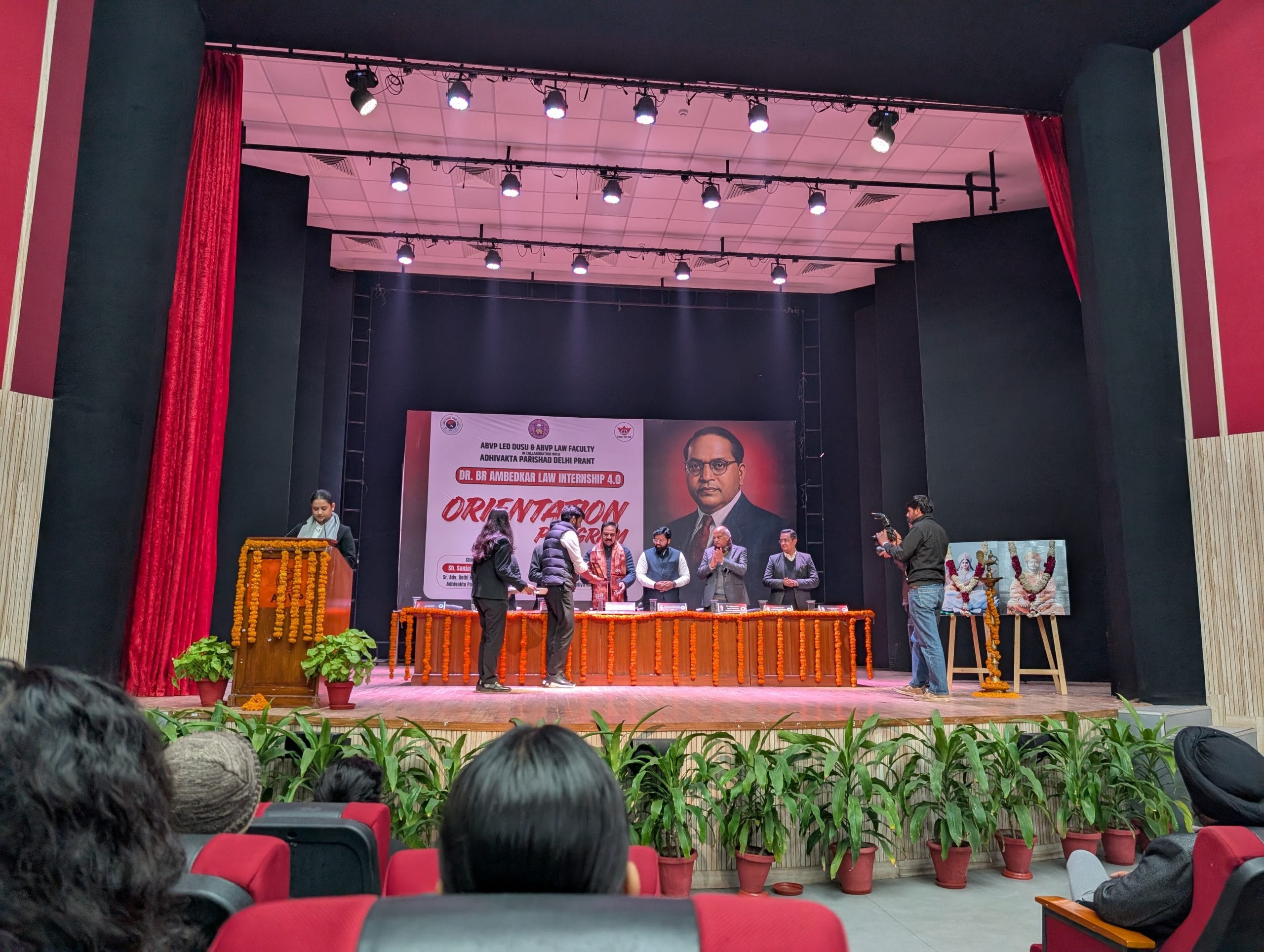
At the event, Borikar reminded the students that the ABVP was extending this opportunity to the students because it wanted to make them into “sensitive lawyers who think about the country and society”.
“If we want to protect the culture, the history, the future of the country, and if the court is used to harm it, then we would need people to keep the country’s perspective forward,” he asserted.
Borikar urged the students to understand what the Shah Bano case was all about, referring to the recent movie ‘Haq’ based on the case.
In the 1985 Shah Bano judgment, the Supreme Court had declared that the Code of Criminal Procedure provision on maintenance applied to all citizens irrespective of their religion.
The issue was highly politicised by then, with then prime minister Rajiv Gandhi overturning the effect of the apex court decision by passing the Muslim Women (Protection on Divorce Act), 1986, which restricted maintenance to divorced Muslim Women to the first iddat period, a move criticised as appeasement to consolidate Muslim votes.
Borikar then moved to recent legal developments.
“Article 370 was removed…The Sri Ram Janmabhoomi andolan was going on for the past 500 years…Whether it’s Article 370 or the Sri Ram Janmabhoomi issue, it wouldn’t have happened in society without courts,” he said.
“The government had the willpower to end both the issues, and the court judgments have been widely accepted by the entire country,” he added.
The orientation concluded with the national song, ‘Vande Mataram’, led by a student from the dais. The student sang only two verses despite the country’s year-long celebrations to mark 150 years of ‘Vande Mataram’.
The National Democratic Alliance (NDA) government has given a clarion call for singing the entire song, accusing the Congress of removing a few stanzas of the song for “politics of appeasement”.
There was visible discomfort on the stage, embarrassment among the organisers, and nudges to communicate with the student in time to continue singing the remaining stanzas as well.
But before that could be done, there was applause. The students had already begun leaving their seats, ready to pick up their internship allotment letters, talking about how “motivating” the session was.
(Edited by Sugita Katyal)
Also Read: ‘How can your kids be kind when you slaughter animals in front of them?’ asks HC judge at VHP event