





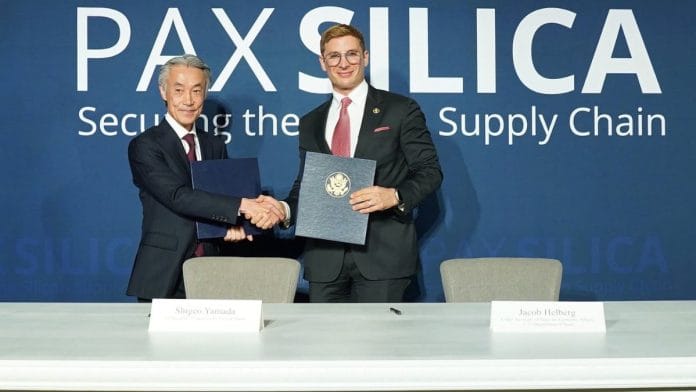



New Delhi: On Thursday, the Trump-led US administration formed a coalition for a secure, prosperous, and innovation-driven silicon supply chain called Pax Silica. The grouping aims to streamline supply chains for advanced manufacturing, semiconductors, AI infrastructure, and logistics.
Other than the US, the coalition includes Japan, South Korea, Singapore, the Netherlands, the United Kingdom, Israel, the United Arab Emirates, and Australia. However, India has been left out of the group.
For India, this comes at a time when India-US trade talks have not delivered any conclusive results, despite multiple high-level deliberations.
The initiative also comes at a time when the US is focusing on reducing its reliance on China, the world’s main supplier of rare earth elements, the key to all the advanced technology and electronics.
Jacob S. Helberg, US Under Secretary of State for Economic Affairs, observed, “Pax Silica brings together some of the world’s most technologically advanced nations to build a secure, resilient, and trusted technology ecosystem. Economic security is national security, and together, we’re strengthening supply chains from minerals to semiconductors to computers and networks.”
Ambitions of Pax Silica
The initiative has consensus for the establishment of secure supply chains, trusted technology and resilient infrastructure for economic growth.
As per the official document, the bloc aims to strengthen growing demands to deepen economic and technological cooperation, promote AI for long-term prosperity, establish trustworthy systems to safeguard mutual security, and support free market and policy coordination for critical infrastructure.
Furthermore, they say they want to unite countries with the world’s most advanced technological companies to realise the economic potential of AI, which will establish a durable economic order underscored by prosperity across partner countries.
This US-led programme also underpins the Trump administration’s aim to consolidate its role in the AI revolution through revitalising the supply chains in critical minerals and responding to China’s growing footprint in the AI competition.
To eliminate Chinese competition, the US also restricted the supply of high-tech chips. However, many have claimed that this would not deter China from developing its very own advanced chip.
Jensen Huang, CEO of Nvidia, said, “China can take over the US in the AI race. They have many AI researchers; in fact, 50 percent of the world’s AI researchers are in China. And they develop very good AI technology. In fact, the most popular AI models in the world today, open-source models, are from China.”
In October, while talking about China’s export controls on critical minerals, Scott Bessent, US Secretary of the Treasury, said: “The new competition is between China and the rest of the world. The US is pushing back firmly and expects strong support from Europe, India and other Asian democracies.”
The partner countries have agreed to share their project details to jointly address AI supply chain opportunities and vulnerabilities, which will include critical minerals, semiconductor design, fabrication, packaging, logistics and transportation, compute, energy grids and power generation.
According to the official document, the initiative will ease the pursuit of new joint ventures and strategic co-investment opportunities, protect sensitive technologies and critical infrastructure from undue access or control by countries of concern.
To operationalise this initiative, the US administration will identify infrastructure projects and coordination of economic security practices.
(Edited by Viny Mishra)