





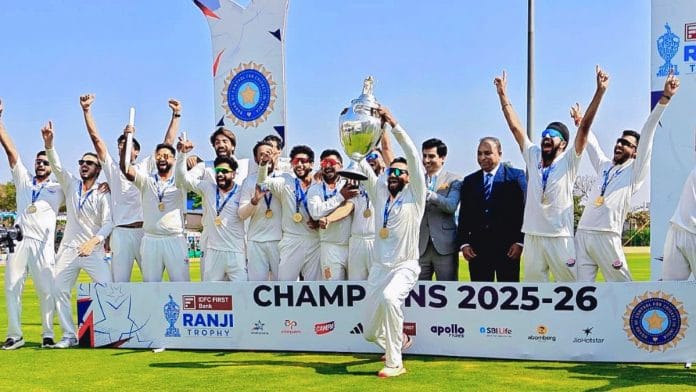



Hubballi: Dhol beats echoed through the KSCA Ground in Hubballi as the Jammu & Kashmir squad burst into joyous celebration, dancing like a team that had finally overcome all odds. They lifted BCCI president Mithun Manhas onto their shoulders, his eyes misty, heart full. There were tight hugs, endless photos, and laughter ringing in the air.
The J&K team had waited long enough. Sixty-seven years of hope, heartbreak and hustle erupted into one historic and unforgettable victory.
The 19th team to win the coveted title, J&K defeated the heavyweights Karnataka, who made it to the final after 11 years, in the Ranji Trophy 2026 final by a first-innings lead as the match ended in a draw.
“When we lost the first match of this season, I told my team the mantra, ‘we can, we will.’ At that moment, they assured me that Ranji Trophy 2026 will come home. And, they have fulfilled their promise,” J&K head coach Ajay Sharma told ThePrint, moments after celebrating the triumph.
“We are a force to reckon with. You cannot take us lightly. We have got ‘asla’ (firepower)… We got spinners, fast bowlers, batsmen. Now people are scared of playing against us. These players are just knocking on the door of the Indian team…it’s beautiful how a game can change your fortune.”
The fifth and final day witnessed the presence of J&K CM Omar Abdullah, BCCI president Manhas, who had earlier travelled to Chennai for India’s T20 World Cup clash against Zimbabwe, and BCCI secretary Devajit Saikia.
Abdullah later announced a Rs 2 crore cash reward for the squad. “…the players will also be entitled to government appointments under the recently notified rules for outstanding sportspersons,” read a tweet from the CMO.
Congratulating Team J&K on their historic triumph in the Ranji Trophy, the Chief Minister announced a cash reward of ₹2 crore for the players and support staff after their emphatic victory over Karnataka on their home turf.
Calling it a watershed moment for Jammu & Kashmir… pic.twitter.com/OnRJCa1EoB
— Office of Chief Minister, J&K (@CM_JnK) February 28, 2026
Manhas, who himself started his cricket career with Jammu, credited Jay Shah, chairman of the board of directors, ICC, for the outcome.
“This journey wouldn’t be possible without Jay bhai. He visited J&K to examine and then there was no looking back. We have had our ups and downs. The only dream was to win the Ranji trophy and I am very proud of the way boys played, they dominated,” Manhas told ThePrint.
The Ranji Trophy 2026 final unfolded like a blockbuster, packed with centuries, five-wicket hauls, heated exchanges, even a headbutt, and a surprise bowling spell from K.L. Rahul. In the end, however, it was Jammu & Kashmir who took home the silverware.
How J&K clinched maiden Ranji trophy
After winning the toss, skipper Paras Dogra opted to bat first on a dry, flat surface. Five J&K batters, Yawer Hassan, Dogra, Abdul Samad, Kanhaiya Wadhawan and Sahil Lotra, struck half-centuries, while Shubham Pundir led the charge with a patient 121 off 247 balls.
Karnataka’s reply faltered despite boasting an India-heavy top order. Mayank Agarwal stood tall with a gritty 160 off 266 deliveries before being bowled by J&K pacer Auqib Nabi. Apart from Kruthik Krishna, who managed to cross 30, the rest of the batting line-up crumbled. Karun Nair, Ravichandran Smaran and Shikhar Shetty were dismissed without scoring.
Although both Auqib Nabi and Prasidh Krishna claimed five-wicket hauls in the first innings, it was Nabi’s spell that proved decisive as Karnataka were bundled out for 293.
When asked about the mentality going against bowlers like Prasidh Krishna and Vyshak, Brigadier Anil Gupta (retd), who oversees administration at the Jammu & Kashmir Cricket Association, said, “Our coaches told everyone, don’t look at the bowler, look at the ball. Fortunately for us, they didn’t bowl well in the first innings; that helped us score. Because we knew we had the capability of bowling any team twice in five days.”
J&K suffered an early setback in the second innings, losing Hasan and Pundir for just 11 runs. But Qamran Iqbal, who had fallen for six in the first innings, bounced back in style with a brilliant century, scoring 160 runs off 311 balls. Lotra wasn’t behind either. On the final day, that is Day 5, he brought his century, 101 runs off 226 balls, as J&K eventually declared at 2:10pm.
‘Equivalent to Dhoni’s 6 in 2011’
This victory carries the weight of 67 years, for every cricketer who has ever worn the J&K colours. From Samiullah Beigh, Parvez Rasool and Abdul Qayoom to Kavaljit Singh, Ian Dev Singh and Dhruv Mahajan, generations dreamed of this day.
Behind the scenes, too, countless hands shaped this moment. The dedication of local coaches laid the foundation, while the guidance of the late Bishan Singh Bedi and subsequently Irfan Pathan gave the team belief and direction.
Former Ranji captain Ashwani Gupta, who led J&K from 1995 to 2002 during an era of bare-minimum facilities, watched the historic win from home. He was overwhelmed. For him, this triumph felt deeply personal.
“We cannot express this moment in words. This win is like a festival, bigger than a festival. J&K will now be known for cricket,” he said.
Gupta reserved special praise for Mithun Manhas. “The cricket infrastructure J&K has today is because of Mithun Manhas and his team. The way he has managed things, and the way the boys have performed, is outstanding. We reached the quarter-finals in the last three seasons, but the job was unfinished. Now the boys have completed it.”
He said the impact will be immediate and lasting. “Now every young boy in J&K will want to play cricket. These 15 players are an inspiration.”
Former J&K cricketer Raman Thaploo, who retired in 2024, likened this triumph to India’s 2011 ODI World Cup win. “When M.S. Dhoni hit that six in 2011, it didn’t just win us a World Cup, it sparked a new era in Indian cricket. This Ranji victory will have a similar effect in J&K. Soon, you’ll see two or three players from here in the Indian team,” Thaploo said.
He pointed out that this squad, a blend of players from both Jammu and Kashmir, shares a rare bond, celebrating each other’s success as their own. This is significant because for a long time, the internal battles between players from the Jammu region and the Kashmir region created rifts within the team. It was Manhas’s masterstroke to bring Dogra on board as captain, which brought harmony in the dressing room, said Thaploo.
Thaploo, who mentors Abdul Samad, Kanhaiya Wadhawan and Umran Malik, also said that the regions complement each other perfectly, and players have understood it. Kashmir, he said, is a breeding ground for fast bowlers, while Jammu produces fearless power-hitters.
“And, now both forces have come together to bring this trophy home,” he said, lauding the grit of J&K’s cricket team, led by Dogra.
Quoting a Hindi line, Thaploo summed up the victory thus: “Bina kuch kiye jai jai kar nahi hoti, koshish karne walon ki kabhi haar nahi hoti.”
(Songs of praise don’t come without trying, and those who try never loses)
J&K’s cricketing renaissance
The importance of this title triumph will resonate strongly back home, particularly within the Jammu & Kashmir Cricket Association (JKCA), which not too long ago was engulfed in controversy. The situation was such that the J&K High Court had stepped in to take stock in 2021.
The association was struggling with governance failures, financial turmoil, poor infrastructure, and allegations of a multi-crore scam. Private leagues folded, there were unpaid dues, players lacked basic facilities and direction.
To move from that chaos to lifting the Ranji Trophy within four to five years may sound like the script of the next big underdog sports movie. But the turnaround was the result of the vision of Jammu-born Manhas, who reshaped the face of cricket in the region, after taking charge in June of 2021.
The transformation, however, was gradual. For over four years, a committee led by Manhas, now the BCCI president, worked quietly behind the scenes, rebuilding J&K cricket brick-by-brick and turning it into a formidable unit. He was part of a three-member sub-committee, alongside Brigadier Anil Gupta (retd) handling administration and Sunil Sethi overseeing legal matters.
“JKCA’s audit had been pending since 2011,” Gupta told ThePrint last year, noting that clearing it was among his first priorities. “There was no website, multiple unpaid bills, no structure or system. You cannot run a cricket association on an ad hoc basis.”
Gradually, visible changes began to emerge, especially in infrastructure, including multiple practice wickets, turf pitches, indoor nets, dressing rooms, sight-screens, and boundary ropes. “Manhas sir has singlehandedly transformed J&K cricket. He deserves full credit. He has given back to the community in a way no one else has,” said Majid Dar, JKCA in-charge.
Dar, who represented J&K until 2014 before becoming assistant coach of the senior team in 2015-16, had in 2015 filed a Public Interest Litigation along with former cricketer Nisar Ahmad Khan, seeking a probe into the alleged scam within JKCA. “If I start listing the on-ground changes implemented by sir, it would take hours,” Dar said.
He pointed out that across age groups, practice sessions now use Kookaburra and SG balls. Players stay in four- and five-star hotels instead of dormitories. The state team is equipped with top-quality gear, travels extensively, and gains exposure essential for growth.
Red soil pitches, once an alien concept to J&K, are now part of the setup.
The GGM Science College ground has eight pitches, four layered with red soil to replicate conditions outside the region, and four with black soil suited to local playing styles.
Support staff strength has also increased exponentially. From once relying on a single coach, the team now has head coach Ajay Sharma, bowling coach P. Krishna Kumar, fielding coach Dishant Yagnik, trainer Sunny Verma, physiotherapist Chirag Pandya, video analyst Susheel Pajnu, and masseur Naresh Kumar.
“We have come a long way. It’s hard to express what this win means for JKCA and the entire region,” Dar said.
Dogra said this victory will serve as a catalyst for cricket in J&K. “I am sure this will inspire youngsters to take up the sport, give it their 100 percent, and believe in themselves. J&K has the potential to produce not just one India A player, but many. The talent here is phenomenal.”
(Edited by Amrtansh Arora)
Also Read: ‘Only proper cricket on Earth now is in Hubballi’—England fans travel 7,500 km to watch Ranji final