





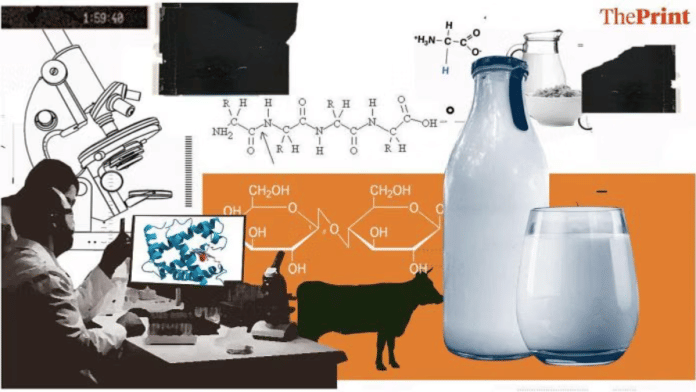



New Delhi: South Asians have long been known to include milk, cheese, and other dairy products in their diets. But did this ability to digest dairy products develop for an evolutionary reason, or did it happen just by accident?
A fascinating new study by the University of California, Berkeley’s Department of Molecular and Cellular Biology, analysed the genomes of 8,000 Indian, Pakistani, and Bangladeshi individuals to understand exactly how lactose tolerance has evolved. The paper, which is available as a pre-print on the bioXRiv server, has not yet been peer reviewed.
Lactose tolerance is not the norm globally. Babies are born with an enzyme called lactase, which helps break down lactose in breast milk. But as people grow up, most of them lose this enzyme and become lactose-intolerant. Those who do not lose this enzyme develop lactase persistence. These include European and North American populations.
For the longest time, it was known that lactase persistence happened in European pastoralist communities around 5,000 years ago because they lived in cold places with no crops or vegetation, and had to rely on dairy and meat to survive.
This meant that being able to digest milk was an evolutionary advantage for them.
But in South Asian communities, as the UCB researchers found, the trait did not develop for any evolutionary reasons but just by accident. In most South Asians, the lactose-tolerance enzyme only spread because they interacted with the European pastoralists. It offered no competitive advantage, since South Asia was always a dairy plus crop-dependent community, and its spread is prevalent even now because it was passed down through generations.
Also Read: Spinal cord relies on a ‘signal’ for healing and repair, and ‘EV’ shuttles in the human body
Hurricanes might need a sixth category
The American Geophysical Union’s new study discusses the need for a new, ‘Category 6’ of hurricanes, as the rapidly warming oceans are producing increasingly extreme cyclones. In a paper presented at the AGU’s annual meeting on 19 December, researchers from the National Taiwan University spoke about how new storm hotspots are growing in the Atlantic and Pacific oceans, partly due to human-induced climate change.
Hurricanes, cyclones or typhoons are basically storms that are formed in the sea rather than the land, and they are categorised from 1 to 5, typically based on their intensity and windspeed. However, the Taiwan University researchers analysed hurricanes over the last four decades and found that storms exceeding 160 knots—higher than even Category 5 hurricanes—have become more frequent in recent years.
They identified two hotspots where most of these hurricanes are originating from– Western Pacific and the Gulf of Mexico—because these areas have higher surface temperatures, and warmer waters reaching deep into the ocean too.
Warm water is the fuel for tropical cyclones, since it creates a feedback loop that leads to more condensation, stronger winds, and more rainfall. The most important finding of this study was that at least 60-70 percent of the intense warming of these oceans is human-induced. If it continues, the kind of storms they lead to might need a separate category altogether, because the intensity will become too high for our current measurements.
‘Earth’s liquid water could have been stored in reservoir’
Around 4.6 billion years ago, the Earth was a hostile, molten world filled with a magma ocean because of repeated asteroid impacts. The surface was so hot that liquid water could not exist at the time. How the planet later acquired and retained enough water to form oceans covering 70 percent of its surface has long puzzled scientists.
But now, a new study led by Guangzhou Institute of Geochemistry in China offers a new answer: Earth’s early water could have been locked away inside the mantle. Published in Science Advances Journal on 11 December, the new paper found that bridgmanite, which is the most abundant mineral in the lower mantle, can trap significant amounts of water within its crystal structure and act like a microscopic reservoir.
The team recreated the extreme pressures and temperatures of the deep mantle in a lab and found that bridgmanite’s capacity to store water increases sharply at higher temperatures. The study suggested that during Earth’s hot, inferno, magma phase, the lower mantle became the planet’s water reservoir, potentially holding up to the equivalent of today’s oceans. We might finally have an answer as to how our Earth became the blue-green planet it is today.
What are asteroids made of & how close are we to mining them
Asteroids aren’t just floating pieces of rock that could accidentally collide with the Earth; they’re also literal gold mines of celestial history and mineral resources. Some of these rocky objects were made during the birth of the solar system and might have rare metals that have been developing over centuries, and could potentially even be mined for resources.
We can study what asteroids are made of by studying the pieces of meteorites that fall onto the Earth and connecting them to nearby asteroids. A new study led by the Institute of Space Sciences (ICE-CSIC) focuses on rare carbonaceous chondrite meteorites, which might be part of C-type, carbon-rich asteroids.
Only about five percent of meteorites that fall on the Earth are made of carbonaceous chondrites, and are often fragile, making well-preserved samples uncommon. By analysing carefully selected specimens using mass spectrometry, the researchers could determine the chemical composition of the asteroids that source them.
The study found that while some primitive asteroids may contain scientifically valuable material, they generally hold low concentrations of precious metals, so large-scale mining is impractical for now.
But another reason why this mass spectrometry study was important is that very soon, we’ll be able to collect asteroid samples from space! So if we analyse meteorites and figure out the chemical signatures of asteroids in space, we’ll be better prepared to know what samples to get and which asteroids to target.
(Edited by Ajeet Tiwari)
Also Read: Humans were ‘lit’ long before we thought & dark chocolate a day keeps ageing away