





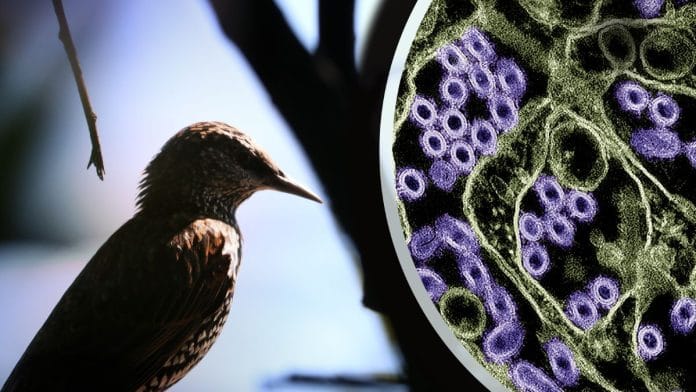



New Delhi: Scientists from Cambridge and Glasgow have found that bird flu viruses are particularly dangerous to humans because they can thrive even in fever-level host body temperatures which would normally stem a flu infection. Published in Science on 27 November, the study identifies a viral gene that helps determine how well a flu virus tolerates heat, which explains why some avian flu strains cause such severe disease in humans.
Human flu viruses are known to struggle at high temperatures and thrive in the cooler upper respiratory tract, at around 33°C. Fever, which can push body temperature above 40°C, is one of the body’s key defences against this virus, to snuff it out and stop it replicating. But bird flu viruses are adapted to infect the guts of birds where temperatures reach 40–42°C. The scientists found that these viruses are far less affected by fever, and tend to continue residing in the human body.
Another concerning fact is that human flus and avian flus can swap genes when they co-infect a host, and it has been seen before in the 1957 and 1968 bird flu pandemics. If human flu viruses adapt and get the gene that can withstand fever, this will spell bad news for flu pandemics. The scientists therefore urged more intensive monitoring of emerging bird flu strains and how they interact with human flu viruses.
Shingles vaccine may slow down dementia
A new study in the Cell journal, published on 2 December, has found further proof that getting the shingles vaccine may slow down dementia and even prevent dementia-related deaths. This research is part of the global discourse that has been ongoing for a few years now—scientists studying dementia believe that there is a link between neurotropic diseases and dementia onset.
In this new study, international researchers decided to use a ‘natural experiment’ in Wales to see whether getting the shingles vaccine has impacted the onset of dementia. According to a law in Wales, people born before 2 September 1933 were never eligible to receive the vaccine—this created the condition of a natural randomised control trial where the scientists could study the impact of being vaccinated or not on an otherwise homogenous sample size.
They looked at people over the age of 80 in Wales who had received the vaccine and who hadn’t, and found that among those who had received the vaccine, there was an almost 20 percent reduction in getting mild cognitive impairment, which is early-stage dementia. Moreover, among the ones already diagnosed with dementia, those who had received the vaccine were less likely to die from dementia-related causes.
Neurotropic diseases are associated with or impact the nervous system—from polio to flu to measles to shingles. Since dementia is strongly correlated with brain inflammation, and these neurotropic diseases do speed up brain inflammation, there is a prevailing hypothesis that getting vaccinated against these diseases could inadvertently protect you against dementia, to some extent. This research is still ongoing and there is no conclusive theory establishing the link between neurotropic vaccines and dementia risk. But the evidence is piling up, including the Cell study.
Many droughts might have led to Indus Valley civilisation’s collapse
The reason for the collapse of the Indus Valley civilisation remains one of history’s biggest mysteries. Scientists have put forth many theories—from invasions to economic collapse to great floods. A new paper in Communications Earth and Environment, published on 27 November, has proposed a fresh theory—droughts. Scientists from IIT Gandhinagar have said that repeated droughts, lasting over 85 years each, may have been the reason for the gradual decline of the Indus Valley civilisation.
This civilisation was one of the oldest, beginning almost 5,000 years ago, centred in present-day Northwest India and present-day Pakistan. It was a contemporary of ancient Egypt, but it began declining sometime around 1900 BCE. The Gandhinagar scientists decided to use climate records, historic water levels of lakes in northwest India, and the geochemistry of Indian caves to determine the weather and rainfall patterns in the region during that time period.
They found a 0.5°C temperature rise, a 10–20 percent drop in annual rainfall, and four major droughts that stretched across up to 91 percent of the Indus region. The scientists found evidence of declining rainfall for years in the areas people abandoned early on. They also found a final, century-long drought 3,500 years ago. This drought aligns with archaeological evidence of widespread deurbanisation, showing that climate stress was a key driver of the civilisation’s slow collapse.
Why does watching someone get hurt on TV make you wince
If you have ever flinched while watching a gory scene on TV or films, there might be a scientific explanation for that. A new study by US, UK, and Dutch researchers found that your brain may be doing more than empathising—it may be simulating the pain you watch on TV.
The study, published in Nature on 26 November shows how the scientists looked at brain activity in 174 people watching films like The Social Network and Inception. They found that parts of the brain that were thought to handle only vision also contain hidden “body maps”. So, what we see on screen triggers echoes of touch on our own bodies.
When people watch violent scenes, visual regions light up in patterns matching the viewer’s own body parts—so scenes involving hands activate areas associated with hands. This suggests the brain is not just watching actions, but also mapping the observed actions directly onto our own sensory system. So what you’re feeling is a result of your body almost mimicking what’s happening on screen, onto your own body. The study said that these findings could have major clinical implications, offering a new, low-stress way to study sensory processing differences in conditions like autism.
(Edited by Gitanjali Das)
Also Read: Moss can survive space, and AI can alter poll results