





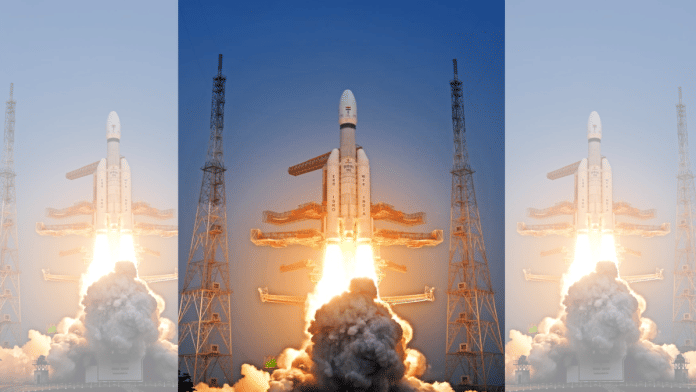



New Delhi: The NVS-03 satellite is unlikely to go up this year. It’s a curious delay. It was meant to be an important segment of the Navigation with Indian Constellation or NavIC Mission by the Indian Space Research Organisation, and was expected to launch by the end of 2025.
NVS-03, a segment of India’s independent regional navigation satellite system, is now the latest addition to the list of delays by the ISRO, which, anyway, had only five launches in the year 2025. And two out of these were not entirely successful. There’s more. This was also the second year in a row that ISRO had only one foreign or commercial satellite launch.
What’s ailing ISRO launches is a question that many are beginning to ask. The answer lies in a deliberate policy pivot and the simultaneous rise of private sector space players.
The Indian National Space Promotion and Authorisation Centre (INSPACe) manifesto had projected 30 launches from January 2024 to March 2025, but in the last two years, ISRO has not managed to launch even half of that. Meanwhile, the NavIC NVS-03 mission, Gaganyaan uncrewed mission, and even the NASA-ISRO Synthetic Aperture Radar (NISAR) mission did not take place according to their original schedules; while NISAR took off in July 2025, the other two have now been postponed to 2026.
This reduction in ISRO’s launches coincides with the opening up of the space sector to private players. The Space Policy of 2023, had redefined ISRO’s role – encouraging it to step away from commercial launches and be more research-oriented, and to focus more on big missions. The goal was to allow the private sector to take over commercial satellite development and launches.
“Now, from Indian soil, we see 5-6 big launches every year. I want the private sector to come forward, and take us to a point where we see 50 rocket launches every year in the next five years,” Prime Minister Narendra Modi had said in August 2025 on National Space Day, setting a goal for the space sector.
The ISRO calendar looks full for 2026 and is ready to play its twin role.
“In 2026, we are going to have Gaganyaan uncrewed launches, and we will also see the first launch of industry-led PSLV (Polar Satellite Launch Vehicle) and SSLV (Small Satellite Launch Vehicle),” an ISRO official told ThePrint. “The private sector launches will start, and ISRO is planning on hand-holding them through it.”
But are India’s private space start-ups ready to wean off ISRO and fly by themselves?
As of now, only two major private players in India have been able to demonstrate the capability of sub-orbital flights. Only Skyroot Aerospace is close to launching its rocket to the Low-Earth Orbit (LEO), where most commercial satellites operate, but even that requires ISRO’s support.
“Our private players are far from doing successful LEO launches by themselves, since the industry is very new,” said Commander Sarup Kumar, former Head of Programs at Agnikul Cosmos. “They will continue relying on ISRO for facilities, support infrastructure and tertiary guidance.”
With private sector players still nascent in the launch industry, and ISRO’s launches declining due to lower demand and a focus on big-ticket missions, India’s space sector is seeing an overhaul.
ISRO might be stretched too thin in its duties of launches and research and development, but experts say the organisation’s strength lies in its attention to detail.
“Of course, there have been delays in ISRO’s missions, no two ways about it. But globally, the space sector sees delays all the time,” explained Dr Ajey Lele, deputy director general at the Manohar Parrikar Institute for Defence Studies and Analyses (MP-IDSA). “The main thing is, ISRO is always certain to cover its bases and take all necessary precautions to make sure the mission is safe, even if it overshoots its deadline.”
ISRO’s launch status this year
The year 2025 began with ISRO experiencing major delays in the Space Docking Experiment (SpaDeX) Mission, which was an important tech demonstration of the organisation’s ability to dock and undock two satellites in space. Originally scheduled for the first week of January, the experiment ended up happening in March 2025.
The first launch of 2025 was the NVS-02 launch on 29 January as part of the NavIC mission, which was only a partial success. A significant strategic and scientific mission, NavIC is India’s attempt to build its own satellite navigation system, like the US’ Global Positioning System (GPS), through a constellation of satellites. NVS-02 was the second in a series of five satellite launches to bolster the base of the constellation.
However, despite a near-perfect launch, the satellite was unable to reach its desired position in orbit. It is, therefore, not in use for the NavIC mission currently, while ISRO scientists figure out how to use it in other ways. This was also ISRO’s 100th launch, and its partial failure was a setback for the organisation.
The next launch, onboard the trusted PSLV, was the Earth Observation Satellite (EOS-9) on 18 May, which was aborted because of a problem during the third stage of the launch. Thus, the second mission of the year was also unsuccessful.
According to experts, however, these failures were not out of the ordinary for a space organisation.
“In rocket science, failures are bound to happen; it isn’t solely an ISRO factor. The best in the world have experienced it,” said Lieutenant-General Anil Kumar Bhatt, Director General, Indian Space Association (ISpA). “What matters is how we learn from our failures, and ISRO always does. Chandrayaan is an example.”
NISAR was the only hugely successful, big-ticket mission of 2025. Not only was it the first collaboration of this kind between NASA and ISRO, but it was also a satellite radar with both L-Band and S-Band frequencies, surveying Earth like never before.
The next two launches aboard the heavy-duty LVM-3 rocket were both successful, too. First was the CMS-03 communication satellite for the Indian Navy in November, and the final launch of the year was the BlueBird Block-2 mission, which was a commercial launch for ATS SpaceMobile, a US-based company.
Multiple missions also got delayed this year, including the Gaganyaan uncrewed mission, which was set for the end of 2025. The NVS-03 mission, which was announced for the end of 2025 after the partial failure of NVS-02, also did not happen. The first industry-made PSLV, too, was supposed to be launched by the end of 2024, and then the end of 2025, before being pushed to 2026.
Private sector readiness
Although India’s private space sector is inching closer to satellites and success, the process remains slow. Aside from Skyroot, the Hyderabad-based start-up, no other company is close enough to launching their rocket in 2026.
Most private launches for the next few years will have to take place from ISRO’s launch ports in Sriharikota, since there are no other available ports. While the new Kulasekarapattinam port is being built in Tamil Nadu, it will be years before it is operational for private launch vehicles.
The landmark Indian Space Policy 2023 opened up the space sector to private companies, inviting them to participate in every segment from building launch vehicles to satellites and even asteroid mining. The government wanted them to use ISRO’s expertise to build an indigenous space industry in the country.
“ISRO, like NASA, will focus primarily on research and development of new space technologies and applications, and on expanding the human understanding of outer space,” reads the Space Policy. “(ISRO should) transition out from the existing practice of being present in the manufacturing of operational space systems.”
The awarding of the PSLV contract to industry players like Hindustan Aeronautics Limited (HAL) and Larsen & Toubro (L&T) has taken place in a bid to open up the space industry. To the government and private sector’s credit, more than 350 space start-ups have mushroomed in the country in the last five years at different levels of readiness, such as Dhruva Space, Ethereal X, Pixxel, Digantara and TakeMe2Space. While some are focused on building integrated launch platforms, others are offering Satellite as a Service (SAAS), while still others build Earth observation satellites.
But private sector takeover, especially in an industry as complicated as space technology, takes time, money, and effort.
“The government has roped in HAL and L&T for industry-led production of rockets, but that too takes time. They are still learning,” said Kumar. “Unless there is a rapid push and funding and an opening up of ISRO’s facilities and systems right away, we can’t even replace ISRO in India, forget competing with the global sector.”
The largest launch provider in the world right now – SpaceX – is a private company that was awarded its first contract by NASA back in 2006, to take NASA astronauts and cargo to the International Space Station. Now, 20 years and billions of dollars later, SpaceX has close to 600 completed missions, and its Falcon9 is the world’s only commercially successful reusable rocket.
“In India for private companies, you need a lot of hand-holding by the government,” said Lele. “Given how many things ISRO is currently busy with, they might not have the capacity for it. It will take time before we’re at the level where industry players can walk on their own.
Also Read: Shubhanshu Shukla, SpaDeX, NASA-ISRO joint satellite—biggest space achievements of 2025
Reasons for delay
One of the main reasons for fewer commercial launches in the last two years is ISRO’s work in long-term missions. Their ongoing projects are on track with their goals of ‘expanding the human understanding of outer space.’ From the focused work on the Gaganyaan mission, to the Bharatiya Antariksh Station, to Chandrayaan-4 and 5 missions, to other future missions like the Mars and Venus Orbiter missions, the organisation is taking steady steps toward realising its ambitious space goals in the next few decades.
These missions, however impressive, do take massive amounts of time and effort.
“ISRO is definitely a behemoth organisation, but for a project like Gaganyaan, certain things will happen. There will be a restructuring of manpower from every vertical — crew module, launch systems, propulsion — the best talent will move to the Gaganyaan project,” explained Commander Sarup Kumar. “This will inevitably reduce some focus from other missions and commercial launches,” he added.
Experts also point out that the number of launches is not the only metric of success for a space organisation.
“Yes, launches are definitely an aspect of success, as are other capabilities. The kind of satellites you’re sending up, the constellations you have, the missions to the Moon, Mars, and human spaceflight also matter,” explained Lt-Gen Bhatt. “These are capabilities that no other country will share with you, so India is figuring it out indigenously.”
Tech demonstrations by ISRO, like SpaDeX Mission and the upcoming Quantum Key Distribution, are all aimed at establishing the capacity to one day undertake the Bharatiya Antariksh Station (BAS) and the eventual human mission to the Moon, while at the same time establishing strategic and defence space capabilities.
“The economics of launches are important, too. ISRO has the capacity for heavy lift launches, as shown with our LVM3, but there’s not a lot of business there,” said Kumar. “There’s no point competing with SpaceX in the LEO, so we aren’t.”
And as Lt-Gen Bhatt expressed, the new age of space missions globally is one of cooperation, not competition.
“If you say ISRO has fewer launches this year, who are you comparing it to? The highest launches in 2025 are not from any other country, but from a private company, SpaceX,” said Lt-Gen Bhatt. “They’ve managed production and brought down the cost in a way that it is the most affordable option.”
With costs as low as $325,000 for 50 kg to a Sun-synchronous orbit, SpaceX rockets’ affordable costs attract even Indian start-ups looking to launch their payloads.
“The right way to look at ISRO’s global competitiveness in the space sector, therefore, is to look at its cooperative projects,” said Lt-Gen Bhatt.
“We collaborated with NASA this year on NISAR, which is a one-of-its-kind mission. We also sent the first Indian astronaut to the International Space Station aboard the Axiom-4 Mission,” he said. “These are all significant achievements that put us on a global level. ISRO is doing what only ISRO can do.”
(Edited by Insha Jalil Waziri)