





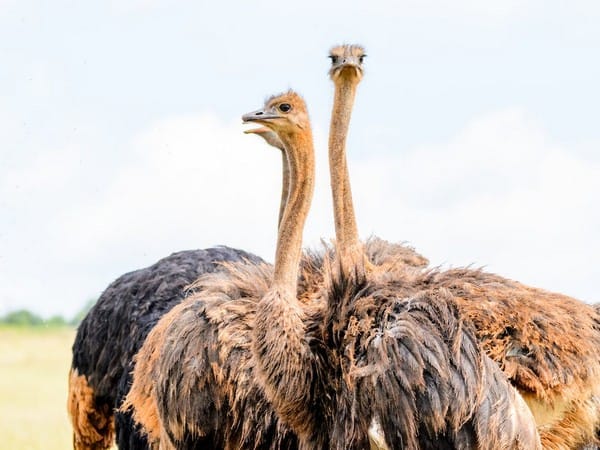



Washington [US], October 22 (ANI): Cooperation and competition in social groups have varied effects on men and women, which may determine which group sizes function best. This is owing to the fact that each has separate interests, according to a recent study from Sweden’s Lund University.
Over a seven-year period, the researchers studied ostriches in differently-sized groups in order to understand the pros and cons of living in a group. At the start of each breeding season, experimental groups of ostriches were established by placing different numbers of males and females in enclosures.
The group sizes were similar to those seen in the wild. During part of the breeding season, the ostriches’ natural cooperative incubation behaviour was prevented by temporarily removing eggs. Using this approach, the researchers could measure what effect the number of males and females and cooperation over incubation had on the group’s reproductive success, measured in the number of offspring born.
“We decided to study the ostriches under controlled conditions in order to distinguish the effect of individual differences from group attributes on reproductive success and find out how competition and cooperation changed with the size of the group,” says Julian Melgar, a biology researcher at Lund University.
It was shown that males and females have different interests, something that was clear in the middle-sized groups. The males wanted to continue mating with females even when the females had already started thinking more about incubating eggs. This resulted in many eggs being crushed.
The males were driven mainly by competition with other males, whereas the females were mainly driven by cooperation both with males and females. This means that males thrive best in relatively small groups in which they are the only male, whereas females like to see that there are other individuals they can cooperate with. Therefore, they also thrive in larger groups.
“The difference in interests between the sexes could help us to explain why the size of ostrich groups varies so much in nature,” says Julian Melgar.
The optimal group size depends on the balance between the sexes, and between competition and cooperation within the group.
Like humans, ostriches manage the challenges of parenting through cooperation. Groups breed in a communal nest and individuals take turns incubating the eggs. However, this cooperative breeding comes at a price – there can be tough competition for mates and whose eggs get incubated.
“As the importance of our results applies not only to ostriches, but also to other organisms that form groups, the results could help us to improve our understanding of the evolutionary driving forces behind the emergence of group living and cooperation,” concludes Julian Melgar. (ANI)
This report is auto-generated from ANI news service. ThePrint holds no responsibility for its content.