





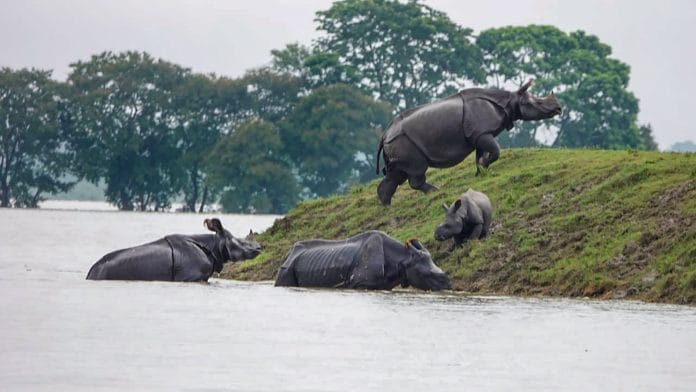



New Delhi: The Indian one-horned rhinos might have at some point roamed the entire northern subcontinent before being confined only to India’s eastern states, according to a new study. Researchers from Lucknow’s Birbal Sahni Institute of Palaeosciences found that climate change and human intervention pushed the species to the eastern pockets of India, gradually making the Brahmaputra floodplains their stronghold.
Scientists reconstructed the ecological history of the Kaziranga National Park (KNP) in Assam over the past 3,000 years and also found that the Indian single-horned rhino may have played a significant role in reshaping the landscape and transforming the dense forests into grasslands.
The study, published in the February issue of the international journal Catena (Elsevier), highlighted that Kaziranga’s current landscape was markedly different from its past. During the assessment, researchers documented the regional extinction of megaherbivores—including the Indian rhinoceros—from northwestern India due to climatic amelioration during the late Holocene (beginning nearly 4,200 years Before Present), especially during the Little Ice Age.
The study mapped how the population and movement of these animals were impacted by human activities and climatic conditions.
“We propose that the wildlife, especially rhinoceros, migrated from the western and northern part of the region into the north-eastern part of the Indian subcontinent in response to climatic amelioration and higher human activities during the late Holocene period,” the study read.
Also read: Kaziranga is ready to share its rhinos. Assam doesn’t want them all in one basket
Method to trace the rhinos
To study the progress of the Indian rhinos, BSIP scientists extracted a sediment core just over a metre long from the Sohola swamp inside Kaziranga National Park. This segment served as a natural archive, preserving pollen grains from plants and fungal spores that thrive on animal dung.
“A 110 cm deep sedimentary profile was trenched at the north-western side of the Sohola swamp, and soil samples were collected at 5 cm intervals for palynological analysis and radiocarbon dating,” the study read.
Radiocarbon dating is a scientific method used to determine the age of organic materials, such as wood, bone, and shells, up to about 50,000-60,000 years old.
Researchers also examined the reasons behind the decline and present confinement of the species through fossil evidence, proving that the Indian rhinos were once widely distributed across the Indian subcontinent. Their presence started declining since the Holocene.
“Over the last 3300 years, northeastern India remained relatively climatically stable with lower human pressure, while habitat loss, climate deterioration, and overhunting in northwestern regions forced rhinoceroses to migrate eastward and eventually concentrate in Kaziranga,” the study read.
A statement issued by the Centre’s Department of Science and Technology, which funds BSIP, read, “The study demonstrates how long-term vegetation and climate changes shaped wildlife survival, migration, and extinction, providing long-term ecological knowledge that can help guide better conservation and wildlife management under present and future climate change.”
(Edited by Theres Sudeep)