





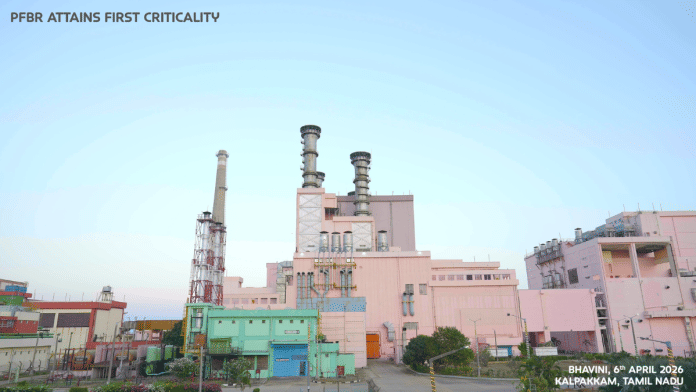



New Delhi: India’s nuclear programme achieved a critical milestone on 6 April after its most advanced nuclear reactor, the Prototype Fast Breeder Reactor located in Tamil Nadu’s Kalpakkam, attained criticality. The reactor is now only a step away from being fully operational.
Calling it a “defining step” in India’s civil nuclear journey, Prime Minister Narendra Modi said that with this feat, India has now advanced to the second stage of its nuclear programme.
“Today, India takes a defining step in its civil nuclear journey, advancing the second stage of its nuclear programme. The indigenously designed and built Prototype Fast Breeder Reactor at Kalpakkam has attained criticality,” Modi said in an X post.
The post added: “This advanced reactor, capable of producing more fuel than it consumes, reflects the depth of our scientific capability and the strength of our engineering enterprise. It is a decisive step towards harnessing our vast thorium reserves in the third stage of the programme. A proud moment for India. Congratulations to our scientists and engineers.”
PFBR is India’s first indigenously developed 500 MWe fast-breeder nuclear reactor located in the Madras Atomic Power Station.
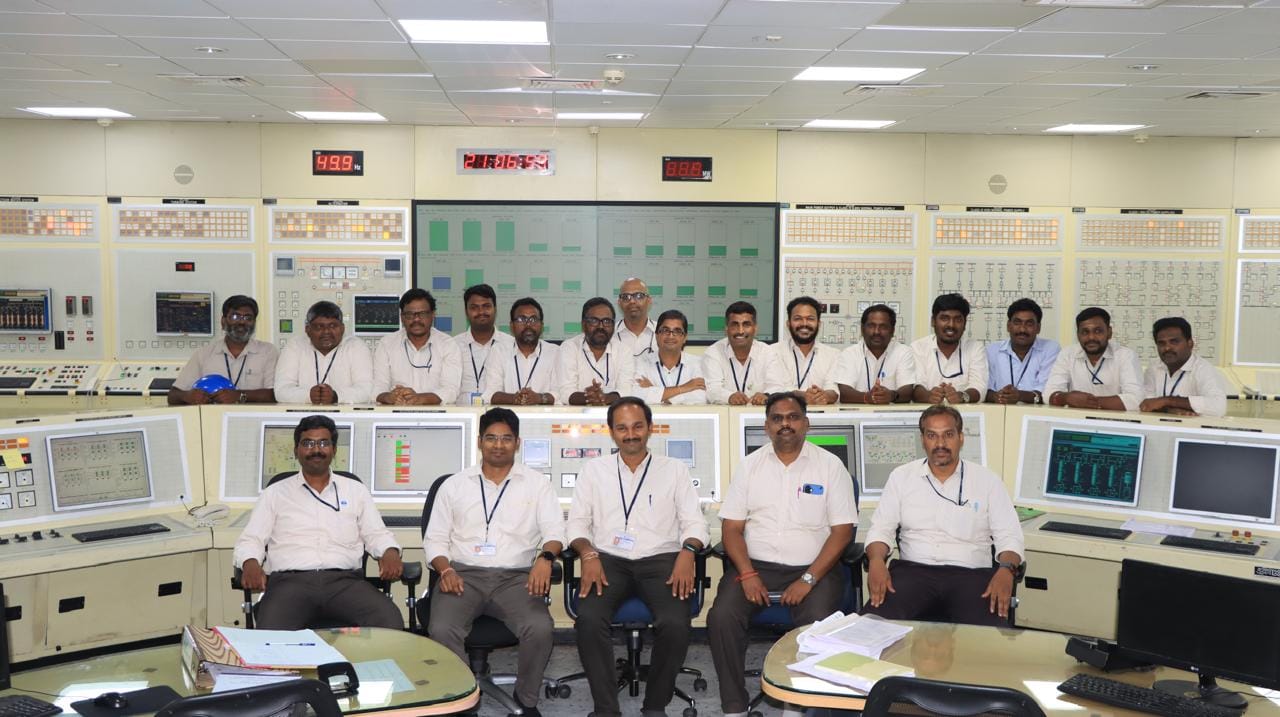
A nuclear reactor attaining criticality means it can sustain a controlled chain reaction of fission, producing a constant power output. However, PFBR still does not produce power at full capacity.
How does the reactor work?
PFBR, being a fast-breeder reactor, generates more nuclear fuel than it consumes, making it one of the most energy-efficient technologies.
The technology used in fast-breeder reactors differs from that in traditional nuclear reactors. Conventional nuclear reactors primarily use uranium as fuel, whereas fast breeder reactors utilise plutonium.
India’s PFBR also currently uses plutonium as fuel, but it has been designed to eventually be able to use thorium, a radioactive element that is abundantly available in India.
The reactor uses fast neutrons and a liquid metal coolant—in this case, liquid sodium—to achieve this. It surrounds the reactor core with a layer of fertile material (like uranium-238), which goes on to convert excess neutrons into fissile fuel.
Fast breeder reactors offer more efficient use of uranium, reducing long-lived nuclear waste by burning spent fuel.
This will pave the way for India to become energy independent.
Prominent nuclear scientist and former chairperson of the Atomic Energy Commission, Anil Kakodkar, said that the PFBR technology makes India only the second country in the world to operate a large fast reactor. The only other country to operate a commercial-scale fast breeder reactor is Russia.
“Today is a historic day. India has entered the second stage of our three-stage nuclear power program with the achievement of criticality of PFBR. Congratulations to every contributor to this critical technology that makes India only the second country to operate a large fast reactor,” he told ThePrint.
According to a document detailing the Kalpakkam reactor’s plan, the Department of Atomic Energy (DAE) explained that PFBR will initially use uranium-plutonium mixed oxide (MOX) fuel. The uranium-238 “blanket” surrounding the fuel core will undergo nuclear transmutation to produce more fuel, thus earning the name ‘breeder’.
In a later stage of the programme, it will also use thorium-232—which by itself is not a fissile material—as a blanket.
“By transmutation, thorium will create fissile uranium-233, which will be used as fuel in the third stage. FBR is thus a stepping stone for the third stage of the program, paving the way for the eventual full utilisation of India’s abundant thorium reserves,” the DAE document read.
For the design of PFBR, safety has been of utmost importance. It is built with inherent passive safety features that ensure prompt and safe shutdown.
The FBR uses spent fuel from the first stage, leading to a significant reduction in nuclear waste. One advantage of such technology is that it eliminates the need to allocate separate land for waste disposal.
“Upon completion of the core loading, the first approach to criticality will be achieved, leading to the generation of power subsequently,” the government said in a statement on Tuesday.
India’s most advanced reactor
Work on PFBR only began in 2004. India was late to the global race because countries like the United States, France, China, South Korea, and Japan had already started work on such breeder reactors in the 1970s and 80s.
But many countries did not continue sustained work on this technology. The US’s Clinch River Breeder Reactor, for instance, was stalled because of the escalating cost of the project, public fears and the government’s shifting energy focus.
A US-based nuclear engineer, Nick Touran, who specialises in advanced nuclear reactor design, reactor development, and the history of nuclear power, called India’s achievement a “great accomplishment”.
“This is a high-tech and powerful reactor, bigger than the Clinch River Breeder the US tried but failed to deliver in the 70s-80s. Breeder technology has long been considered the ultimate goal for nuclear fission. Often demonstrated, not yet done economically,” he wrote on X.
Senior Congress leader and former Minister of State for Commerce and Power, Jayaram Ramesh, recalled his initial interaction with the scientist working on PFBR. told ThePrint that journey towards the PFBR attaining criticality has been extremely challenging but also rewarding. He said that India’s three stage nuclear programme, concieved in the 1950s by pioneer nuclear scientist Homi J Bhabha, was routed in Fast Breeder Reactors (FBR).
“I hope this government now commits to taking this programme to its third phase. The logical next step will also be to advance India’s work on the Advanced Heavy Water Reactors (AHWR) too. People are saying there has been a lot of delay in reaching this stage of the nuclear programme, but I would not call it that. The process has been extremely challenging and has been a learning curve,” Ramesh said.
Recalling his initial interaction with the scientists, Ramesh added, “I have visited the Kalpakkam facility multiple times. In 2008, when I was the power minister, I had the good fortune of having a detailed interation with Dr Baldev Raj (former director of the Indira Gandhi Centre for Atomic Research). This milestone is the result of decades of dedicated and determined effort. When many countries in the world was abandoning this technology, India believed in its potential.”
In 2024, the work on PFBR was revived with a greater focus on nuclear technology. The Modi government last year also launched the Nuclear Energy Mission for Viksit Bharat, under which it established its commitment to scale up India’s nuclear power capacity to 100 GW by 2047.
“Beyond energy generation, the fast breeder programme strengthens strategic capabilities in nuclear fuel cycle technologies, advanced materials, reactor physics and large-scale engineering. The knowledge and infrastructure developed through this programme will support future reactor designs and next-generation nuclear technologies,” DAE said in a statement on Tuesday.
(Edited by Insha Jalil Waziri)