





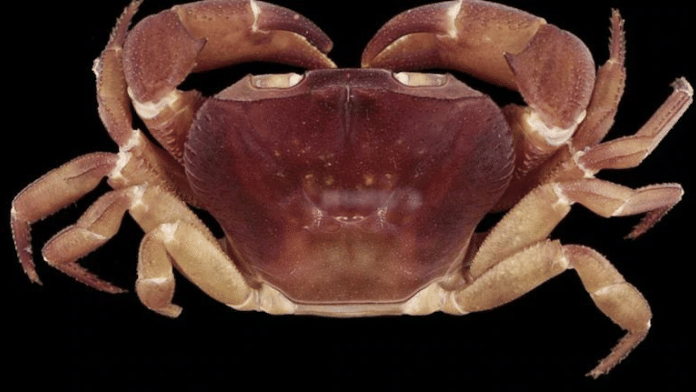



New Delhi: It was recently discovered that a freshwater crab species found only in the Silent Valley National Park in Kerala has a unique trait — it has both male and female reproductive organs. This condition, known as gynandromorphy, was discovered for the first time by scientists from the Zoological Survey of India and MES Mampad College of Calicut.
The paper, Unveiling gynandromorphy in the freshwater crab Vela carli (Roux, 1931) (Decapoda: Brachyura: Gecarcinucidae): the first reported case in the family, published on 10 March in the Crustaceana Journal, the study analyzed the anatomy of over one hundred individuals of the crab species known as Vela carli, which were collected from Palakkad and Mallapuram in Kerala. Scientists found at least three adult specimens
“These three anomalous specimens appear to represent the first known cases of gynandromorphism in the freshwater crab family Gecarcinucidae,” the study found.
Crabs are usually dimorphic species, meaning their males and females have very distinct traits. Not just reproductive organs, male crabs usually have larger claws, narrower abdomens, and sometimes even different colours than female ones. Since crabs reproduce internally, their sexual organs are also well-defined, making it easy to distinguish between males and females by looking at the underside of the invertebrates.
This, however, was not as easy for the scientists collecting the species to differentiate.
The three crabs categorised as gynandromorphic are neither fully female nor fully male. This is due to anomalies in parts of the crab’s body, specifically the pleopods, which are seen in males for transferring sperm. Most male crabs have four pleopods for different parts of the reproductive process, but none of the three crabs examined had all four: one had three, another also had three but two were poorly formed, while another only had two pleopods.
It could just mean that they were underdeveloped male crabs. However, that was not all. All three crabs also had gonopores, which are the female reproductive organs. None of the gonopores was fully developed, and did not resemble the organs found in developed female crabs.
Taken together, these findings led scientists to conclude that the Vela carli species has gynandromorphic individuals. This is the first time such a discovery has been made for this family of crabs.
Also Read: India’s NavIC is not fully functional even after 27 years—military loses the most
Why is it significant?
Gynandromorphy is an indicator of poor childhood growth and could also be seen as a developmental disorder in crabs. However,
various reasons for this developmental anomaly could exist, which the scientists explored in their paper.
“Morphological anomalies in crabs may be caused by the presence of chemical pollutants in the environment, such as tributyltin and copper. However, since the gynandromorphs of V. carli were collected from the Silent Valley National Park … chemical pollutants are unlikely to have influenced the reproductive system of this species,” read the paper.
Since pollution and environmental degradation were ruled out as a possible reason for this phenomenon, scientists
Early developmental errors, such as changes in the embryo or cell division, could have led to this reproductive anomaly. Another reason could be a hormonal imbalance, which has also been seen to cause androgyny in other species of crustaceans. The third reason, which requires further research, is climate-related stresses like temperature changes and rainfall variations that could cause larger issues such as unequal sex ratios in certain animal species.
The study filled an important gap in crustacean developmental research, especially given that the species is endemic to India — this information will help in the understanding of flora and fauna species in the subcontinent.
(Edited by Insha Jalil Waziri)