





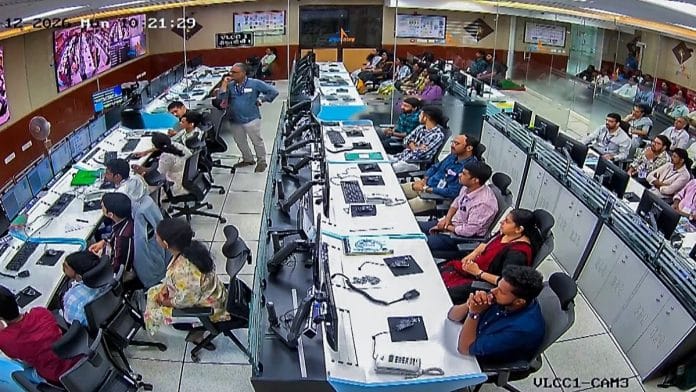



New Delhi: The Indian Space Research Organisation’s failure to place 16 satellites in the intended orbit on Monday was much more than just a bad start to the year. For the first time since 1999, when India launched its first foreign satellite, the space agency has failed a foreign customer. It was also the first time that a commercial satellite mission carrying payloads from private startups had failed.
The PSLV-C62 mission, which had the EOS-N1, built by the Defence Research and Development Organisation (DRDO), as its primary payload, was also carrying eight foreign passenger satellites.
The mission carried Theos-2, an earth observation satellite built jointly by the UK and Thailand; Munal, a technology demonstration satellite by Nepal; Edusat, an IoT demonstration satellite, Uaisat, an agricultural data collection satellite, Galaxy Explorer, a radiation measurement satellite, Orbital Temple, a communications satellite and Aldebaran-1, a marine rescue satellite by Brazil’s AlltoSpace.
The mission also carried the Kestrel Initial Technology Demonstrator, developed by a Spanish startup, as a small-scale prototype intended to re-enter Earth’s atmosphere.
On Monday, ISRO’s PSLV-C62 mission failed after there was an anomaly in the third phase of the flight. ISRO chairperson V Narayanan said that a Failure Analysis Committee (FAC) will assess the reason behind the anomaly.
PSLV, which is otherwise considered the space agency’s ‘workhorse’, has made 63 launches, with nearly a 90 per cent success rate.
Ajey Lele, deputy director general at the Manohar Parrikar Institute for Defence Studies and Analyses (MP-IDSA), said that before this mission, India had an “unblemished record” with foreign payloads.
He also added that this was the first time an ISRO mission carrying commercial satellites from start-ups was unsuccessful. Earlier, all other failures were in missions carrying ISRO payloads.
“There might be some questions as to the feasibility of launching through ISRO after two back-to-back failures of PSLV,” said Lele.
“But we should also remember that it is the first time this is happening. Percentage-wise, PSLV has a high success rate.”
Also read: The twist no one saw coming — comet 3I/ATLAS is older than the Sun
India’s record with foreign customers
ISRO launched its first foreign payload in 1999 with Germany’s DLR-TUBSAT—a remote sensing microsatellite. Since then, ISRO has launched 434 satellites for foreign customers, with its last successful commercial mission in December 2025. Countries like Singapore, the UK, the USA, Brazil, Spain and Finland have been among India’s regular customers.
On 24 December, ISRO had launched the US’s BlueBird Block-2, a massive next-generation satellite from AST SpaceMobile. The same month, ISRO had also carried out the European Space Agency’s PROBA mission. This was carried out on the PSLV-C59 mission.
(Inputs from Akanksha Mishra)
(Edited by Theres Sudeep)