





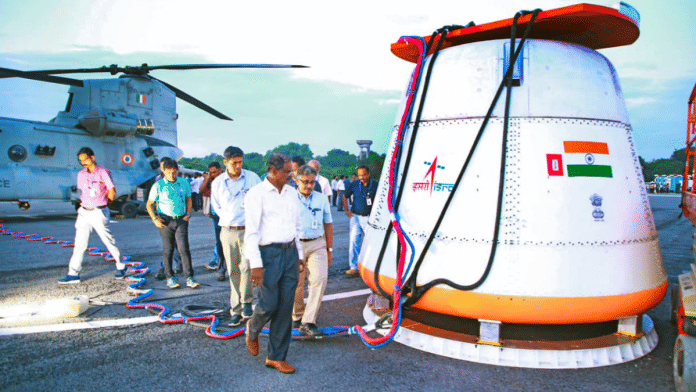



New Delhi: The Indian Space Research Organisation on Friday successfully conducted the second integrated air drop test, or IADT-02, for India’s first human spaceflight mission, Gaganyaan. The test was critical to ensure the safety and smooth splashdown of the module that will carry the Indian astronauts.
Union Minister for Science and Technology Jitendra Singh said that the test was carried out in partnership with the Indian Air Force and the Indian Navy from the Satish Dhawan Space Centre in Sriharikota.
“Congratulations ISRO for the successful accomplishment of Second Integrated Air Drop Test (IADT-02) for Gaganyaan, India’s first Human Space flight scheduled next year. The second Integrated Air Drop Test (IADT-02) was successfully conducted at Satish Dhawan Space Station Sriharikota. This marks an important milestone towards the readiness for the Gaganyaan mission,” Singh announced in a post on X.
ISRO had conducted the first integrated airdrop test in August 2025.
Also read: India and China make Earth glow brighter at night. 16% more
How was the test conducted?
Senior officials from ISRO told ThePrint that an IADT is conducted to test the series of parachutes deployed in the Gaganyaan crew module to ensure that it splashes down safely during its return journey.
The space agency is yet to issue an official statement on the details of IADT-02.
The test involved the Indian Air Force Boeing CH-47 Chinook helicopter carrying an underslung weight of about 5,000 kg—equivalent to the weight of the Gaganyaan crew module. The test capsule was then lifted to an altitude of 3-4 km, from where it was dropped into the sea a few kilometres from the coast.
The test examined the gradual descent of the capsule to ensure that all parachutes function properly and that the descent is controlled.
This ensures that the astronauts inside the capsule do not have to experience a sudden descent. Once the capsule has successfully splashed down, the Indian Navy vessels will fish it out, inspect it, and bring it to shore.
Gaganyaan, now slated for 2027, will launch a crew of two or three astronauts into low Earth orbit at a distance of nearly 400 km from the ground for a three-day mission, then bring them back safely.
ISRO said last year that it would be conducting its uncrewed mission with a humanoid, Vyomitra, in the first half of 2026. The test flight will be launched before the astronauts to demonstrate an end-to-end mission. In this flight, the aerodynamic characterisation of the human-rated launch vehicle, along with mission operations of the orbital module, re-entry, and recovery of the crew module, will be tested.
(Edited by Prasanna Bachchhav)