





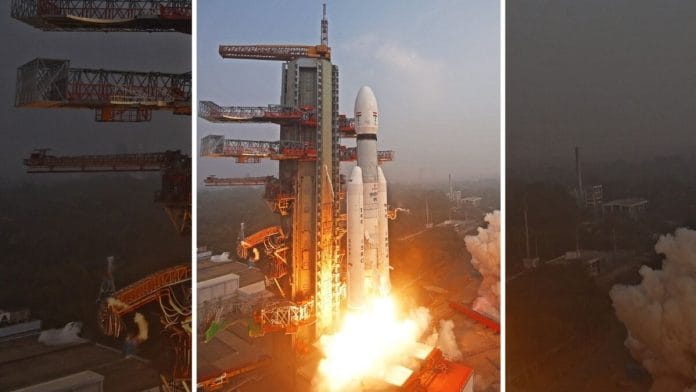



New Delhi: Between 2015 and 2024, India launched 393 foreign satellites, earning nearly $143 million and 272 million euros and solidifying its presence in the global commercial launch arena, states the Economic Survey 2025-26.
The survey, tabled before the Parliament Thursday, added that India’s space sector was valued at about $8.4 billion, accounting for around 2 per cent of the global space market. It is projected to expand to about $44 billion over the next decade, driven by launch services, satellite communications, earth observation, navigation and a rapidly growing private ecosystem.
“India’s space sector has emerged as a fast-growing, technology-intensive and increasingly commercial segment of the services economy,” the economic survey reads.
The document states that NewSpace India Limited (NSIL), the commercial arm of the ISRO, had significantly increased its revenue between 2020 and 2025. From Rs 322 crore in 2020, NSIL’s revenue increased to Rs 2,940 crore in 2023, and was projected to be Rs 3,246.1 crore in 2025.
“Profitability has also improved steadily, driven by demand-driven missions, satellite capacity leasing, and end-to-end commercial project execution, including dedicated launch services and the deployment of communication satellites,” the survey reads.
Also read: Space insurance is gaining traction among Indian startups. PSLV failure highlights the need
Growing market
The economic survey also highlighted that India’s satellite-enabled services were expanding rapidly, with its satellite data services market valued at $495 million in 2024.
A majority of these services were driven by applications in defence, climate services, logistics and urban planning. Apart from these areas, India’s private space ecosystem has also expanded into manufacturing, launch vehicles, data analytics, and downstream services, attracting over Rs 1,000 crore in private funding in the 2023 financial year.
“Policy initiatives such as the Indian Space Policy 2023, the operationalisation of IN-SPACe, and liberalised FDI norms have lowered entry barriers and enabled a transition towards a mixed public-private services model,” the survey reads.
This, the report states, has enabled the space sector to evolve into a “high-value, export-oriented and innovation-driven services segment.”
(Edited by Saptak Datta)