





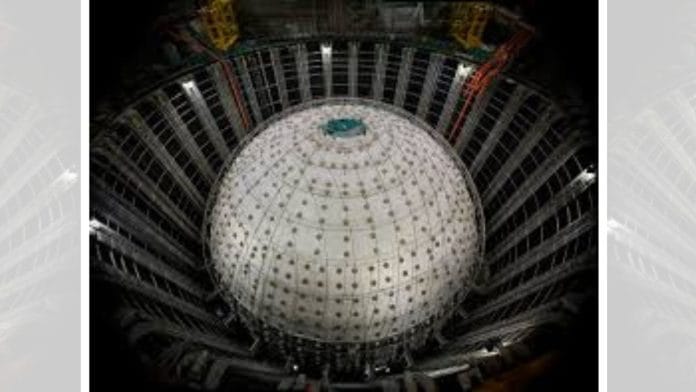



New Delhi: The world’s largest neutrino detector—Jiangmen Underground Neutrino Observatory (JUNO) in China—delivered its first results last week, sharpening our understanding of the ghost particles that are neutrinos and setting the stage for solving bigger cosmic puzzles.
The results were a breakthrough moment in particle physics worldwide. But for physicists in India, it was bittersweet—a reminder of a missed opportunity, a fight they have been partaking in for nearly two decades. “We had proposed this [JUNO-like] project in 2006.
So, we could have been where China is today. We had a big advantage back then,” Naba Mondal, the former project director of the Indian Neutrino Observatory (INO), told ThePrint.
INO—India’s ambitious underground neutrino observatory—was supposed to be built in the Bodi Hills of Theni in the Western Ghats of Tamil Nadu. After the initial hiccups due to uncertainties over location, the observatory was also approved by the Cabinet in 2015 and was to be constructed at an estimated Rs 1,583 crore. But political interference and local outrage put the project on hold.
Scientists who have been involved in the project call it a missed opportunity for India now.
“There was a lot of misinformation spread around the facility. We were willing to clarify all public concerns and doubts, but we did not get a platform to do so effectively,” Mondal rued. “If INO had been approved, India would be leading the global neutrino research.”
Also Read: Immortality was ‘scientifically proven’ in 1910s. But cancer cells compromised the study
India’s to-be mega project
INO was proposed as a mega project for particle physics research. Neutrinos—a fundamental elementary particle commonly known as the ‘ghost particle’— hardly interact with other forms of matter due to their lack of electrical charge and hence are notoriously difficult to detect.
So, neutrinos have to be studied in the absence of cosmic rays or any other interfering particles from space that could drown out their faint signals. And, this is why the proposed site for India’s neutrino observatory was a 33-acre plot that would lead to a 1,200-metre-deep cave in Theni.
This underground facility was designed to house a magnetised detector with three modules, each weighing roughly 17,000 tonnes, and nearly 50,000 magnetised plates. Called the Iron Calorimeter (ICAL), this could have recorded neutrino interactions as they passed through the detector.
The laboratory was to take the shape of a large cavern—132m X 26m X 20m in size. The large cavern would house several smaller caverns, which would be accessed by a tunnel, 1,900m in length and 7.5m in width.
If the facility had seen the light of day, the magnet inside would have been 50-kilotonne, making it the world’s biggest.
Thick rocks would also have shielded the facility to ensure that neutrino ‘flavours (properties)’ could be tracked without interference.
A senior official from the Centre’s Department of Science and Technology (DST)—the agency in charge of the project with the Department of Atomic Energy—explained that the first chosen site for INO was Singara in the Nilgiri Hills. However, the Union Environment Ministry declined that proposal due to the area’s proximity to the Mudumalai Tiger Reserve.
Site proposals were limited. “The site needed to be geologically stable, with low seismic activity. This is why we could not go north. Tamil Nadu was the ideal location,” the official said.
In India, seven primary and 14 participatory research institutes—led by the Tata Institute of Fundamental Research (TIFR) and the Indian Institute of Mathematical Sciences (IIMSc)—were due to benefit from the observatory.
The opposition
Between 2018 and 2020, Professor Mondal and his colleagues, who had been leading the INO project, tried to meet the politicians who had opposed the observatory. All they wanted to do was explain the project and dispel the misinformation around it. But, “we weren’t given that opportunity”, Mondal said.
When scientists first conducted a recce of the Theni site, residents raised a primary concern—whether the facility would have any health or environmental impacts. Most politicians confused the neutrino lab with a nuclear facility, which could have potentially harmed not only the underground water but also the surrounding forests.
For the observatory, environmental concerns became the final nail in the coffin.
In 2022, the Tamil Nadu government officially filed an affidavit before the Supreme Court, opposing the construction of the proposed INO. It highlighted that the facility was too close to a tiger corridor that connected the Periyar Tiger Reserve on the Kerala-Tamil Nadu border and the Mathikettan Shola National Park. “The project in question falls exactly on the hill slopes of this part of the Western Ghats, which align within it a significant tiger corridor, namely the Mathikettan-Periyar tiger corridor,” the state’s affidavit said.
At the time, Professor Gobinda Majumder, project director at the Pottipuram Research Centre, Tata Institute of Fundamental Research, released a statement, saying that the INO site would be deep underground and would have no impact on the tigers or their habitat on the surface.
(Edited by Madhurita Goswami)