





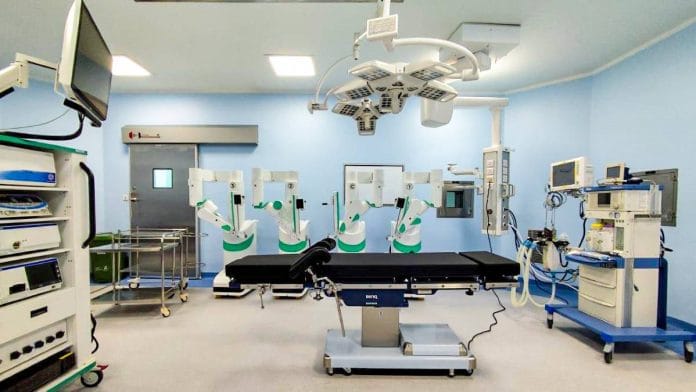



New Delhi: Inside one of AIIMS New Delhi’s operation theatres, a surgeon sits at a console—the command station for robot-assisted surgeries—with eyes fixed on a screen, guiding instruments no wider than a pencil to perform the operation.
Once the surgeon begins directing the procedure from the console, the robot proceeds to physically execute the task inside the patient’s body.
Such robot-assisted surgery setup has now become a norm at AIIMS, which has been conducting robotic surgery since 2010, but frequently so in the last decade.
On Tuesday, doctors at the institute’s Department of Surgical Disciplines crossed 1,000 robot-assisted surgeries, a first for a general surgery department in a government hospital in India.
“The system works on a master-slave model,” explains Dr Hemanga Bhattacharjee, professor of surgery at AIIMS. “The surgeon’s hands control every movement. The robot only translates those movements inside the body with greater precision.”
From the console, surgeons operate using instruments that bend and rotate far more than the human wrist can. A magnified three-dimensional view allows them to work in narrow spaces, such as the pelvis or deep abdominal cavities, where conventional laparoscopic surgery can be limiting.
Dr Sunil Chumber, head of surgery at AIIMS, says the advantage is most visible in minimally invasive cancer surgeries. “In procedures like rectal cancer surgery, space is extremely limited. Robotics gives better vision and finer control, which can reduce trauma and fasten recovery,” he explains.
While AIIMS Delhi was among the earliest public healthcare institutions in India to acquire a robotic surgical system, adoption has been slower in public health systems across the country due to high capital costs and procurement hurdles.
Currently, government hospitals account for just 10 percent of robotic surgery systems, whereas an estimated 90 percent are housed in private hospitals.
More than 100 surgical robots are now operational across Indian hospitals and experts estimate that India does 50,000 to 60,000 robotic surgeries every year.
Leading government centres such as AIIMS Delhi, PGI Chandigarh, SGPGI Lucknow, JIPMER Puducherry, AIIMS Jodhpur, AIIMS Rishikesh and SMS Medical College Jaipur have now established active robotic surgery programmes.
Also Read: Can cancer cells ‘cheat’ drugs? US researchers find they ‘fake’ death to escape treatment
Data on changing surgical practice
International trends explain why robotic surgery is expanding so rapidly. Citing data from the American surgical community, Dr Chumber says the real shift is not from open surgery, but from laparoscopy to robotics.
Open surgery involves a large incision and direct manual access to the organ, laparoscopic surgery uses small incisions with long instruments and a camera, whereas robotic surgery builds on laparoscopy by allowing the surgeon to operate through robotic arms with greater precision, flexibility and control.
“In 2017, nearly 40 percent of hernia surgeries were done using open techniques, and even in 2022, that number remained almost the same,” he says. “So open surgery has not increased.”
What has changed sharply is the use of robotic systems.
“In 2017, only about 15-16 percent of hernia surgeries were done robotically. By 2022, that figure surged to almost 40 percent. That is a significant leap,” Dr Chumber adds.
At the same time, laparoscopic procedures declined. He noted that laparoscopic hernia surgeries accounted for around 20-30 percent of cases in 2017, but dropped to roughly 15-18 percent by 2022. The trend, he said, shows that many laparoscopic surgeons are increasingly shifting to robotic methods.
Why private hospitals moved faster
Long before government hospitals began adopting robotics, private hospitals had already embraced it. The reasons were practical rather than experimental.
Early on, access was restricted by cost and training. Systems were expensive, surgeons had to travel abroad for training, and only a handful of hospitals could afford both. Over time, more surgeons trained in robotic techniques, and more systems entered the Indian market, lowering entry barriers.
Dr Vivek Bindal, chairman of Clinical Robotic Surgery Association of India, a network of over 300 surgeons who conduct robotic surgery, explains that insurance coverage also played a role. Around 2019, robotic procedures began finding space within health insurance policies after regulatory clarity from the Insurance Regulatory and Development Authority of India (IRDAI). Even partial reimbursement made the option viable for more patients.
“The COVID-19 pandemic further accelerated adoption. Hospitals prioritised minimally invasive procedures that reduced complications, hospital stays and infection risks. Robotic systems fit neatly into that shift,” says the doctor.
“Competition changed the market as well. For years, a single global company, Intuitive, dominated surgical robotics. Since 2019, newer international and Indian-made systems like SSI Mantra have entered, pushing hospitals to adopt the technology to stay competitive.”
According to Dr Bindal, government hospitals are catching up. “But capital and funds remain the biggest hurdle,” he adds.
From metros to smaller cities
Doctors at AIIMS New Delhi estimate the adoption of robotic surgery is growing at a rate of 15-20 percent annually in India.
At AIIMS, robots are assisting in performing procedures to treat conditions affecting the liver, bile ducts and often the gallbladder. These include pancreatic duodenectomy, gastrectomy, esophagectomy colectomy, anterior resection for gastro-intestinal malignancy, various complex abdominal wall reconstructions for hernias, kidney transplantation and minimally invasive resection of thyroid, parathyroid, adrenal and pancreas for endocrine tumours.
“At present, gastrointestinal and general surgery account for the maximum number of robotic procedures in India. This branch is commonly referred to as GI and general surgery. For many years, it has consistently remained the leading speciality in terms of robotic surgical volume, and it continues to hold that position,” says Dr Bindal.
What is striking now is not just adoption by large corporate hospital chains, but its spread beyond metros. Hospitals in Tier I and Tier II cities like Lucknow and Mysuru are reporting hundreds of robotic procedures annually, across specialties including gynaecology, gastrointestinal surgery, urology and oncology.
According to hospital administrators, the appeal is not only clinical. Shorter hospital stays means quicker bed turnover. Faster recovery reduces post-operative care costs.
Doctors at AIIMS also say that robotic surgery has been linked to improved surgical outcomes worldwide. Studies show that robotic-assisted procedures lead to a 50 percent reduction in postoperative pain compared to traditional open surgery.
“Hospital stays for patients are about 30 percent shorter, helping reduce overall healthcare costs. In addition, robotic surgeries are associated with nearly 40 percent lower rates of surgical site infections due to smaller, more precise incisions,” says Dr Bhattacharjee.
The cost question
Robotics assisted surgery, however, doesn’t come cheap.
The whole business remains expensive. The cost of a single system can run in crores, with additional annual maintenance expenses. Training surgeons, nurses and technicians is equally critical.
“Take gallbladder surgery as an example. If it is done as an open procedure, it costs around Rs 10,000 to Rs 15,000. If the same surgery is done laparoscopically, it usually costs about Rs 10,000 more because of better facilities, an air-conditioned operation theatre, trained staff and overall hospital infrastructure. In a five-star hospital, the cost goes up even further,” Dr Chumber says.
“When gallbladder surgery is done using robotic technology, some hospitals that have tie-ups with robotic companies add around Rs 1 lakh to the bill. So, if a surgery otherwise costs Rs 15,000, the robotic version comes with a significant additional cost. Over time, however, I believe these costs will settle at a more reasonable level,” he adds.
(Edited by Nida Fatima Siddiqui)
Also Read: PSLV-C62 failure: What Indian start-ups say about trusting ISRO as a launch partner