





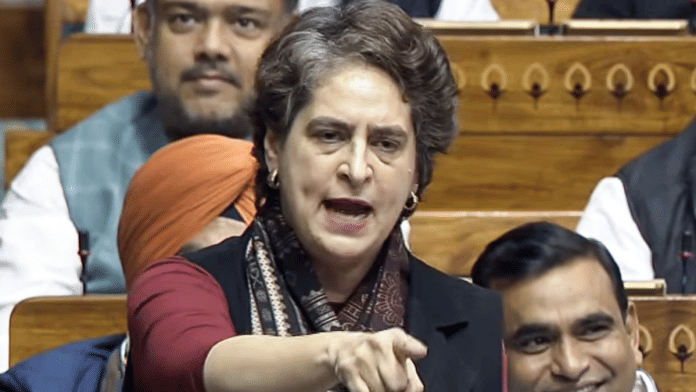



New Delhi: The BJP government has committed a “sin” by turning Vande Mataram into a subject of dispute, Congress MP Priyanka Gandhi Vadra said Monday, challenging Prime Minister Narendra Modi’s claim that Jawaharlal Nehru took the lead in adopting its truncated version as the national song disregarding the views of leaders such as Netaji Subhash Chandra Bose.
Speaking in Lok Sabha, Priyanka lambasted the BJP-led government, accusing it of coming up with the idea of holding a Parliamentary debate on Vande Mataram keeping next year’s assembly elections in West Bengal in mind.
She claimed the government also wanted to divert people’s attention from “burning issues” by forcing them to continue to gaze into the past instead of resolving the issues of the present and shape their future.
“By turning this mahamantra (sacred chant) of the country’s soul into a disputed matter, you are committing a sin. The Congress shall not be a party to this sin. This national song Vande Mataram has always been loved, been sacred for us, and shall always remain sacred for us,” Priyanka said, in a speech that saw frequent interjections from the treasury benches meet with her smiling repartees.
Priyanka pointed out that like the present form of Vande Mataram, India’s national anthem Jana Gana Mana, a creation of Rabindranath Tagore, is also essentially selected stanzas of a long poem. And it was Tagore who played a major role in picking the stanzas that feature in the national song and the national anthem both, she said.
“It is an open assault on the constituent assembly and the Constitution,” said Priyanka, referring to Modi’s remarks in his speech that the truncation of the song written by Bankim Chandra Chatterjee was the result of a divisive mindset.
Raising questions on the current form of Vande Mataram which was adopted by the Constituent assembly is not just an insult to the great minds and the great wisdom reflected in their decision, but also exposes an anti-Constitutional mindset, she said.
“Have our friends in the ruling side become so arrogant that they have started considering themselves bigger than Gandhi, Tagore, Rajendra Prasad, Ambedkar, Maulana Azad, Sardar Patel, Subhash Bose?”
Appearing to quote from ‘Vande Mataram-The Biography of a Song’ by the late historian Sabyasachi Bhattacharya, Priyanka claimed that the first two stanzas of the song were written by Bankim Chandra Chatterjee in 1875.
He added the later four stanzas—dropped in 1937 by the Congress during its adoption to be sung at the party’s events and afterwards as the national song—in 1882 during the publication of Ananda Math, the novel where it was incorporated, she said.
She added that in 1896, at the Congress’s Calcutta session, Tagore sang after giving tunes to it, and in the years that followed it became an anthem against the partition of Bengal in 1905 by the British. It was only in the 1930s that the song became disputed against the backdrop of communal politics rearing its head in the country, she said.
“On 17 October, 1937, Bose, ahead of the Congress’s session in Calcutta, wrote to Nehru. The PM did not mention that in his speech. Bose wrote: ‘My dear Jawahar, reference Vande mataram, we shall have a talk in Calcutta and also discuss the question in the working committee if you bring it up there. I have written to Dr Tagore to discuss this matter with you when you visit Shantiniketan. Please do not forget to have a talk with him when you are in Shanti Niketan’,” Priyanka said.
She also said that Nehru’s response three days later was also missing from Modi’s speech, accusing the PM of cherry-picking facts to suit his narrative.
She said Nehru had responded to Bose on 20 October 1937 that “there is no doubt that the present outcry against Vande Mataram is to a large extent a manufactured one by the communalists. Whatever we do we cannot pander to communalist feelings but meet real grievances where they exist. I have decided now to reach Calcutta on the 25th morning. This will give me time to see Dr Tagore as well as other friends.”
Following the dialogue, Tagore had said that he freely concedes that the whole composition “read together with its context is liable to be interpreted in ways that might wound Muslim susceptibilities”, she said.
However, he had also built a strong case for the retention of the first two stanzas, saying they should “need not remind us every time of the whole of it, much less of the story with which it was accidentally associated. It has acquired a separate individuality and an inspiring significance of its own in which I see nothing to offend any sect or community”, Priyanka said.
She said that at the 1937 Congress Working Committee meeting, the Congress embraced Tagore’s advice, with Nehru stating, “The first two stanzas are such that it is impossible for anyone to take objection to, unless he is maliciously inclined. Remember, we are thinking in terms of a national song for all India.”
Priyanka said that the Congress Working Committee in 1937 that had adopted the first two stanzas of the song had Gandhi, Bose, Nehru, Acharya Narendra Dev, Patel on the same page.
She also pointed out that the Constituent Assembly that went on to adopt the same stanzas as the national song in 1950 had members including B.R. Ambedkar and Syama Prasad Mookerjee, the founder of the BJP precursor Bharatiya Jana Sangh.
(Edited by Ajeet Tiwari)