





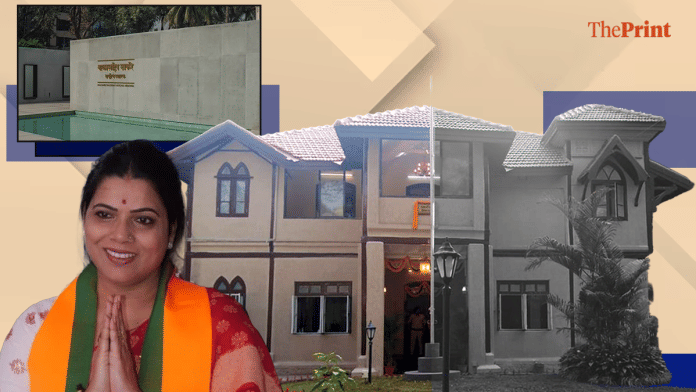



Mumbai: The residence had fallen quiet. The ceiling had started leaking. The floor was covered with a thick layer of dust. The heritage furniture and upholstery had begun falling apart. The house wore a haunted look. But after a gap of four years, the mayor’s bungalow at Byculla is being decked up for Ritu Tawde, the first citizen of Mumbai.
The bungalow is now undergoing renovation and maintenance, and according to the BMC, it should be ready soon. Not a large project, but a basic renovation is underway, the project engineer at BMC told ThePrint. “…just basic maintenance, because the house was closed for years,” the engineer told ThePrint, adding that the work includes cleaning, polishing, painting, and changing the furniture upholstery.
“When the new mayor comes in, based on the mayor’s demands and needs, we will add more items to the house. This is a heritage house, so we can’t change the structure too much. For the rest of the works, like flooring, gardening, compound walls, and noise reduction, I will issue the tender later on,” the engineer said.
Before the Byculla Zoo bungalow, Mumbai’s mayors used to live at Dadar Shivaji Park, which is now being converted into Bal Thackeray’s memorial. Much of the work is complete, but the memorial has not opened to the public, so far.
Shiv Sena’s Vishwanath Mahadeshwar and Kishori Pednekar have earlier walked the halls of the Byculla bungalow.
Mahadeshwar was the first mayor to reside in the bungalow after vacating the Shivaji Park residence. On 20 January 2019, he moved into the residence and remained there until the end of his term.
From November 2019 to March 2022, Sena’s Kishori Pednekar served as the mayor and lived in the house.
“I have lots of memories in that bungalow. From my son’s wedding to staying with staff all locked up during COVID-19—my memories are quite sweet and unforgettable,” ex-mayor Pednekar told ThePrint.
Since then, the bungalow has been empty.
Following the corporation elections last month, the Mahayuti is set to form the BMC administration, with the BJP getting its first go at the mayoral post in four decades.
Also Read: Grassroots workers or ‘proxies’? How Maharashtra women leaders have fared with quota in local bodies
Shivaji Park mayor’s bungalow
Around a century ago, this Victorian-era structure was built in 1928 as the residence of the queen of Bikaner. Later, the British used this property to store documents.
Spanning four acres, it is a Grade-II heritage structure, a vital local landmark that defines a region’s identity and where internal changes and adaptive reuse are permitted.
A curved driveway leads up to the bungalow, which comes with a garden in the backyard. Sea-facing, the bungalow is lined on its perimeter by coconut and mango trees, with waves persistently thrashing its back fence.
After Independence in 1962, the BMC bought the bungalow to make it the official mayoral residence and spent nearly Rs 1.5 lakh for its renovation. The first mayor to stay in the house was Dr B.P. Devgi from 1964-65. Since then, 76 mayors of Bombay/Mumbai have worked and rested within its walls.
The sea-facing property is ground-plus-one storey. The ground floor has two halls, each of 500 square feet. It also has a kitchen and a 300 sq ft VIP room. On the upper floor, the bungalow has four bedrooms.
Since the turn of the century, the bungalow has undergone cosmetic renovations for maintenance purposes.
In 1966, Bal Thackeray founded the Shiv Sena party and held its first rally at Shivaji Park ground, opposite the Mayor’s bungalow. Since then, the bungalow has been a witness to multiple thundering speeches of Bal Thackeray for the next 40 years.
This property is very close to the heart of Thackerays and Shiv Sainiks. According to old Shiv Sainiks, Bal Thackeray would visit the bungalow before his Dussehra rally speech, spending some time with the Shiv Sainiks and the mayor before heading to the park.
Shiv Sena supremo Bal Thackeray’s association with the mayor’s bungalow ran deeper. When he wanted to meet corporators or MLAs, he preferred the sea-facing bungalow.
The bungalow is also witness to an event—now etched in history—when the then home minister of Maharashtra, Chhagan Bhujbal, dared to do what nobody else had. Bhujbal, once a protégé of Bal Thackeray, split from Shiv Sena in 1990. He joined the Congress and then the Nationalist Congress Party.
In 1999, when the Congress-NCP came to power in the state, Bhujbal was made the deputy and home minister. And he issued orders to arrest Bal Thackeray in a case that involved hate speech and causing enmity between communities through his editorials in Saamana, the Sena mouthpiece.
Since Thackeray did not want to be arrested from his residence, Matoshree, and did not want to go to the police commissionerate, he went to the sea-facing bungalow.
With the entire city tense, Thackeray was arrested from this bungalow, in a never-seen-before incident and was produced in the magistrate’s court in Bhoiwada nearly half an hour later. He was let go within an hour.
After the death of Bal Thackeray, Shiv Sena was looking for a place to build a memorial for Thackeray, and the family wanted the memorial in Dadar.
In 2017, the BMC decided to convert the sea-facing bungalow into the late Bal Thackeray’s memorial. The general body of the BMC corporators approved the proposal to lease the bungalow to a trust constituted by the state government for the task at a nominal annual rate of Re 1 for the next 30 years. However, the construction of the memorial was to be done without touching or damaging the existing heritage structure.
The mayor’s residence, thereafter, shifted to the bungalow inside Byculla Zoo.
“That old Shivaji Park bungalow was beautiful, and anyone who has stayed there loved it. We were lucky to have stayed there,” Pooja Mahadeshwar, corporator of Shiv Sena-UBT and wife of late mayor Vishwanath Mahadeshwar, told ThePrint.
The Mahadeshwar family was the last to stay at the Shivaji Park bungalow, where they stayed for two-and-a-half years.
“It was quite a historic property, and staying there was a big deal. Whenever I used to stand at the porch on the first floor, I could see people peeping in from the gate only to get a glimpse of it,” said Pooja Mahadeshwar.
Also Read: Cracks appear in Thackeray alliance as Raj’s MNS backs Shinde Sena’s mayor bid in Kalyan-Dombivli
Byculla mayor’s bungalow
After the decision to convert the Dadar bungalow into the Bal Thackeray memorial, the Byculla bungalow was selected.
“When the question arose where to shift the Mayor, we had two options in front of us—Malabar Hill and Byculla. But Malabar Hill was Mumbai’s end, and for people coming from North Mumbai or elsewhere, it was far off. Since the Byculla one was centrally located and was easier for people to come and go, Uddhav saheb said we should shift here,” said Kishori Pednekar.
But some Shiv Sainiks, including then-mayor Vishwanath Mahadeshwar, opposed the decision, preferring the Malabar Hill bungalow as the mayoral residence.
At that time, Mahadeshwar opposed the residence, saying it fell in a silent zone, and he feared that the incoming crowds could not be controlled. He said that staying there would disturb the zoo’s environment. In the area, activities after 6 pm were prohibited, and that could create hurdles in organising mayoral functions, he believed. He even wrote a letter to then-civic chief Ajoy Mehta, stating that the bungalow’s small size could make it difficult for him, especially to meet dignitaries and foreign delegates.
However, he later relented. The Mahadeshwars stayed at this bungalow for only 6 months before Kishori Pednekar moved in.
“When Uddhav saheb told us, we had to move. Naturally, we felt a bit sad leaving that bungalow, but we were not angry,” said Pooja Mahadeshwar.
Its serene calm—for Pednekar—was an added beauty.
“There is no bigger peace than staying surrounded by nature and animals. This bungalow was very quiet. That Dadar bungalow had a constant sound of waves and on the front side, the noise of traffic,” she said.
“When I first entered the mayor’s bungalow, I found out there was no portrait of Babasaheb Ambedkar. I took charge in November, so immediately on 6th December, I installed a picture of Ambedkar at the entrance,” she added.
The Byculla bungalow, a part of the Byculla Zoo, is also a heritage structure. It is nearly 6,000 sqft, with a lawn in the backyard. Before becoming the mayor’s residence, additional municipal commissioners of the BMC used to stay at this bungalow.
The current mayor’s bungalow is a ground-plus-one-storey structure with a big hall for meetings and official purposes on the ground floor, and a small bedroom and master bedroom upstairs with a balcony.
Pednekar shifted to the mayor’s bungalow in Byculla in November 2019 after her election and invested the next two to three years in redesigning the bungalow with flora and fauna.
“Let anyone say anything, I am spiritual at heart. I planted trees there in the backyard. I planted 8 Audumbar trees (cluster fig). In one corner, four trees stood close to each other. I re-modelled the area with a canopy and constructed a bench there. I made it into swami kata,” Pednekar said. “Post that, and even today, the staff meditates here for 10-15 mins every day.”
Adding that the front yard can’t be changed because of protocols, she said in the back lawn, she even constructed two ponds, “where I had planted lotuses, which would bloom now and then”.
Pednekar shared that one of her most important memories in the house was her son’s wedding, which she held in 2021 during the pandemic and conducted in accordance with all protocols. “…one of my sweetest memories.”
The bungalow, which is attached to the iconic Veermata Jijabai Bhosale Udyan/Rani Baug/Byculla Zoo, remains classified as a silent zone.
“And so, at times, I could hear Shakti and Karishma (tigers at the zoo) roar. It was so soothing. Sometimes, the elephant (she died a couple of years ago) would also make noise, which was audible,” Pednekar said.
The bungalow has stray cats too, and Pednekar said that when she moved in, 12 cats visited, and the number later grew to 24. “Even today, I send two-and-a-half litres of milk and fish for them,” she said.
(Edited by Madhurita Goswami)
Also Read: Three-term Ghatkopar corporator, ‘Marathi Hindu’ Ritu Tawde is BJP’s Mumbai mayor pick