





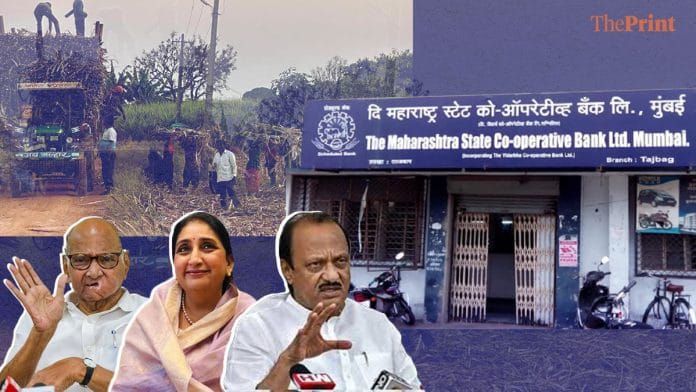



Mumbai: Nearly seven years after the Bombay High Court ordered a probe into alleged irregularities at the Maharashtra State Cooperative Bank (MSCB), a special court has formally closed the case by accepting a 2024 C-summary closure report filed by the Mumbai Police’s Economic Offences Wing (EOW).
The decision brings an end to criminal proceedings against more than 70 individuals, including former Maharashtra Deputy Chief Minister Ajit Pawar and his wife Sunetra, named in the First Information Report (FIR) filed in 2019 at the high court’s direction.
It comes about a month after Sunetra Pawar took oath as Maharashtra Deputy CM, taking over her late husband’s political legacy in the Mahayuti government in Maharashtra. Last week, Sunetra also took over as the Nationalist Congress Party (NCP) national president.
The case was politically high-profile, with Shiv Sena’s Anandrao Adsul, Peasants and Workers Party’s Jayant Patil, Congress’ Diliprao Deshmukh and Madan Patil, and NCP’s Ishwarlal Jain and Rajendra Shingane named among the accused.
The timing of the FIR was also curious as it came ahead of the Maharashtra assembly polls. The Bharatiya Janata Party (BJP) and the undivided Shiv Sena, which had wrested power from the Congress-NCP combine in 2014, was seeking a second term.
The MSCB is alleged to have sanctioned loans to the tune of Rs 25,000 crore to co-operative sugar factories despite their weak financial conditions and, in many cases, without any collateral. The factories were then shown to be sick and allegedly sold to close relatives of certain politicians.
In the course of the seven years of what came to be known as the Maharashtra State Cooperative Bank ‘scam’, there were several twists and turns as the state saw several changes in power.
How probe started
It was way back in April 2012, when Pune-based businessman and activist Surinder Mohan Arora began raising allegations about large-scale financial irregularities in Maharashtra’s cooperative banking system.
He alleged that the MSCB, district central cooperative banks and affiliated sugar factories and spinning mills had sanctioned loans without adequate collateral, leading to losses to the public exchequer. These allegations formed the base of a Public Interest Litigation (PIL).
After prolonged proceedings, on 22 August 2019, the HC directed the EOW to register an FIR within five days and conduct a detailed investigation. Subsequently, an FIR was lodged on 26 August, invoking serious offences under the Indian Penal Code (IPC), including criminal breach of trust, cheating, forgery and criminal conspiracy, along with provisions of the Prevention of Corruption Act.
More than 70 individuals were named as accused, including former directors and officials of MSCB, district cooperative banks, cooperative sugar factories, and political figures associated with these institutions.
On 10 September 2020, the EOW filed its first C-summary closure report before the special court, concluding that no criminal offence was made out against any of the accused.
By that time, the government had changed hands. The Maha Vikas Aghadi (MVA), led by Uddhav Thackeray and comprising the then undivided Shiv Sena and NCP and the Congress, was in power. Ajit Pawar was the Deputy CM.
A C-summary closure report is filed when investigators conclude that the material on record does not disclose the commission of a criminal offence. Once accepted by a court, it amounts to a judicial determination that criminal prosecution is not warranted on the facts as investigated, although civil, regulatory or administrative consequences may still arise from the same transactions.
The EOW’s action prompted Arora to file the first protest petition on 27 October 2020, challenging the police’s findings and seeking further investigation. That act kept the case alive despite the initial closure recommendation.
While the protest petition was pending, developments around the investigation continued. On 10 October 2022, the EOW informed the special court that both the complainant and the Directorate of Enforcement (ED) flagged issues that were not examined during the first investigation.
The police sought the court’s permission to conduct further investigation, effectively reopening scrutiny of the loan sanctions, recoveries and sale of cooperative sugar mills connected to the case.
By this time, the MVA government had been toppled and a Mahayuti government, then comprising just the BJP and the Eknath Shinde-led Shiv Sena, was in power. The Ajit Pawar-led NCP joined this government after a vertical split in the NCP in July 2023.
The following year, the EOW filed a second C-summary closure report on 1 March 2024, stating that even after examining the supplementary material and allegations supplied by the complainant, the essential ingredients of criminal offences were still not established.
Also Read: Mumbai Monorail 2.0? Safety certification for white elephant, but still waiting for green flag
ED’s involvement
In 2019, based on the EOW’s case, the ED registered a case of alleged money laundering against the accused. This created an immediate flutter as it also named NCP founder Sharad Pawar as an accused along with others. While all other accused were either directors or functionaries of the MSCB until 2011, the senior Pawar had no direct connection with the bank or the case.
The ED’s move turned into a political spectacle ahead of assembly polls that year as Sharad Pawar declared he will present himself for questioning on a given date and NCP workers gathered outside the ED office. The law and order machinery reached out to Pawar, requesting him to not come. The case against the senior Pawar eventually hit a wall.
Meanwhile, the ED filed for an intervention into the investigation and proceedings in 2020 but was rejected by the court, which stated that the agency was not the aggrieved party.
In March 2023, four months before Ajit Pawar joined the Mahayuti government, it filed the first charge sheet against two firms connected to Jarandeshwar Sugar Mill and pointed out that the Deputy CM had links with the sugar mills and firms involved in the case. The ED then filed two supplementary charge sheets, first in August and then in September, against several firms and senior ministers.
The ED filed for an intervention a second time in March 2024, challenging the EOW’s closure report and citing its charge sheets and investigation to prove it was an aggrieved party this time.
The economic intelligence agency had also provisionally attached properties worth Rs 50.2 crore belonging to a sugar mill of Baramati Agro, led by Ajit Pawar’s nephew, Rohit Pawar, an MLA from the Sharad Pawar-led NCP camp.
The action came less than two months before the 2024 parliamentary polls. The ED alleged that the sugar mill, Kannad Sahakari Sakhar Karkhana at Chhatrapati Sambhajinagar, was involved in bidding for the factories shown to be sick by the MSCB.
The EOW’s closure report relied on internal inquiries and findings that no quantifiable loss had been caused to MSCB and that loan recovery procedures were in accordance with law. This led to the filing of a second protest petition by Surinder Arora, keeping the matter under judicial consideration.
In January 2025, the ED summoned Rohit Pawar and questioned him for almost 10 hours. “We always fight against this government and agencies. I have submitted all necessary documents to ED, and I have been summoned 1 February. I will go again,” Rohit told reporters later as he was asked to come in for questioning again in February.
After interrogations, in June, ED submitted a charge sheet to the special Prevention of Money Laundering Act (PMLA) court naming three additional accused–Rohit Pawar, Baramati Agro Ltd and Rajendra Ingwale, director of Hitech Engineering Corporation India Ltd, wherein the money was allegedly transferred by Rohit’s company.
In July, the special court took cognizance of the charge sheet and observed that Rohit Pawar knowingly participated in the fraud. But it granted relief to Rohit In August, stating that a judgement on the EOW’s closure report is crucial and the ED’s case cannot continue if the predicate offence is closed. The Mumbai Police’s EOW had filed the closure report in March 2024.
Latest developments
In February 2026, after hearing the prosecution, the complainant and intervenors, the PMLA court accepted the second C-summary closure report, rejected the protest petitions and declined the ED’s plea to continue proceedings linked to alleged money-laundering.
The court held that the investigation did not disclose material sufficient to proceed with criminal prosecution and that the matter could not be taken forward merely on suspicion or political controversy.
The closure of the case carries major political implications. Ajit Pawar, one of Maharashtra’s most influential political figures, died in a plane crash on 28 January, just weeks before the special court accepted the closure report. Soon after, Sunetra Pawar rose rapidly as she was sworn in as Maharashtra’s Deputy Chief Minister and became president of the NCP.
The acceptance of the C-summary has seemingly vindicated her strengthening position within both the party and the government. The ED’s money laundering case is based on and connected to the EOW’s FIR, originally filed in 2019. Under the PMLA, the ED’s investigation typically requires an underlying criminal act to be clearly established.
As the EOW states that no such criminal offense occurred in the case, the court’s acceptance of the report creates a hurdle for the ED’s probe, potentially leading to discontinuation of the investigation, unless the agency is able to establish new offences related to the MSCB and the sugar mills.
(Edited by Tony Rai)