





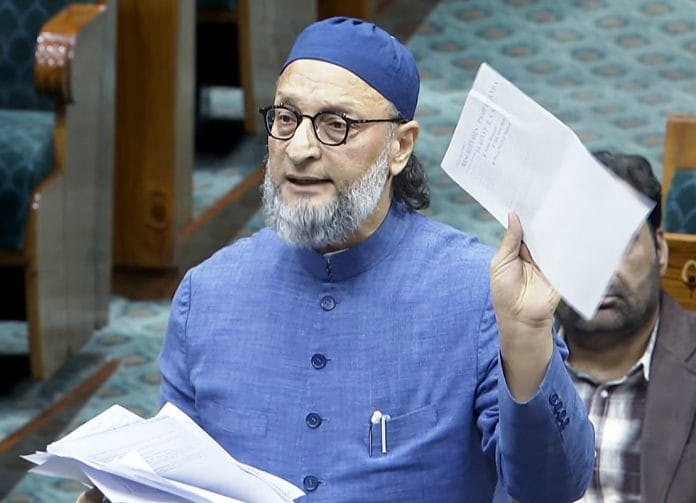



New Delhi: Terming the Special Intensive Revision (SIR) exercise as ‘backdoor NRC’ meant to disenfranchise people in the name of religion, AIMIM chief Asaduddin Owaisi said it also violated parliamentary legislation.
Owaisi, the leader of All India Majlis-e-Ittehadul Muslimeen (AIMIM), was speaking in the Lok Sabha during a discussion on election reforms.
The Election Commission of India (ECI) is not a body empowered to concern itself about citizenship, said AIMIM chief Owaisi, adding that the power of determining citizenship lies with the Union Home Ministry and the Government of India, among others.
“What ECI is doing is wrong. It has no role in this. How is it that the ECI is assuming the power given to another agency of Parliament? ECI is violating the sanctity of a law that was passed in this August House,” Owaisi said.
“I oppose SIR; this is nothing but a backdoor National Register of Citizens (NRC). This is a selective exercise to disenfranchise people in the name of religion,” Owaisi added.
At the outset—said Owaisi—the SIR is violative of the powers prescribed by the Parliament.
“It’s contrary to the judgment of the Supreme Court. It is a mala fide exercise of power, only to selectively disenfranchise based on religion. The Election Commission of India cannot be bigger than the SC and Parliament of India,” he said.
Citing the Representation of the People Act (RP Act) of 1950, Owaisi said it prescribes people’s inclusion in electoral rolls based on self-declaration of citizenship, backed by one of the six documents, which, he added, includes Aadhaar cards.
“This is an Act, which was passed in the Parliament. Supreme Court, in its Lal Babu Hussain judgment, held that once a voter has been included in the electoral roll, there is a presumption that they are citizens; they cannot be removed except by an enquiry into the citizenship of the individual voter and giving them an opportunity of hearing, after informing the basis on which doubt arose concerning the citizenship,” he added.
Owaisi accused the Election Commission of putting the burden of proof on the voter, which, he said, completely violates the 1950 RP Act, as well as the 1960 electoral rules.
The SIR, he further said, has put the onus on voters who were already part of the electoral rolls in 2025. Instead of extending the benefit of presumption to them, voters are now required to submit documents to prove their citizenship.
Referring to B.R. Ambedkar, Owaisi said that when Babasaheb was asked whether India is a democracy, he had said that’s true only in a formal sense. “To be a democracy in the substantial sense, political power has to be held by the most marginalised and the weakest. He repeatedly said political power is the key to social progress,” said Owaisi.
The AIMIM chief expressed concerns about the under-representation of Muslims in the Parliament. “You have only four percent Muslims here. The ruling party has no Muslim members…. Muslims are not there. I mean that they are not even being reflected in secular parties. For example, if Muslim-majority seats like Wayanad can elect non-Muslims, surely Rai Bareilly, Amethi, and Etawah can elect Muslims,” he said. Adding, “We are only becoming electors, not getting elected.”
In a request, Owaisi further asked the “ruling party to please consider adopting a mixed-member parliamentary system, like Germany”. “Each voter has two votes—one for their MP and one for a political party,” he said.
Delimitation, he said, should not be conducted in the way that it had been in Kashmir and Assam. There is a need to build a consensus and make the right to vote a fundamental right, he added.
(Edited by Madhurita Goswami)
Also Read: Fresh challenges to electoral roll revision in Assam & UP; SC notice to EC on Assam plea
Owaisi is wrong on every count of fact and constitutionality. ECI is a constitutional body ensuring free and fair elections. It is their constitutional duty to ensure that those exercising their franchise are entitled to do so under the constitution of India, which means they must be legitimate citizens and not illegal aliens that have acquired voter IDs by hook or crook. The writ of the constitution is what gives ECI the right to ensure that voters are only those who are constitutionally mandated to vote aka, they must be lawful and law abiding citizens of India. Even an electoral contestant can be dismissed by the ECI if he or she is not a citizen, that too a law abiding citizen. In the context of elections, the ECI has the power to determine if someone is a legitimate citizen and therefore a legitimate voter.