





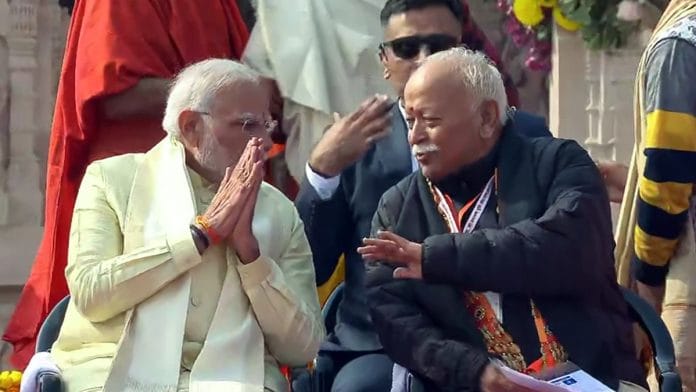



New Delhi: On 6 April, a letter said to be written by Rashtriya Swayamsevak Sangh (RSS) chief Mohan Bhagwat to Prime Minister Narendra Modi, raising serious concerns about Assam Chief Minister Himanta Biswa Sarma and his wife, Riniki Bhuyan Sarma, went viral.
In the purported letter, Bhagwat is seen asking Modi whether Union Home Minister Amit Shah was trying to save Sarma. RSS functionaries said that the letter, widely shared by Sarma’s adversaries on social media, was fake.
This is not the first time the RSS has been targeted with fake or AI-generated content.
However, the situation has escalated ahead of the assembly elections, including in Assam, with two AI-generated letters, said to be written by Bhagwat to Modi, going viral, creating a problem for the RSS and the Bharatiya Janata Party (BJP), especially in Assam, where it is hoping for a comeback.
Similarly, a deepfake video quoting a letter by Bhagwat to Modi, which raised concerns over a passport-related controversy related to Sarma’s wife, also went viral. The issue was first highlighted by the Congress.
Congress leader Pawan Khera had accused Sarma’s wife of holding multiple passports from different countries. Both Sarma and the BJP denied the allegation, saying it was “fake and fabricated”.
A senior RSS functionary said the Assam unit had filed a police complaint with the Guwahati Cyber Cell over a fake AI-generated post falsely using the RSS’s name.
The functionary added that the FIR has been registered and was expected to act as a deterrent for the future.
“We would like to draw your kind attention to a fake and misleading post, allegedly generated using Artificial Intelligence, which is currently being circulated in the name of the Rashtriya Swayamsevak Sangh (RSS),” reads the complaint filed by the RSS Uttar Assam unit in March. “The content being circulated is false, malicious, and intended to mislead the public and tarnish the image of the organisation,” it adds.
An RSS functionary filed another police complaint in Delhi in March regarding a separate letter in Rohini, which claimed to be written by the RSS to Modi.
“The current state of the Bharatiya Janata Party in Assam is not only deeply worrying but also poses a serious threat to the party’s ideological existence. The BJP, which was built on the strength of nationalism, sacrifice, and organizational strength, now appears to be falling into the hands of opportunists and corrupt elements from the Congress party,” read the fake letter flagged by the RSS functionary.
A senior RSS functionary requesting anonymity said they had faced similar fake letters and fake surveys allegedly undertaken in the name of the RSS during the Bihar and Haryana elections.
“The RSS never conducts political surveys, and fake letters are made viral talking about surveys conducted by the RSS ahead of elections. Similarly, many fake letters were also made viral ahead of the Bihar and Haryana elections, and they have become a nuisance and a menace. The authorities need to crack this nexus immediately,” said an RSS functionary.
In 2019, Mohan Bhagwat and six other senior RSS leaders had their X accounts verified to curb misinformation circulating on social media in their and the organisation’s name.
Deepfakes and AI letters
The RSS is not the only organisation affected by deepfake videos and AI-generated letters.
Many politicians, including Lok Sabha MP Shashi Tharoor, have reported being victims of such content in the recent past.
On Thursday, Tharoor took to X to raise concerns over the issue. “There are an alarming number of deepfake videos circulating of me, with convincing-sounding AI-generated voice-overs over genuine footage of old interviews, having “me” saying things I have never said,” Tharoor said.
The Information Technology (Intermediary Guidelines and Digital Media Ethics Code) Amendment Rules, 2026, notified on 10 February and effective from 20 February, introduced a formal definition of “synthetically generated information” (SGI) and imposed enhanced due diligence obligations on intermediaries such as X, YouTube and Meta.
The guidelines include mandatory labelling of AI-generated or synthetic content and sharply reduced timelines for removing unlawful material. Under the new framework, platforms must take down unlawful or government-flagged content within three hours of receiving notice—a significant reduction from the earlier 36-hour window.
(Edited by Sugita Katyal)