





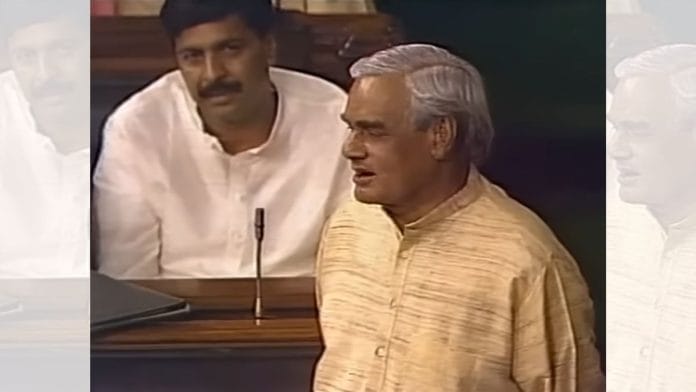



New Delhi: It was at the ‘insistence’ of senior BJP leader Pramod Mahajan that a reluctant Atal Bihari Vajpayee agreed to form what turned out to be a 13-day government after the 1996 Lok Sabha elections despite reservations from party leaders including Sushma Swaraj, a new book has revealed.
According to it, Mahajan who was defence minister in that short-lived government argued: “…how long will we continue to carry the image of an opposition party, and how long will the public continue to believe that the BJP can never come to power?”
The book, Atal Sansmaran, is authored by Ashok Tandon who served in Prime Minister Atal Bihari Vajpayee’s PMO from 1998-2004 as incharge of media relations in the rank of additional secretary. Tandon points out that when the then President Dr Shankar Dayal Sharma “handed Atal ji the appointment letter for the post of Prime Minister, a task Vajpayee was unwilling to accept, upon returning and discussing the matter among senior party leaders, no one was in favor of forming a government under such circumstances”.
However, Mahajan insisted that BJP must shatter the perception that it is merely an opposition party, and stake a claim to form the government. “And then we are prepared for whatever the consequences may be.”
Citing an exchange between Pramod Mahajan and Sushma Swaraj, Tandon writes about a meeting of the party bigwigs that he describes as ‘quite heated’.
“Despite Atal ji’s liberal image, no other party came out in support of the BJP and he submitted his resignation to the President even before the trust vote could be taken up in the Lok Sabha,” the book states.
The book also sheds light on the relationship between the BJP and the Rashtriya Swayamsevak Sangh (RSS). Vajpayee, it suggests, set boundaries against the backdrop of ‘interference’ by the Sangh in the central government’s day-to-day affairs. He also signalled that political moves require discretion and cannot be dictated by the Sangh.
The book also suggests that Vajpayee was not in favour of calling early elections in 2004.
“In January 2004, the BJP held a two-day National Executive meeting in Hyderabad to devise its strategy for the upcoming Lok Sabha elections. The mood was euphoric following the party’s sweeping victories in the December 2003 assembly elections in Madhya Pradesh, Rajasthan, and Chhattisgarh, where it had ousted Congress government. Party leaders believed that this strong momentum could translate into a national mandate if general elections were advanced,” Tandon writes.
It was unanimously decided at the Hyderabad meeting to hold Lok Sabha elections earlier than the scheduled October 2004 deadline and Vajpayee, known for his ‘humility and statesmanship’, accepted the decision in the spirit of consensus, the book adds.
“During the return journey, when asked why he agreed to early elections despite having six months left in office, Vajpayee gave a characteristically selfless reply—he said that delaying elections might have invited criticism that he prioritised personal tenure over the party’s prospects. Holding them early, he believed, would free him of such—win or lose.”
“If we cannot win even early elections,” Vajpayee reflected. “At least the blame will not be mine.”
Tandon’s book also focuses on key episodes from Vajpayee’s political life—his early days and subsequent rise in politics, while also focusing on the Pokhran-II tests conducted in 1998, and the IC-814 hijack.
Also Read: Anger management, quality sleep & learning Hindi—what Modi shared when hosting NDA MPs for dinner
Vajpayee & Sudarshan
The book, published by Prabhat Prakashan, goes on to recall how in 2005, after the fall of the Vajpayee government, the then RSS chief K.S. Sudarshan publicly said ‘now Vajpayee and Advani ji should retire from politics,’ and that BJP needs ‘new leadership’.
Vajpayee termed Sudarshan’s remarks as ‘sad and inappropriate’. Asked for his reaction, he told media persons: “I am in the BJP, not the RSS.” The book argues that Vajpayee’s equation with Sudarshan was marked by ‘respect, dialogue, and conflict’.
“Atal ji had been a volunteer of the RSS from the beginning, but he had internalised its ethical and cultural ideals in his own way. Sudarshan ji was a staunch volunteer, thinker, and organiser, with a scientific temperament, who became the RSS’s fifth Sarsanghchalak in 2000, when Atal ji was the Prime Minister of a coalition government of parties with diverse ideologies,” the book states.
It further submits that while both Sudarshan and Vajpayee had the same objective—national interest and the cultural reshaping of India—their approach and style differed.
“Sudarshan ji believed that when the BJP was in power, it should vigorously implement the RSS’s ideology such as the Uniform Civil Code, the Ram Mandir, and the abolition of Article 370. Atal ji, on the other hand, believed it was appropriate to adopt flexible and pragmatic decisions while adhering to coalition dharma and keeping in mind the pluralistic structure.”
Pokhran-II, Kalam as pick & IC-814 hijack
Tandon’s book also recounts at length the fall of Vajpayee’s 13-day and 13-month governments. He writes: “…it is believed that Narasimha Rao sensed that the US was working behind the scenes to prevent Vajpayee from becoming Prime Minister.
Adding, “According to some declassified US emails, the US was not in favor of Vajpayee becoming Prime Minister. In a report, US Ambassador Frank Wisner, based on his pre-election conversations with Vajpayee, wrote that his body language suggested he was in favor of nuclear testing. When Vajpayee first became Prime Minister in 1996, during the swearing-in ceremony, Rao quietly handed him a handwritten note urging him to complete his unfinished task (nuclear testing).”
The book also highlights how a view had emerged within the BJP that Vajpayee himself should assume the office of President and hand over the prime ministership to Advani.
“Vajpayee flatly rejected suggestions from within his party that he himself should move to Rashtrapati Bhavan and hand over the post of Prime Minister to his number two leader, L.K. Advani. Vajpayee was not prepared for this. He believed that a popular Prime Minister becoming President on the strength of a majority would not bode well for Indian parliamentary democracy and would set a very bad precedent—and he would be the last person to support such a move,” Tandon goes on to write.
The book also sheds light on how Vajpayee then invited opposition leaders to build consensus on the presidential nomination.
“I recall that Sonia Gandhi, Pranab Mukherjee, and Dr Manmohan Singh came to meet him. Vajpayee officially revealed for the first time that the NDA had decided to nominate Dr A.P.J. Abdul Kalam for the presidential election. There was a moment of silence. Then Sonia Gandhi broke her silence and said, ‘We are shocked by your selection. We have no option but to support him, but we will discuss your proposal and take a decision’.”
Further, the book recounts the drama that unfolded during the hijack of Indian Airlines flight 814 from Kathmandu to New Delhi carrying 176 passengers and 15 crew members.
“Negotiations were held between the Indian government and the hijackers, and the then Foreign Minister, Jaswant Singh, escorted the three freed terrorists to Kandahar. That day, a highly dramatic incident unfolded at Palam Airport. I received a call from some media friends, saying that Jaswant Singh was taking some journalists with him to Kandahar, and outside the airport, some other journalists were insisting on accompanying them. Journalists on a plane carrying terrorists? I sensed something was amiss,” Tandon writes.
He claims he then got in touch with the then Ministry of External Affairs (MEA) spokesperson. “I knew full well that Jaswant Singh would not listen to me. He didn’t even carry a mobile phone. I rushed straight to the Prime Minister’s residence. Upon reaching 3 Race Course Road, I learned that Atal ji had gone to rest for the afternoon. I was at a loss for what to do.”
Adding, “Finally, I told Atal ji’s adopted daughter, Namita, the entire situation and said there was no other option but to wake him up at this time. Namita, also astonished at how Jaswant Singh ji could make such a mistake, woke him up, and I called Navtej Sarna from my mobile phone and said that the Prime Minister wanted to speak to Jaswant Singh ji immediately. Atal ji spoke to Jaswant Singh ji, and Navtej got the media team off the plane.”
Tandon adds that ‘a sharp-tongued female journalist from a private TV channel’ was still refusing to get off the special plane and was not listening to anyone. “On one hand, security personnel could have reached Palam at any time with the terrorists, and on the other hand, this journalist was not moving an inch. I then called Navtej Sarna and told him to call some female security personnel, seize the woman journalist, and take her off the plane. Under no circumstances should a journalist remain on the plane.”
In a post on X, Tandon clarified on 19 December, “This was an unintentional mistake. I did not intend to involve my friend Navtej Sarna in this matter…”
(Edited by Amrtansh Arora)
Also Read: ‘88 cr to 10,107 cr in 20 yrs’: Maken flags BJP’s 115x bank balance, rues ‘no level playing field’