





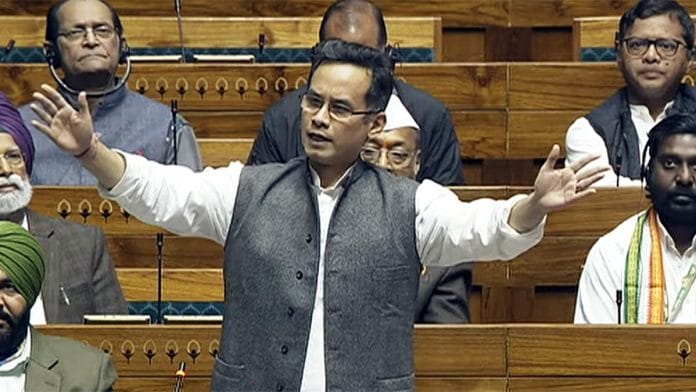



New Delhi: The Congress on Monday rejected Prime Minister Narendra Modi’s allegation that it capitulated to the Muslim League on Vande Mataram, claiming it was the party’s efforts during the freedom movement, particularly the partition of Bengal in 1905, that turned the song into a political slogan against the British in the first place.
Initiating the debate marking 150 years of Vande Mataram from the Opposition’s side, Congress Deputy Leader in the Lok Sabha Gaurav Gogoi launched a scathing attack on the BJP, saying that it lacks an understanding of Bengal, and highlighting the recent controversy over a Delhi Police circular that mentioned Bangla as a “Bangladeshi language”.
“There were two objectives of the PM’s one-hour speech. First, he made it look like that his political ancestors were fighting against the British or took part in various movements against the British. This intent to revise and rewrite history was also reflected in his speech. His second objective was to lend a political colour to this Vande Mataram debate,” Gogoi said.
Gogoi, who represents the Jorhat Lok Sabha constituency, said that Vande Mataram, India’s national song which was composed in 1875 by Bankimchandra Chattopadhyay and later incorporated into his novel Anandamath in 1882, was first sung at the 1896 Calcutta session of the Congress.
It is documented in history that Tagore himself set the tune to its first stanza, made Bankim listen to it, and first sang it at the Calcutta session of the Congress.
Later, it became a political rallying cry during the Swadeshi movement against the partition of Bengal in 1905, said Gogoi.
Subsequently, at the 1907 Benares (now Varanasi) session of the Congress, Sarala Devi Chaudhurani substituted the term “saptakaoti”, used by Bankim to refer to Bengal’s population when he composed it, with trimshatkoti (30 crore) as the Congress wove it into the larger national movement, Gogoi said.
The Congress leader also took a swipe at Modi, listing his repeated invocation of Jawaharlal Nehru in his speeches, “14 times during the Operation Sindoor debate, 10 times during the debate on the 75th anniversary of the Constitution, and 15 and 20 times respectively during the discussions on the Motion of Thanks on the President’s Debate in 2022 and 2020.”
“But I want to tell him and his party very humbly, no matter how hard you try, you will not be able to put a single black stain on Nehru’s legacy,” he said.
Gogoi said that the difference between the Muslim League, founded by Mohammed Ali Jinnah, and the Indian National Congress was that while Jinnah was against Vande Mataram, Maulana Abdul Kalam Azad of the Congress made it clear that he had no objections to the song.
He then pointed out that during the 1937 Calcutta session of the Congress, the party had adopted the first two stanzas of the song to be sung at the party’s conventions and events.
“The intent of Vande Mataram was to strike terror in the hearts of the British, but when did you make efforts to realise that? They speak about 1937. I want to ask where were your political predecessors during the Quit India movement in 1942? If you feel that the Congress conspired to weaken Vande Mataram, then I ask, where were you when the principal idea that Vande Mataram stood for—which was against British rule in India—was being fought for?” Gogoi asked.
Gogoi, who is the president of the Assam Congress unit, highlighted the role of Tagore in the discussions initiated by Nehru on the objections raised by the Muslim League against the song. Gogoi quoted Nehru as having said at the 1937 session that “the word Vande Matarm became a slogan of power which inspired our people and a greeting which ever reminds us of our struggle for national freedom”.
Tagore had played a pivotal role in impressing upon the Congress leadership that it would not be imprudent to adopt only the first two stanzas of the song for its “spirit of tenderness” and the emphasis it gave to the “beautiful and beneficent aspects of our motherland”.
The later portions of the song contain extensive references to Hindu goddesses that followers of Islam—a monotheistic faith—were not comfortable with, particularly with the growing polarisation coinciding with the rise of the Muslim League. The opposition also stemmed from Anandamath, Bankim’s novel about a rebellion in the mid-eighteenth century, Bengal set against the backdrop of famines.
Tagore had said that he “found no difficulty in dissociating it from the rest of the poem and from those portions of the book of which it is a part, with all sentiments of which, brought up as I was in the monotheistic ideals of my father, I could have no sympathy.”
At the 1937 CWC, the Congress embraced Tagore’s advice, with Nehru saying, “The first two stanzas are such that it is impossible for anyone to take objection to, unless he is maliciously inclined. Remember, we are thinking in terms of a national song for all India.”
The CWC also adopted a resolution saying that the first two stanzas of this song have become a “living and inseparable part of our national movement and as such they must command our affection and respect.”
“The Committee recognises the validity of the objection raised by Muslim friends to certain parts of the song. While the committee have taken note of such objection in so far as it has intrinsic value, the committee wish to point out that the modern evolution of the use of the song as part of national life is of infinitely greater importance than its setting in a historical novel before the national movement had taken shape,” it said.
Speaking after Gogoi, SP chief Akhilesh Yadav accused the BJP of employing the “divide and rule policy” of the British. “They are not nationalists but rashtra vivadis,” said Yadav.
(Edited by Viny Mishra)