





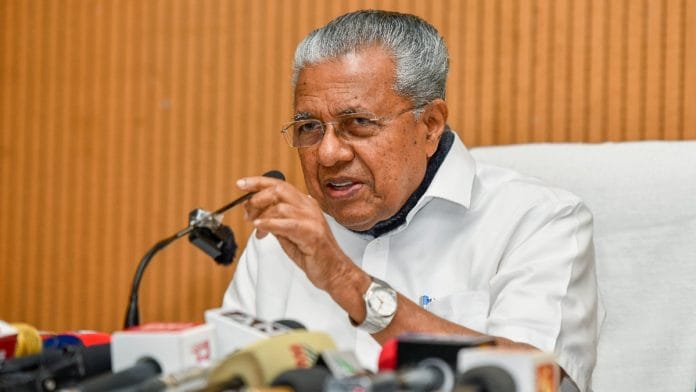



Thiruvananthapuram: Nearly a month after the debacle in the Kerala local body polls, the Left has expressed confidence that the ruling front could win 110 seats in the upcoming Assembly polls. The LDF also ruled out any anti-incumbency sentiment.
Elections to the 140-seat Kerala assembly are expected in April. In 2021, the Left had secured 99 seats.
Speaking to reporters, Kerala Chief Minister Pinarayi Vijayan said the LDF is confident of securing a third term.
“There are enough reasons for us to feel confident. If we look at the state of Kerala, that is enough. So, we expect the people to re-elect us with more seats,” Vijayan said Thursday evening, adding that the reasons for the local body poll results were different, while assembly polls are for deciding the future of the state itself.
The LDF government had last week initiated a ‘Nava Kerala survey’ to take direct responses from citizens on the government’s performance. The volunteers, selected from interested applicants, are also seeking suggestions from the public on improvements. The one-month survey is expected to conclude in February.
In the recently concluded local body polls, the UDF won 504 gram panchayats, 79 block panchayats, seven district panchayats and 54 municipalities. The LDF, meanwhile, won 340 gram panchayats, 64 block panchayats, seven district panchayats, 28 municipalities and one corporation.
According to vote share data released by the Election Commission, the CPI(M) secured 27.16 per cent of the votes against the UDF’s 29.17 per cent, while the BJP secured 14.76 per cent. Congress ally Indian Union Muslim League (IUML) secured 9.77 per cent, while the CPI(M)’s largest ally, the CPI, secured only 5.77 per cent of the votes.
Sajad Ibrahim K. M., head of the department of political science at the University of Kerala, said the UDF particularly benefited from minority votes.
“There has been a shift of nearly five per cent Muslim and Ezhava votes in favour of the UDF from the Left,” Sajad said, adding that the LDF’s election strategy may not have resonated with these communities. He also noted that the Sabarimala issue may have backfired.
However, CPI(M) says the communities were misguided by the UDF and the BJP.
“The minorities were misguided in the run-up to the polls. They didn’t understand that they face a threat even in Congress-ruled states,” CPI(M) Thrissur district secretary K. P. Abdul Khader told ThePrint.
Minority sentiment
According to the Lokniti-CSDS survey, around 39 per cent of the Muslim voters supported the LDF in the 2021 assembly elections, particularly the poorer and lower-middle-class Muslims, helping it secure a second term.
Similarly, the Left enjoyed the support of 53 per cent of Ezhava voters, up from 49 per cent in 2016. The LDF had secured a vote share of 45.43 per cent against the UDF’s 39.47 percent in 2021.
The ruling front, which enjoyed broad support in 2021 due to its welfare measures during the COVID-19 pandemic, entered the local body polls with a similar strategy focused on welfare, development politics and the promise of continuity.
At the centre of this campaign was Chief Minister Pinarayi Vijayan’s ‘New Kerala’ narrative, highlighting projects such as the expanded NH-66, the GAIL pipeline and the state’s investment push.
A month before the polls, the government announced welfare measures worth Rs 10,000 crore, including a hike in monthly welfare pensions, and declared Kerala free of extreme poverty 1 November. Despite this, the LDF positioned itself as the principal force resisting BJP-led communal polarisation, while also attacking the UDF over its alleged association with Jamaat-e-Islami.
However, voting patterns in Muslim- and Ezhava-dominated regions suggest a different story this time.
In Muslim-majority Malappuram district, the LDF won only four of the 94 gram panchayats, compared to the UDF’s 87. The UDF also secured 14 of the 15 block panchayats, 11 of the 12 municipalities, and the district panchayat.
Similarly, in Kozhikode, where the CPI(M) is considered strong, the party retained the Kozhikode Corporation, but the UDF secured 38 of the 70 gram panchayats, while the Left won only seven. The UDF also secured four of the seven municipalities in the district.
CPI state secretary Binoy Viswam said the LDF failed to understand the mood of minority communities in the state.
“For whatever reason, they did not trust us as their allies. But we don’t believe they have left us completely. We need to study this thoroughly,” Viswam said, adding that statements by some community leaders associated with the LDF created an image of the party as Islamophobic.
In the months preceding the polls, SNDP Yogam (Sree Narayana Dharma Paripalana Yogam, a major social service organisation in Kerala) general secretary Vellappally Natesan, who is considered close to the LDF, sparked multiple controversies with remarks against the Muslim majority in Malappuram district and the Indian Union Muslim League.
Performance in the strongholds
While Muslim consolidation aided the Congress-led UDF in northern Kerala, the LDF also faced setbacks in its traditional strongholds of Thiruvananthapuram, Kollam and Alappuzha, where Hindu Ezhava voters form a significant base.
In Kollam, the LDF won 33 gram panchayats against the UDF’s 32, and seven block panchayats against the UDF’s three. It also won three municipalities, while the UDF won one. Although the LDF retained the district panchayat, the UDF captured the Kollam Corporation, which the Left had ruled for over 25 years. In 2020, the LDF had won 39 seats in the corporation, while the UDF had just nine. The NDA secured two gram panchayats in the district but drew a blank elsewhere.
Similarly, in Thiruvananthapuram, the BJP-led NDA captured the Thiruvananthapuram Corporation, winning 50 of the 101 seats. The NDA also won six of the 73 gram panchayats, while the LDF won 35, the UDF 25, and 15 ended in a tie. In block panchayats, the LDF won five of the 11, while the UDF secured the remaining six and all four municipalities.
In Alappuzha, the LDF won 36 gram panchayats, seven block panchayats, one municipality, and retained the district panchayat. The UDF won 23 gram panchayats, four block panchayats, and five municipalities. The NDA secured five gram panchayats in the district.
“When we look at the data, there is no basis to say that the CPI(M) has been uprooted,” political analyst K. P. Sethunath said, adding that a section of the Ezhava community shifting towards the BJP in strongholds such as Kollam, Alappuzha, and Thiruvananthapuram should be a cause for concern for the party.
(Edited by Viny Mishra)
Also read: In this Kerala village, BJP’s now a serious player. But local body polls win came with a disclaimer
I saw Scandinavian quality of life in Kerala in the form of dirty beaches, beggars, homeless people sleeping on pavements , ancient buses, killer mosquitoes, and bill-stuck walls to name a few.