








New Delhi: The Aam Aadmi Party (AAP) had everything going for it in 2022. After consolidating power in Delhi, the party formed its second government in Punjab, wrested control of the capital’s civic body, made inroads in Goa, and secured a toehold in Gujarat with five MLAs and a 14 percent vote share.
The Congress’s shrinking footprint had created a vacuum in the Opposition space, opening up the possibility of a third pole in national politics. The AAP believed it was well-placed to occupy that space—one electoral success at a time.
Until Friday’s order by a special court in Delhi dismissing the case filed by the Central Bureau of Investigation (CBI) and discharging Arvind Kejriwal and other implicated AAP leaders, the party’s future appeared uncertain and bleak.
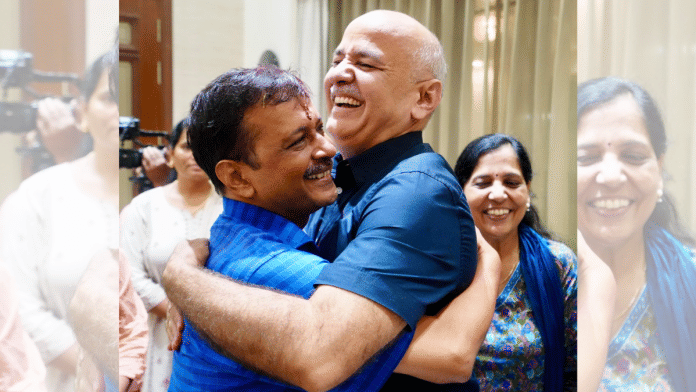
Kejriwal’s reaction to the verdict—breaking down before a swarm of television cameras, and later tearing up again at home as he embraced his wife Sunita and their children, Harshita and Pulkit, captured the emotional toll the past four years had taken on him.
“Narendra Modi and Amit Shah together hatched the biggest political conspiracy to finish AAP. The sitting CM was dragged out of his house and put in jail. Kejriwal is not corrupt. I have only earned honesty in my life. Today, the court has said that Kejriwal, Manish Sisodia and AAP are honest,” Kejriwal told reporters after walking out of the court.
His emphasis on honesty underscored the party’s biggest challenge as the case dragged on—the taint of corruption. While prominent leaders facing corruption charges is a routine occurrence in Indian politics, it became a particularly heavy burden for the AAP, given that the party was born out of an anti-corruption movement in November 2012 and lacked a strong ideological glue to hold it together.
With the arrests of its leaders, beginning with Sisodia in February 2023 and culminating in the arrest of Kejriwal in March 2024, the stain of corruption deepened as the AAP struggled to stay afloat. In fact, Kejriwal’s arrest, the first of a sitting chief minister in independent India, threw the AAP into complete disarray.
Apart from Arvind Kejriwal and Manish Sisodia, prominent AAP leaders Sanjay Singh and Satyendar Jain were also arrested in money-laundering cases in October 2023 and in May 2022.
Kejriwal’s refusal to step down as chief minister or hand over charge to another leader meant that governance in Delhi, already strained by a bruising feud between the elected government and the Centre’s nominated Lieutenant Governor, descended into further chaos.
By the time he walked out of jail in September 2024, after spending nearly five months in custody, and named Atishi as his replacement as chief minister, it was too late for the AAP to regain a grip over its ‘Delhi Model’ of governance.
Five months later, the Bharatiya Janata Party dislodged the AAP from power in Delhi after a decade, sending Kejriwal into a shell. It took months for Arvind Kejriwal to shake off the setback and turn his focus to Punjab, in a bid to retain power in 2027 by any means necessary.
“Until now, winning Punjab was our sole focus, as we did not anticipate the case collapsing so soon. It was essential for us to retain power in at least one state for the sake of survival. The court’s discharge order has come as a huge morale booster for us. We are now going all out not just in Punjab, but in Gujarat too,” a senior AAP leader told ThePrint.
To be sure, Kejriwal has in recent weeks made several trips to Gujarat, where urban local body polls are scheduled for March. A spate of resignations—including that of the AAP’s Gujarat farmer wing president, Raju Karpada—has shaken the party in recent months.
AAP insiders say the immediate task before the leadership, armed with the legal reprieve, is threefold: rebuilding cadre morale, convincing voters that its core plank of clean politics remains unsullied, and reclaiming the governance narrative in Punjab.
“The BJP has achieved what it wanted. The fact remains we have lost Delhi and it’s increasingly difficult to win back power as elections have become highly transactional. Our challenge will be to establish how the entire campaign against us was baseless as the court refused to so much as take cognisance of the charge sheet,” a party functionary told ThePrint.
(Edited by Tony Rai)