





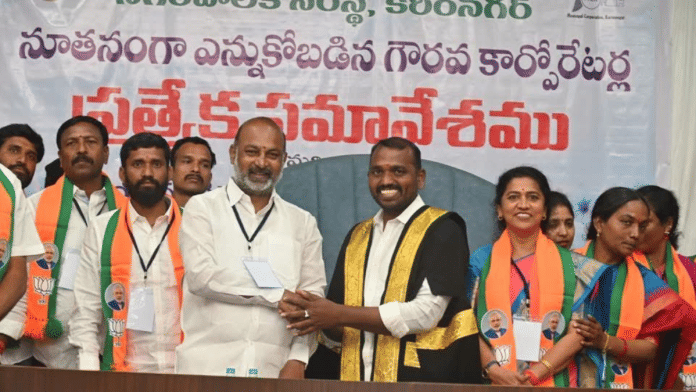



Hyderabad: The Bharatiya Janata Party (BJP)’s victory in the Karimnagar Municipal Corporation and its claim to the mayor’s post marks a significant political milestone for the party, its first corporation win since Telangana’s creation in 2014.
The win comes barely two months after the BJP clinched the mayoral post in Thiruvananthapuram in December last year, dislodging the Communist Party of India’s (Marxist) candidate who held power in the corporation for more than 30 years.
The BJP won Karimnagar comfortably by 34 votes, despite a tense political situation.
The party won 30 of the 66 wards, and was short of just four seats to claim the mayoral post. BJP Member of Parliament Bandi Sanjay was inducted as an ex officio member of the municipality, taking the tally to 31.
The support of four Independents helped the party cross over the threshold, and gain control over the third most populous city in Telangana.
The Bharat Rashtra Samithi (BRS), which won in eight wards, chose to abstain from voting for the mayor, although it contested the elections. The Congress and the All India Majlis-e-Ittehadul Muslimeen (AIMIM), which won 14 and three seats respectively, participated in the voting process.
The victory sparked state-wide celebrations by the BJP cadre with the party winning a corporation for the first time after 1981 when N.S.N. Reddy became the mayor of Visakhapatnam in united Andhra Pradesh.
Calling the win “spectacular”, Telangana BJP president N. Ramchander Rao said the BJP won firmly, defeating all attempts by the Congress and BRS to subvert the democratic verdict.
“With the BJP at the helm in the Karimnagar Municipal Corporation, we are committed to transforming the city towards Viksit (developed) Telangana – Viksit Bharat”.
Rao said in a post on X.
During the press conference, I also presented a detailed analysis of the BJP’s performance in the Telangana Municipal Elections and the broader political trends emerging from the results.
BJP Growth and Expansion
🔸BJP increased its tally from around 240 wards in 2020 to nearly… pic.twitter.com/qlFGyuEfOf
— N Ramchander Rao (@N_RamchanderRao) February 16, 2026
Union Minister of State for Home Bandi Sanjay Kumar, an MP from the Karimnagar Lok Sabha constituency, called this victory “personal”, saying he began his political journey as a corporator from Karimnagar.
“History created in Karimnagar. For the first time, a BJP Mayor took oath in the city. Today is not just a political victory; it is an emotional moment. “It feels like a dream that many of us carried quietly for years,” he said in a post on X.
History created in Karimnagar 🪷
For the first time, a BJP Mayor took oath in the city.
Congratulations to Shri Kolagani Srinivas garu on becoming the first BJP Mayor of Karimnagar and Shri Y. Sunil Rao garu as Deputy Mayor.
Today is not just a political victory. It is an… pic.twitter.com/G4iSWFFf2u
— Bandi Sanjay Kumar (@bandisanjay_bjp) February 16, 2026
Not far from Karimnagar, in Nizamabad, where the BJP emerged as the single largest winner, it chose to sit in the opposition.
In the Nizamabad Municipal Corporation (NMC), the BJP won 28 out of 60 wards, shy of just three seats required to stake a claim to the mayor’s post.
Despite being positioned to lead, BJP MP Dharmapuri Arvind announced that the party would not contest the mayoral race.
“We earned the people’s mandate through trust and conviction. The rest is arithmetic. Horse-trading is not my path,” Arvind said, signalling that the party would not engage in backroom deals to secure power.
The BJP’s strong showing in both Nizamabad and Karimnagar represents its most significant urban gains since the 2020 polls, with the party winning 335 of the total 2,996 wards. In the 2020 elections, it won 293 wards.
For the Congress that won the by-polls in Jubilee Hills and Secunderabad in mid 2025, and subsequently also the grama panchayat elections in December last year, this decisive win has led to the ruling party calling it the mid-term verdict of its governance.
The Congress, led by Revanth Reddy, won in 1,537 wards and five corporations, while the BRS and MIM won 781 and 70 wards respectively. The CPM, independents, and smaller registered parties won the remaining.
The elections to 116 municipalities and seven corporations were held on 11 February, with the results declared on 14 February and mayoral elections held on 16 February. As many as 36 municipalities did not reflect a clear majority for any one party.
(Edited by Sugita Katyal)