








New Delhi: Clad in a magenta Kanjeevaram saree from poll-bound Tamil Nadu, Union Finance Minister Nirmala Sitharaman’s Budget speech Sunday announced a slew of projects for the election-bound states of Kerala, Tamil Nadu, West Bengal and Assam—ranging from a dedicated rare earth corridor to a high-speed rail corridor and turtle trails.
Last year, the finance minister wore a Madhubani saree—a cultural heritage of Bihar, which was to go to the polls later that year. The traditional folk art form has its roots in Bihar’s Mithila region, drawing its name from the Madhubani district.
A key announcement was a proposal to establish dedicated rare earth corridors in Odisha, Andhra Pradesh, Tamil Nadu and Kerala in a bid to reduce India’s dependence on imports and strengthen domestic capabilities in critical minerals.
“A scheme for Rare Earth Permanent Magnets was launched in November 2025. We now propose to support the mineral-rich states of Odisha, Kerala, Andhra Pradesh and Tamil Nadu to establish dedicated Rare Earth Corridors to promote mining, processing, research and manufacturing,” the finance minister announced.
The announcement builds on an earlier scheme approved by the Centre last year in November—‘Scheme to Promote Manufacturing of Sintered Rare Earth Permanent Magnet’—with a financial outlay of Rs 7,280 crore. It aimed to establish a 6,000-metric-tonnes-per-annum (MTPA) integrated REPM manufacturing capacity in India, covering the full chain from rare-earth oxides to finished magnets.
“By building a domestic integrated ecosystem, the move was intended to enhance self-reliance in a critical input for electric vehicles, renewable energy systems, electronics, aerospace and defence, and to position India as a key player in the global REPM market,” the government said in a statement last year.
The finance minister also proposed a coconut promotion scheme to increase production and improve productivity in major coconut-growing states, including Tamil Nadu and Kerala.
“India is the world’s largest producer of coconuts. About 30 million people, including nearly 10 million farmers, depend on coconuts for their livelihood. To further enhance competitiveness in coconut production, I propose a Coconut Promotion Scheme to increase production and enhance productivity through various interventions 16 including replacing old and non-productive trees with new saplings/plants/varieties in major coconut growing States,” she said.
The BJP has its eyes set on Tamil Nadu, with Prime Minister Narendra Modi on 23 January pitching the 2026 state Assembly election as a battle between “development and decay”, while highlighting how the state was ready for a “double engine sarkar” under the NDA.
The Budget also proposed a dedicated programme for Indian cashew and cocoa to make India self-reliant in raw cashew and cocoa production and processing, enhance export competitiveness and transform Indian cashew and cocoa into premium global brands by 2030, the minister announced.
High-speed rail connectivity also got a push with the finance minister proposing the development of seven high-speed rail corridors between major cities to improve mobility and economic integration.
One of the corridors connecting Hyderabad and Chennai will improve connectivity between Telangana and Tamil Nadu. Other proposed corridors include Varanasi-Siliguri (in West Bengal) and Delhi-Varanasi.
“In order to promote environmentally sustainable passenger systems, we will develop seven High-Speed Rail corridors between cities as ‘growth connectors’, namely i) Mumbai-Pune, ii) Pune-Hyderabad, iii) Hyderabad-Bengaluru, iv) Hyderabad-Chennai, v) Chennai-Bengaluru, vi) Delhi-Varanasi, vii) Varanasi-Siliguri,” she said in the Budget speech.
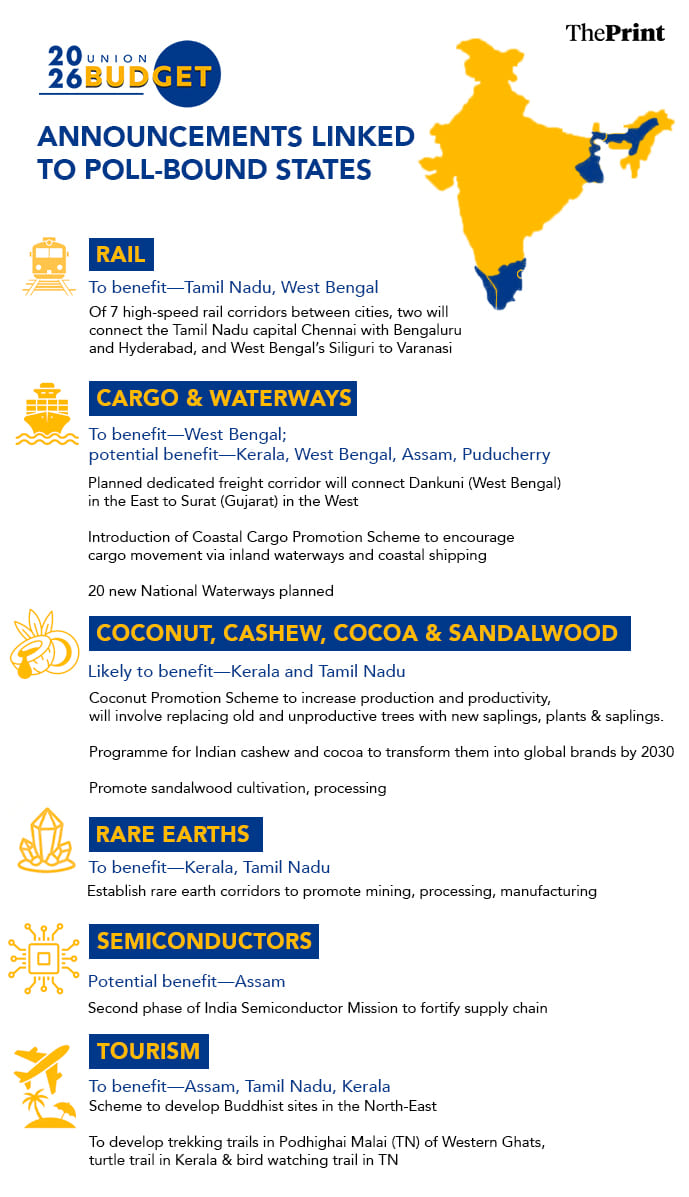
The finance minister also proposed establishing new Dedicated Freight Corridors (DFC) connecting Dankuni in West Bengal to Surat in Gujarat, creating a major freight link between eastern and western India.
Currently, India has two operational DFCs: the Eastern DFC runs from Ludhiana to Dankuni, and the Western DFC connects Dadri with Jawaharlal Nehru Port near Mumbai. The move is aimed at enhancing the movement of goods across the country, particularly between Gujarat and the eastern region.
The BJP has been gearing up for the West Bengal elections with Union Home Minister Amit Shah leading from the front.
The finance minister, while stating that India has the potential to offer a world-class trekking and hiking experience, announced the development of ecologically sustainable mountain trails in Himachal Pradesh, Uttarakhand and Jammu and Kashmir; Araku Valley in the Eastern Ghats and Podhigai Malai in the Western Ghats.
Apart from this, it has also announced turtle trails along key nesting sites in the coastal areas of Odisha, Karnataka and Kerala; and bird-watching trails along Pulicat Lake in Andhra Pradesh and Tamil Nadu.
To promote religious tourism, the government has also announced plans to develop Buddhist sites in the northeastern region.
“The North-Eastern Region is a civilizational confluence of Theravada and 18 Mahayana/Vajrayana traditions. I propose to launch a Scheme for Development of Buddhist Circuits in Arunachal Pradesh, Sikkim, Assam, Manipur, Mizoram and Tripura. The Scheme will cover preservation of temples and monasteries, pilgrimage interpretation centers, connectivity and pilgrim amenities,” she added.
CPI(M) Rajya Sabha MP John Brittas told the media the high-speed rail corridor had been a long-standing demand of Kerala.
Opposition leaders slammed the Budget, saying its provisions excluded Kerala.
“When Kerala went ahead with a project on its own, the Centre stopped it. In between, E. Sreedharan too said the Centre was planning something. Now, when the Union government announced seven corridors, Kerala’s name is not there at all,” Brittas said, adding that the Finance Commission report, published along with the Budget, was also disappointing.
He said all states, including BJP-ruled states, had demanded a 41 percent share of tax devolution.
“Now, they are talking about coconuts. Earlier, when they created the Rubber Board, they took rubber from Kerala to other states. We don’t know what their plan is now,” Brittas said.
Congress MP K.C. Venugopal also said that Kerala had been ignored in key sectors such as health. He added that the state was ignored when high-speed rail corridors were announced in other states as well.
“It shows how the Centre is seeing the state. This Budget has completely ignored Kerala. The scheme for coconut rejuvenation was started during the UPA regime. The same applies to coir and cashew; there is no clarity on their plan,” Venugopal said, adding that there should also be clarity on whether the rare earth corridor would lead to the entry of private players into the sector.
(Edited by Sugita Katyal)
Also Read: No Budget allocation for Chabahar Port as India withdraws from Iran amid US ‘maximum pressure’