





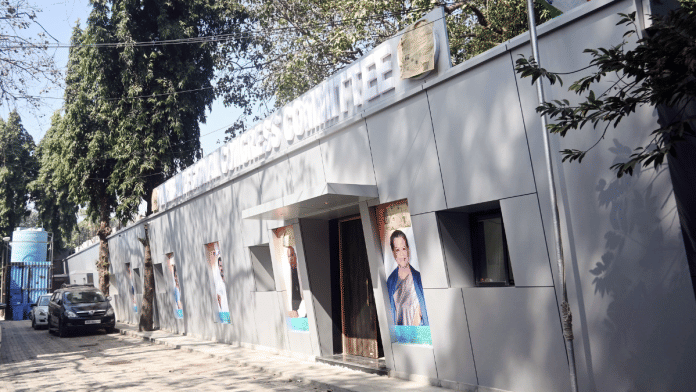



Mumbai: In an election seen as crucial to its relevance in Mumbai, the Congress has registered its worst-ever performance, winning just 24 seats in the Brihanmumbai Municipal Corporation (BMC), sliding down even from its previous lowest tally of 31.
When Mumbai voted in the BMC elections Thursday after a nine-year gap, the Congress returned to the civic battleground from a position far removed from the dominance it once enjoyed in the city where it was founded.
Unlike previous decades, when it was a principal contender for control of the civic body, it was widely seen as fighting to retain relevance rather than being really in the race.
In the BMC polls, the party contested 143 of the 227 seats, while its ally Vanchit Bahujan Aghadi (VBA) had contested 42.
According to the Maharashtra Election Commission data, the Congress won 24 seats, recording its worst-ever performance in Mumbai, lower even than the 31 it won in the 2017 BMC elections.
The Congress’s performance seems to have taken a beating amid the surge of the Mahayuti in Mumbai and the appeal of the reunion of the Thackeray cousins—Uddhav and Raj—and their parties.
In the results declared Friday, the BJP emerged as the single largest party by winning 89 seats, followed by Shiv Sena (Uddhav Balasaheb Thackeray) with 65 seats, Shiv Sena (SHinde faction) with 29 seats. The Indian National Congress won 24 seats, the AIMIM eight seats. The Maharashtra Navnirman Sena (MNS) won six seats, and the Nationalist Congress Party (NCP) three.
The BMC, India’s richest civic body, was once central to the Congress’s political presence in Mumbai. Over the past decade, however, the party has steadily faded from the city’s municipal power structure.
Maharashtra Pradesh Congress Committee General Secretary Dhananjay Shinde said the party did not indulge in any malpractices. “We fought the elections without using money recklessly, without any malpractices, and we stayed grounded in our ideology of working for the people”.
“I call this a significant victory and achievement. Given the statistics and our efforts, we have fared well, given the fact that a lot of people have left us in the past. The corrupt leaders went elsewhere,” he told ThePrint.
He further added, “We have a 2029 vision—to contest the elections within the Constitutional framework using the party’s core value system, as we have this time and all the times in the past. Our core value remains the same, to fight for the people and provide them with the basic needs as we say roti, kapda and makan. That work should be done with honesty and without any discrimination and corruption like these others have done.”
He said his party’s district committees had autonomy in choosing how they wanted to contest the elections and who they wanted as their candidates.
“There was a decentralisation of authority, power and decision-making process. They decided autonomously whether to run independently or in an alliance that matched the party’s ideology. The candidates were also chosen by them in all the different locations. The credit for this autonomous approach towards candidacy goes to Harshwardhan Sakpal (Maharashtra Congress president).”
Also Read: Marathi manoos to ‘Adanistan’: 5 talking points of Maharashtra’s high-stakes civic polls campaign
Congress’s slide in BMC
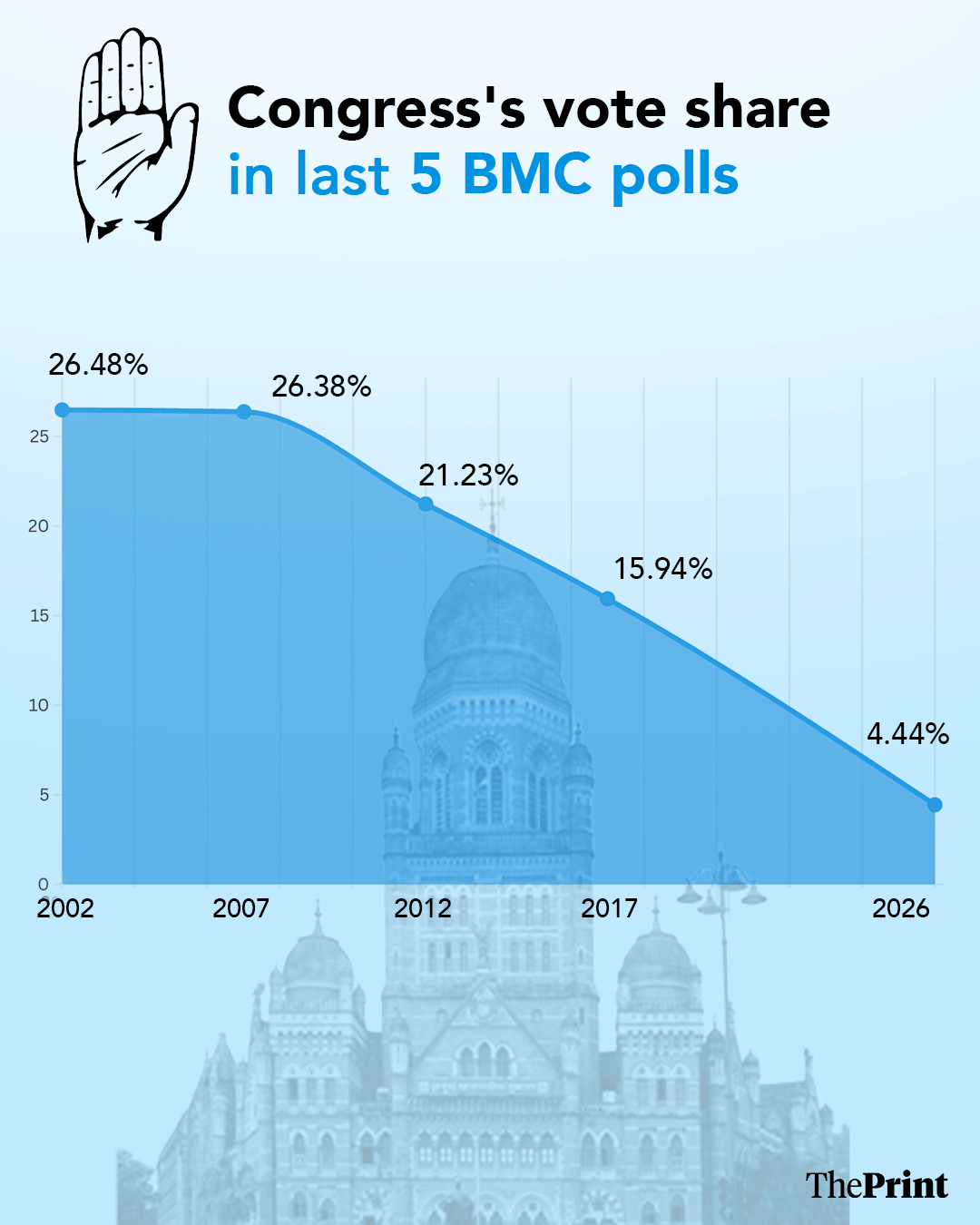
The party’s vote share in the corporation slid from 26.48 percent in 2002 and 26.38 percent in 2007, to 21.23 percent in 2012, and 15.94 percent in 2017, when Mumbai civic body voted last, according to data from the Maharashtra Election Commission.
In the 2017 civic polls, the Congress had won 31 of 227 seats, a sharp fall from the 52 it secured in 2012. In the 2017 polls, the party was pushed to third position as the BJP made major gains in what had long been a Shiv Sena stronghold, winning 82 seats, just two short of the Sena’s (undivided) figures. The NCP (undivided) and the MNS were reduced to nine and seven seats, respectively.
In the years following the 2017 defeat, the Congress has struggled to regain ground in Mumbai. The party has faced a combination of challenges—a weakened grassroots presence, declining appeal among middle-class and younger voters, and the high cost of campaigning in a megacity where elections demand extensive resources and visibility.
This decline was compounded by the prolonged delay in holding BMC elections. Litigation over ward delimitation and OBC reservation kept the civic body under administrator’s rule for years, denying the Congress an opportunity to rebuild its presence through local representation.
During this period, rivals consolidated their influence through state and national power, while Congress’s visibility in civic governance continued to diminish.
Organisational decline & factionalism
The electoral slide has been accompanied by deepening organisational problems within the Mumbai Congress.
For years, the city unit has seen multiple factions, internal rivalries and leadership tussles, which have weakened coordination on the ground and hurt voter outreach. Party workers and leaders have often complained about decision-making being confined to small groups, with repeated disputes over ticket distribution and strategy eroding morale at the grassroots.
Senior leaders have acknowledged that the absence of strong, unifying figures—such as the late Murli Deora and Gurudas Kamat, who once held the unit together—has widened internal divisions.
Several long-standing leaders earlier told ThePrint about being sidelined from key decisions, contributing to disengagement and drift within the party’s Mumbai organisation.
The strain has also reflected in high-profile exits, most notably that of Milind Deora, once seen as a key face of the Congress in Mumbai, who resigned as Mumbai Congress president in July 2019 and left the party for the Shiv Sena in January 2024.
His departure was widely viewed as symptomatic of deeper structural issues within the party’s city unit, rather than an isolated political move.
(Edited by Nida Fatima Siddiqui)