





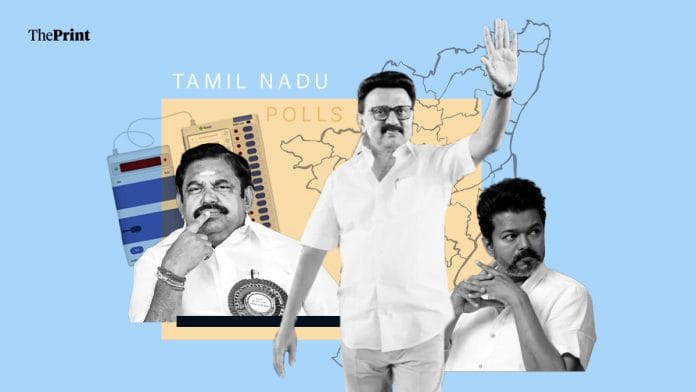



Chennai: The date is locked, the battle lines drawn, and the political parties are all geared up for the poll battle in Tamil Nadu, where Dravidian ideology still calls the shots in the political landscape.
Voting will take place on 23 April, while the results will be declared on 4 May. The last date for filing nominations is 6 April followed by the scrutiny of nominations on 7 April. The last date for the withdrawal of candidatures is 9 April.
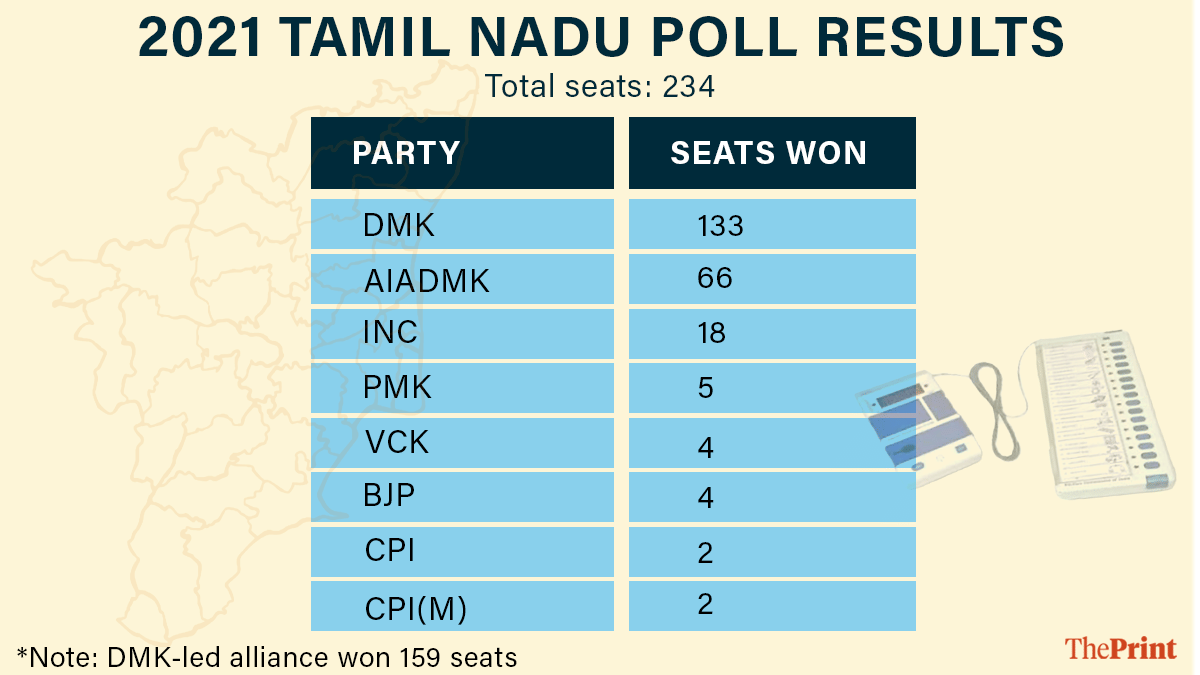
Though major political parties remain anchored in Dravidian ideology, they still remain divided over authenticity, alliances with the Centre, populism than ever. In power since 2021, the ruling Dravida Munnetra Kazhagam (DMK) and its allies defend anti-incumbency through welfare delivery, secularism and high growth claims. The ruling party, however, is accused of nepotism and dynasty politics.
On the other hand, the All India Anna Dravida Munnetra Kazhagam (AIADMK) has teamed up with the Bharatiya Janata Party (BJP) along with smaller allies like Pattali Makkal Katchi (PMK). The AIADMK, thus, faces barbs from its Dravidian rival of joining hands with the Hindutva forces.
A third alternative is now up with the emergence of actor Vijay’s Tamilaga Vettri Kazhagam (TVK), which is trying to position itself as a powerful independent force by contesting all 234 assembly seats.
The 2026 polls are being defined by a mix of governance issues, social fragmentation and ideological clashes. Rising crime rate, rural distress in some belts, women’s safety and empowerment, versus the broader ideological war against Hindutva are also being discussed by major political parties.
Political analyst Ramu Manivannan says that the BJP and opposition parties are picking up law and order, and women safety concerns as an assessment of governance.
The sustainability of freebie culture is another major flashpoint. The DMK’s popular schemes such as financial aid for women, free school breakfasts, free bus pass have gained it wide support, yet the rivals argue these create fiscal dependency, crowd out productive spending and fail to be implemented effectively. The opposition parties promise “responsible welfare” and development-focused governance.
“We have seen a fairly good response to the schemes such as Naan Mudhalvan, free bus travel, free breakfast. We cannot completely dismiss that these programmes have worked and there is a visibility to it. The schemes can always be criticised but people do benefit because it is a welfare initiative,” Manivannan told ThePrint.
“A line needs to be drawn to ensure that people qualify for gaining these benefits. Opposition parties don’t completely dismiss all these schemes even if they come to power; it’s just political play.”
Both the AIADMK and the BJP are harping on infrastructure and economic growth. The DMK is aggressively highlighting the ‘Dravidian Model’ that, it claims, brought in massive industrial investments, IT sector expansion and inauguration of hundreds of urban and rural projects, asserting that welfare and jobs can go hand-in-hand.
Bolstered by the tie-up with the BJP, the AIADMK promises to revive its rural-focused development style with better execution. It argues that only an alliance with the Centre can bring in true progress.
“We have seen the funds going to Gujarat for several schemes and investments are being led there. When compared to other states, especially in the south we can see that the void is clearly visible,” Manivannan says. “This is what the DMK is raising, and the AIADMK needs to defend its interest and maintain the state rights. It does not have a leader who stands their ground and it has succumbed to the idea of BJP, which has weakened its ideological stand.”
The true Dravidian
Given that smaller players like Desiya Murpokku Dravida Kazhagam (DMDK), Viduthalai Chiruthaigal Katchi (VCK) threaten vote division, the eternal “who is the real Dravidian” debate is expected to decide the poll outcome.
Every major player claims the authentic mantle of Dravidian ideologue Periyar’s anti-caste, rationalist, secular and anti-Hindi legacy. Tamil and Dravidian pride reflect a strong anti-Hindutva stance, framing contests as ‘Dravidian versus Aryan’, or ‘state autonomy versus central overreach’.
Since 1967, the DMK and the AIADMK have alternated power, both offering Dravidian social justice wrapped in freebies. The DMK rules with strong minority and urban support. It goes by the core Dravidian ideology focused on social justice, federalism, secularism, and popularised by welfare schemes in education, healthcare, among others.
DMK president M.K.Stalin remains the biggest player with a political journey from being the Mayor of Chennai, MLA, party president to now the Chief Minister. Despite his son Udhayanidhi being the deputy and heir apparent, Stalin’s popularity remains prominent among the supporters.
The AIADMK claims itself as the genuine populist heir of Annadurai and Maruthur Gopalan Ramachandran, popularly known as MGR, with a “purer Dravidianism” that is free from family dynasties. The party blends Dravidian social justice with mass appeal through subsidies, gold schemes, and rural focus, while maintaining anti-Centre rhetoric.
But the AIADMK, after Jayalalithaa’s death in 2016, is weakened by the Edappadi K. Palaniswami-Ottakarathevar Panneerselvam (EPS-OPS) civil war. With its senior, expelled leader and three-time chief minister OPS joining the DMK, the party faces the challenge of split in Thevar votes and cadre loyalty.
As for the TVK, Vijay draws directly from Periyar, Ambedkar, as well as Kamaraj for inclusive social justice and rationalism. The fledgling party calls for secular, social justice, inclusiveness, state autonomy, women’s empowerment, rationalism, anti-corruption measures, while rejecting regressive politics.
Vijay positions the TVK outside the traditional binary, explicitly branding the BJP as an ideological rival due to its perceived divisive and communal forces, while framing the DMK as a political rival over alleged corruption, dynasty rule, and betrayal of welfare promises and schemes.
Among other parties, Vaiko’s Marumalarchi Dravida Munnetra Kazhagam (MDMK) positions itself as the uncompromising radical Tamil nationalist. Similarly, the Naam Tamilar Katchi (NTK) pushes for a Tamil-only identity.
The fight is not just rhetorical; it decides alliances, campaign slogans and how parties attack each other on secularism and federalism.
Also Read: BJP has a wish list for Tamil Nadu. It’s brought seat-sharing talks with AIADMK to a standstill
BJP: the third factor?
Once marginal, the BJP has steadily built urban pockets through the AIADMK alliance, anti-DMK consolidation and central scheme outreach among urban middle-class and business communities.
It has paired the Hindutva strategy with infrastructure development pitches, economic reforms, and central welfare schemes. For that end, the party highlights its own central schemes such as national highway and airport expansions, arguing that only a strong Centre-state partnership can deliver real speed and scale.
Ideologically, the BJP highlights economic liberalisation, large-scale infrastructure, and cultural nationalism while positioning itself as the one that respects Tamil history and pride.
In doing so, it avoids direct clashes with the deeply ingrained Dravidian secularism and anti-Hindi legacy, limiting mass appeal in rural belts. The party does not have a strong independent support group as such.
Nevertheless, the BJP is targeting not just a few seats but a decisive urban and semi-urban footprint in Coimbatore, Chennai, Tiruppur, Erode and parts of Madurai. The party is promising faster national highway projects, industrial corridors, port upgrades, airport expansions and large renewable energy parks to contrast with the DMK’s alleged delays.
While it eyes to supplant the AIADMK as the principal opposition voice against the DMK, the BJP still faces the tag of an ‘outsider’ party in a Dravidian state. It is seemingly hoping that the alliance arithmetic plus infrastructure promises will finally crack the Dravidian stronghold.
Former BJP state president K. Annamalai, a key player who engages in youth outreach, is known for sharp anti-DMK rhetoric. His successor and former AIADMK minister Nainar Nagendran, who belongs to Tirunelveli, joined the BJP in 2017. The elevation in April 2025, following the AIADMK alliance announcement, aims to strengthen regional ties and recalibrate strategy.
The ‘common enemy ‘
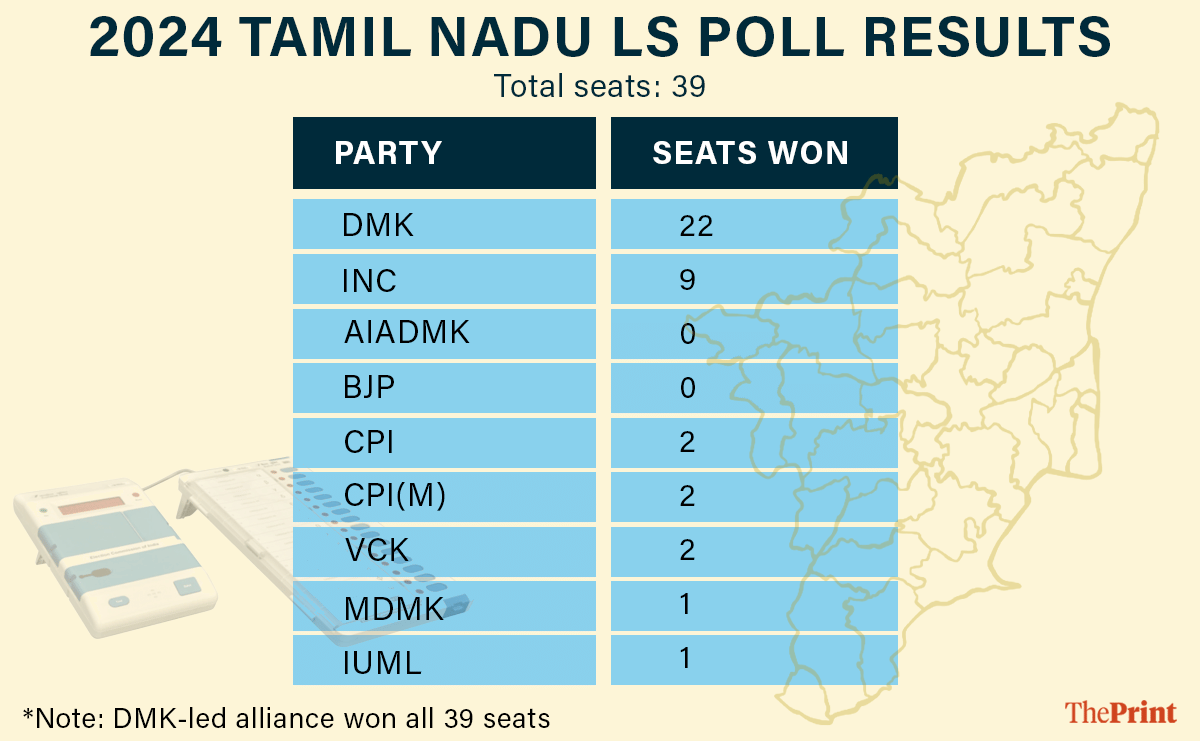
The DMK and its allies repeatedly accuse the BJP-led Centre of imposing Hindi, Hindutva ideology and withholding central funds. In response, the National Democratic Alliance (NDA) allies accuse Stalin of misusing state welfare and infrastructure funds for dynastic gains.
The DMK aggressively defends its ‘Dravidian Model’ by highlighting state-led welfare schemes as direct deliverables that reach the poor without central interference.
The ruling party says that it upgraded both urban and rural infrastructure with hundreds of projects worth thousands of crores, and presents them as proof that only a Dravidian government can balance freebies with genuine development.
It further allies with the Congress, building on anti-BJP sentiments. Led by K. Selvaperunthagai, the Congress remains vital for vote arithmetic in southern districts of Kanyakumari, Ramanathapuram and other regions.
The anti-DMK coalition, meanwhile, point to delayed or incomplete infrastructure projects, cost overruns, poor quality of roads and stalled industrial parks as evidence of corruption and inefficiency.
At a rally in Trichy, EPS said that only a quarter of DMK’s promises have been implemented. “Tamil Nadu is fed up with the ruling DMK’s false and tall promises. People would not believe Stalin anymore because his previous poll promises have not been fulfilled,” the AIADMK leader said.
In terms of alliances, the “common enemy” strategies are the ways in which the parties plan their alliances.
“Youth and urban voters, digital mobilisation, and women-centric outreach are seen as the new trends. The DMK is now also making its appeal to the youngsters and tapping the women vote bank through welfare schemes,” political analyst A.Ramasamy tells ThePrint.
“The larger women electorate is becoming significant for all the political parties and the strategies are being crafted in the same manner. The DMK and the AIADMK have a stronger outreach mechanism, but other parties need to work on similar lines.”
Vijay, TVK’s strategy
Contesting all 234 seats independently, Vijay is banking on his massive youth fanbase and anti-establishment appeal. Despite the Karur stampede and the ongoing CBI probe, the TVK enjoys youth support from the huge fan base.
The party positions itself outside the DMK-AIADMK binary, calling both corrupt and BJP-compromised, even as it is on the same front with the Dravidian parties on social justice and secularism.
But, the attention on personal matters of Vijay is hindering the presence of the party on the grassroot levels. “It is undoubted that the delay on the release of (Tamil thriller) Jana Nayagan, the CBI inquiry in Karur case and other issues surrounding his personal matters will affect Vijay’s electoral focus,” political analyst Ravindran Thuraisamy tells ThePrint.
“If he proves a good vote bank in 2026, he will utilise it for Rahul Gandhi in 2029. There is obviously pressure on all ends for TVK, and he will receive (expelled AIADMK leader) Sasikala-like treatment. The votebanks work differently than fan base.”
Caste mobilisation
Traditional caste voters such as the Vanniyars, the Thevars/Mukkulathors, the Kongus, the Dalits, and the Muslims remain the bedrock of Tamil Nadu politics even as youth and digital trends grow. While new trends of youth, women and digital outreach are loosening rigid caste arithmetic in urban areas, rural and semi-urban belts still vote heavily along community lines.
The Vanniyars, the largest Most Backward Class (MBC) group concentrated in northern districts, is the anchor of PMK’s support. The Thevar or Mukkulathor communities in southern districts of Madurai, Theni, Ramanathapuram, Tirunelveli, Thanjavur have historically been AIADMK loyalists, but are now divided after OPS exit. The Sasikala-led All India Puratchi Thalaivar Makkal Munnetra Kazhagam (AIPTMMK) is targeting them as well.
The Kongu Vellala Gounders and the Vellalars in the western belt of Coimbatore, Erode, Tiruppur, Namakkal remain a solid AIADMK and KMDK base. The Dalits, especially Arunthathiyars and Paraiyars, are mobilised by the VCK within the DMK alliance for reserved seats and anti-caste land reforms. The Muslims in coastal and Ramanathapuram pockets stay consolidated behind the Indian Union Muslim League (IUML) and DMK’s secular front. The Nadars and other MBCs add regional weight in southern and central areas.
“Community-based politics still remains a strong strategy because the traditional vote banks, especially in southern parts of Tamil Nadu remain intact. The Vanniyar, Thevar/Mukkulathor, Kongu and other communities remain loyal to their leaders, especially the ones from their community,” political analyst Sunilkumar V.M. says.
This loyalty, he adds, gives the AIADMK the residual strength in southern districts, though it is trying to revive through the TTV Dinakaran (AMMK) alliance.
(Edited by Tony Rai)
Also Read: ‘Everything starts & ends with one family’: In Trichy, Modi accuses DMK of ‘scientific corruption’